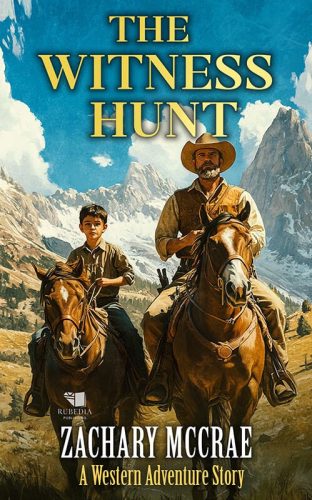
The Witness Hunt
The gang wants the boy. Sheriff Neil Walker stands in their way…
Sheriff Neil Walker is hunting a ruthless gang when a storm delivers something he never expected—a terrified twelve-year-old boy, half-dead and on the run.
The boy is the only witness to a brutal execution. Now the gang isn’t just covering their tracks… they’re hunting him.
Neil gets to him first. But bringing the boy to safety may have just painted a target on them all.
Rebecca has already lost her husband to war—she won’t lose her son, too. With nowhere else to turn, she puts her trust in a sheriff who’s just made himself their only shield.
Because the gang knows the boy is alive.
And they’re coming.


Prologue
Sedalia, Missouri
1872
“We’ll get ’em today, just see if we don’t!”
Sitting tall in the saddle, Sheriff Neil Walker mumbled through the woolen muffler covering his chapped, bearded face. He couldn’t remember ever tracking men in a worse snowstorm. He’d lost all feeling in his fingers and toes hours ago, despite heavy leather boots and gloves. Every time he shifted the muffler to speak to his deputy, Tristan Barrett, ice crackled on his beard and pierced his eyelids.
Sure is a fine time to be scouting that onery Jennings Gang.
But Neil had gotten word from a sheriff about twenty miles south of Sedalia that the gang had headed this way the day before yesterday. If he could catch them, it would be the triumph of the last four years. The Jennings Gang had robbed more banks, shot more people, and plundered more ranches than even Jesse James.
I won’t let a few feet of snow stop me now!
Riding on a dappled gray stallion, twenty-five-year-old Tristan nodded in agreement. Usually a man of few words, he didn’t often speak unless he had something thoughtful to say. Or maybe he was too cold to talk. The temperature on the jail thermometer this morning had read ten below, and as far as Neil knew, it’d surely plummeted since then. As Pa used to say, “It was cold enough to freeze fire.”
“We’ve been scouting close to an hour,” Tristan mumbled, “and it seems like we oughta be close to finding some sign.”
Neil nodded, unwilling to expose his face to the frigid, biting wind. His large brown Belgian stomped an impatient hoof when Neil pulled him to a stop at the edge of a ridge.
“Reckon we can hope,” Neil answered, blinking back tears as the wind whipped in his eyes. “But I’m durned if I can see which direction to head now.”
The men looked over a short ridge of shale, blotted out by a fresh annoyance of wind-driven snow. Neil shrugged, peering in both directions before turning to Tristan. “What do you think? We can’t ride down the ridge, but we can go north or south down the path. Which direction you think they went?”
In answer, Tristan dismounted, dropped his horse’s reins so the animal would stand and wait, and walked with his head lowered. Tristan had been an excellent scout during the years he’d been working for Neil.
Neil felt a flicker of warmth watching Tristan work. Through the years, he’d become a close, trusted friend. They’d lived through Indian raids, droughts, and two hard winters together, each trusting the other without question. Neil often felt he couldn’t have found a better deputy anywhere.
After sitting quietly for a few minutes, Neil watched Tristan head back to his horse, Monty. He lowered the plaid muffler covering his nose and mouth and pointed south. “Saw a few signs of horse prints that way. Snow’s scouring the trail, so we probably can’t follow them far,” Tristan said over the howling wind, “but I saw horse manure too. It’s not frozen, so I’d say they went that way not less than an hour or two ago.”
“Then south it is,” Neil said. He waited for Tristan to mount, chirruped to the Belgian, Buddy, and rode into the storm.
Snow fell from the clouds, small blue–gray flakes, landing to cushion the trail beneath the horse’s hooves. It piled in drifts, silently, deadly, the cold sneaking beneath the edges of coats and gloves, and inside boots. Neil knew they couldn’t stay out much longer before finding shelter and building a fire. As much as he wanted to capture the Jennings gang, he wanted to be alive to cart them off to jail.
“How much farther should we ride, Sheriff?” Tristan shouted over the ever-increasing wind.
“Can’t be too far or we’ll freeze to death.” Neil looked ahead. Men had been lost and frozen to death in storms such as this. It would be foolhardy to forget that.
“Let’s head as far as Gus Cutter’s place. We can get warm there. Think you can make it?”
Tristan nodded, ducked his head again, and shook Monty’s reins.
“Just be careful,” Neil shouted over the wind. “We wouldn’t want to stumble out here.”
Another nod, then only the sound of the wind. As the men plodded along, faces ducked into their chins, trying to keep the horses on a path covered with deep drifts of snow, Neil let his mind wander a bit. Thinking about everything that had brought him to this moment, chasing after one of the worst gangs in Missouri. Who would have thought that a gangly, knock-kneed kid from Georgetown, Missouri, would one day grow up to be sheriff?
“There,” Tristan shouted the word. His black-gloved hand pointed to the trail before them. A frozen puddle of water had cracked over a muddy place, leaving the impression of horse prints. Off in the distance, Neil saw a plume of chimney smoke from the Cutter cabin.
“Could they have gone to Gus?” he asked. “It’s right down the trail.”
Tristan shrugged a shoulder, but Neil figured he knew the answer as well as his deputy. A couple of years ago, Gus Cutter had come to settle near the edge of Sedalia. As far as Neil knew, the man kept to himself, paid off his debts at the general store, and planted wheat to sell. He lived a quiet, peaceful life alone. Neil knew Gus had once been a member of the Jennings gang. The man had come to him and admitted it.
“I done my time in prison, Sheriff,” Gus said, “and I’m ready for a new start.”
Neil leaned low over Buddy’s neck, the cold slicing at his eyes. “Tristan,” he called out, “if they’ve already found Gus—”
“Don’t say it,” Tristan shot back, urging his own horse forward. “He’s tough. Old, but tough. Maybe he heard ’em coming.”
“I hope to God he did.” Neil’s jaw clenched. “Gus may’ve been a sinner once, but he didn’t deserve the gang coming after him again.”
Tristan’s voice tightened. “I keep thinking about what he told you. About wanting to change. About the church.”
“But, I want ya to know I never done nothing bad, Sheriff. Never killed no one or robbed no banks. I was mostly the fella stayed behind and done the cooking and the wash. An’ now I got religion, I’m fixing to dedicate my life to the church here in Sedalia. I won’t cause you no trouble.” Gus had told them.
Although Neil had been cautious the first year Gus lived in the area, he’d come to believe the man might be sincere. Gus worked his small farm, helped Rhett Cross, the town’s pastor, and didn’t cause any trouble.
“Yeah,” Neil murmured. “A man trying to turn his life around shouldn’t have to look over his shoulder.”
A crack of gunfire split the air. Buddy lurched beneath him, ears flicking.
Neil’s heart slammed against his ribs. “That’s coming from Gus’s place.”
“Then we’re almost too late,” Tristan said, kicking his horse harder. “If they’re already shooting.”
They crested a small rise, snow whipping around them in frantic spirals. More shouting carried across the frozen fields. Men’s voices, angry, panicked, desperate. The sound seemed to be coming from a small, wooded area.
Neil felt dread coil in his gut. “Stay sharp,” he warned. “If they’re still there, we ride in fast and loud.”
Tristan drew his revolver. “I’m ready.”
“Let’s hurry. I don’t have a good feeling about this.” Neil swallowed hard. “God help us if we’re too late.”
Another round of gunfire rang out. Loud. Sharp. Ominous.
He kicked a boot heel into Buddy’s flank and sent the Belgian plodding through the deep snow. The horse’s powerful hooves sent up sprays of powder, racing forward. The wind whipped back into Neil’s face, blowing his muffler behind his head to flap in a crazed beat. Even with the horse moving forward, time seemed to slow down, each step a mile as they plodded through the snowdrifts.
Whatever had happened, it didn’t sound good.
Chapter One
Sedalia, Missouri
Winter 1872
Earlier that same day
Rebecca Monroe laid aside the green checked dress she’d been sewing, folding it carefully on the table. She got up and put another log into the fireplace, then used the Andiron to push it onto another burning log. Patiently, she waited for the new log to catch, sending out snappy sparks as it popped into flame.
Holding out her hands to the warmth, Rebecca tried to ease the stiffness from her fingers, the usual price for hours of sewing. Many days, her fingers were so sore she wanted to weep, however much good that would do. She knew if she didn’t work, she and her son wouldn’t eat.
Thank God I have a way to earn a living.
As Mother used to tell her, “We must be grateful for our small blessings every day.” Rebecca tried to remember, even when her shoulders ached and she just wanted to quit. Rubbing her arms along the sleeves of her pale, blue dress, she tugged a dark shawl closer around her shoulders and went to look out the window.
It shouldn’t be long until Tucker comes in from school.
A little while ago, the wind had picked up again, and snow scrubbed the glass panes in tiny pellets of ice. Rebecca peered out, hoping to see her son coming into the yard, but the world outside was a frightening swirl of white. It had been snowing a little when Tucker set out for school this morning, but not with the ferocity it had now.
If he didn’t come within the next hour, Rebecca would hurry to the barn and hitch up the wagon. She swiped the windowpane with a bare hand, seeing clear patches of ground beneath the snow and the barn still visible. Not too worrisome yet. Tucker had a good head on his shoulders. If the weather got too bad, he knew enough to stay over with a neighbor.
Not that I’d know…
With one final glance, Rebecca walked over to the black iron range and stirred the pot of beef stew simmering on top. It sent a delicious scent into the room, making her stomach rumble. Hopefully, Tucker would be hungry when he got home and not as belligerent as usual. She checked on the bread baking in the oven and went to sit back down. As a seamstress, her work to make ends meet never ended. Rebecca flexed her fingers, picked up the green checked dress, and began to make tiny tucks along the bodice.
I hope Tucker’s in a better mood today.
Considering this last week, Rebecca had little hope that things had changed. She wanted her son to have a decent education, to go farther in life than she had, but if he couldn’t stay in school, those dreams might be shattered.
Rebecca made small, neat stitches, thinking of her own troubled school days. Sewing almost always reminded her of being young and having other children make fun of her worn-out, often patched, clothing.
Although her parents had been hardworking, and Rebecca was their only daughter, money was always hard to come by. Clothes were patched, mended, and often made over from her brother’s outgrown shirts or trousers. Most of the other children at school came from the richer families in Sedalia, their clothes either store-bought or sewn by Miss Mix, the town’s favorite seamstress. None of them, Rebecca was certain, ever wore an older brother’s shirt made into a blouse.
I wish I’d stayed in school longer. Ignored the taunts and stares.
Even now, as a widow with an eleven-year-old son, Rebecca wished she’d been wiser when she was younger. The day she turned fourteen, the mayor’s wife offered her a job cleaning house. That ended Rebecca’s school days, although she’d never begrudged it then. Being able to help Mother and Da, and then meeting Tucker’s father, the mayor’s gardener. They married when Rebecca turned eighteen and had a few happy years before the war came. She could still feel the horror of seeing Ambrose’s name on the list of casualties at the Battle of Pea Ridge.
Ambrose, her husband, had been drafted and left to join the army. The first year, he came home once on leave. It was the last time she’d ever see him. He wrote letters, filled with hope and longing, about all the dreams they’d accomplish when he came home. Sadly, that never happened. Rebecca never had the chance to tell him they were going to have a child.
Left alone, Rebecca had to fend for Tucker on her own. Thankfully, Mother and Da were still alive for a few years. They’d left her the farm, such as it was, and the sturdy two-story house. When Miss Mix retired, her hands too cramped to sew a fine seam, she gladly helped Rebecca start a business.
“If you’re willing to work hard,” Miss Mix promised in a voice crusty with old age, “You’ll never lack for work.”
“I love Tucker with all my heart and will do anything for him,” Rebecca promised, a feeling just as strong today as it had been several years ago.
The front door banged open, sending in a drift of snow, until Tucker slammed it behind him. The loud noise startled Rebecca from her memories of the past. The needle rammed into her finger, and she dropped the dress in a hurry to avoid spotting it with blood.
“Tucker. I was getting worried when I saw the storm. Was it hard coming home?” She rammed the finger into her mouth, waiting for an answer.
She chose to ignore the scowl on his wind-chapped face and the blueness of his lips. Again, his Hudson Bay jacket hung open to the new blue shirt she’d sewn a week ago. Even though she’d told him to button it up on the walk home, he refused to obey.
“Is it getting colder out there?” Rebecca stopped sucking on her injured finger when he didn’t answer. “Dinner’s almost ready. It should warm us up inside. Beef stew and fresh-baked bread.”
Tucker didn’t answer, just gave a sullen shrug of his shoulders as he tossed a couple of strapped schoolbooks onto the small horsehide sofa. “I’m n-n-never going b-b-back there!” he stuttered and then stormed off upstairs. A second later, she heard the bedroom door slam loudly.
Rebecca sighed. It wasn’t right for her son to behave in such a way, not at eleven years old. Why, if any of her three brothers had acted like that, Da would have worn them out with a razor strap, and they’d never have behaved badly again. She knew she should be firm with him, but the truth was, he needed a father; someone stronger than her.
The children at school, especially this term, were harsh and bullied him. A couple of older boys had started there right after harvest and had taken a particular dislike of Tucker. If only he had a father.
Rebecca knew it had to do with his stutter. When he got anxious, Tucker’s words came out in a jumble. Remembering her own torment at school, Rebecca saw Tucker always wore fine clothes, as good or better than those of any schoolmates. She bought his schoolbooks so he didn’t need to use hand-me-downs. Anything money could buy, she did, but she couldn’t take away the one thing that caused him so many tears and anguish.
Still, he had to eat. She put a bowl of beef stew on a wooden tray, then a couple of slices of freshly baked bread, along with a mug of warm tea. Carrying it upstairs, she called, “Tucker, open the door, please. I have your dinner.”
“Please, Ma, I’m s-s-sorry, I’m n-n-not hungry.”
“You have to eat.”
When he didn’t respond, she set the tray on a small table beside the bedroom door. “Tucker, sometimes other children are mean for no reason at all. You just have to learn to ignore them.”
“J-just l-leave me alone. I’m t-tired of having the other boys make f-fun of me, and I don’t want to eat right now!”
“All right.” Rebecca agreed, wishing Ambrose hadn’t gone to war and died.
Rebecca ate her own lonely meal, hoping that by the time they needed to do evening chores, Tucker would help. The idea of going out in the snow to milk Judith alone made her uneasy.
I’ll have to tie a rope to the door and hope I find the barn.
There was still about an hour of daylight left before she had to face anything. Rebecca sighed and sat back down to sew. Snow or no snow, she needed to deliver some finished dresses in a couple of days.
***
Ma’s footsteps went back downstairs. All day long, Tucker had thought about a plan, especially after Freddie Chatworth made fun of him for stuttering. The teacher had asked a question, and even though Tucker answered it correctly, Freddie made sure to tease behind Miss Lyon’s back.
“T-t-ten times t-t-twelve is one-t-t-twenty,” Freddie taunted while Tucker’s face flamed. A few of the other kids laughed behind their slates or didn’t ask him to join the snowball fight at recess.
Ever since Freddie had started coming to school at the end of October, he’d made fun of Tucker every chance he got. “Hey, T-T-Tut T-Tucker, you gonna talk like a baby all your life?”
Every day it got harder to bear. Tucker grabbed a small rucksack from under his bed. Ma had told him it once belonged to his pa, a man he had never known. Pa had been a soldier in the war between the states—a hero, Ma said—and died before Tucker was born. Maybe that’s why some of the kids made fun of him. All of them had a pa at home to help them. Even though Tucker knew Ma loved him, it wasn’t the same as having a pa.
All day today, he’d decided on his perfect plan. Today had been the last straw.
I’ll run away. I won’t go to school. I won’t ever have to listen to anyone tease again.
Tucker didn’t quite know where he’d go, or what he’d do, but he figured he’d work that out as he walked along. He put a couple of changes of clothes in the rucksack, a compass, a jackknife, and a coil of rope. There was a piece of half-eaten butter bread left from dinner. Tucker wrapped it in a linen cloth to take along, too, in case he got hungry later. The beef stew Ma made sure smelled good, but he knew better than to stop and eat it. Right now, he needed to leave and get somewhere warm before nightfall.
The snow swirling past the window looked worse. It had been hard to walk the mile home from school, and it would be hard to find a place tonight, but he was determined to leave. Now. Before Ma could stop him.
My mind’s made up.
Not that he didn’t love Ma, but she didn’t understand. Today, he’d had all the insults he could take, and he wouldn’t stay to hear more tomorrow. He thought of leaving a note for Ma, but didn’t. If the snow got any worse, he’d have to find a place to hunker down tonight or freeze to death.
The way he felt right at that moment, maybe freezing to death wouldn’t be such a bad thing.
Chapter Two
One foot in front of the other, one foot in front of the other.
It was something Ma said when a chore was too hard, or they had a long way to walk in the summer. Tucker tried to think about it and hope for the best, but the truth was he was beginning to get awfully scared. The snow fell harder and deeper than he’d expected. Walking home from school, the snow had been coming down in gentle, soft fluffs that covered the hard, scrabble ground.
But now, he could barely see anything in front of him. The cold pierced him clean through, too. Tucker had managed to slip down the stairs and out the kitchen door while Ma was sewing in the parlor. He thought longingly of the warm fire and wished he could go back home.
Even though he had a warm coat, a woolen cap, and gloves, Tucker felt like the wind had icy fingers poking him with every step. He could never remember being this cold.
I guess this was a dumb plan.
The further he stumbled, Tucker knew he’d lost all sense of direction. When he left the house, he hurried past the barn and struck off over their south pasture. Sedalia was to the north, and Tucker sure didn’t want to go that way. Not if it meant running into Freddie or any of his tormenting friends.
Tucker’s plan had been to keep walking, find a warm barn where he could spend the night, then maybe walk more in the morning. With each step, his knees sank further. His woolen trousers were wet, his legs burned from the icy cold. Now his boots were filled with melting snow, and he worried about losing his feet to frostbite.
Mr. Whitley, who worked in the livery stable, had lost three fingers to frostbite. He often showed the boys his red stubs on the right hand, cut off at the knuckle. Tucker shuddered, imagining stubs for feet.
His breath felt raw in his throat, and he walked slower and slower. Tucker had heard enough men in town telling horror stories about people freezing to death in blizzards. Even though he’d been so angry when he left the house and figured it might be a good idea, now Tucker just wanted to live.
Please, God, just let me get somewhere warm.
Next chapter ...
You just read the first chapters of "The Witness Hunt"!
Are you ready, for an emotional roller-coaster, filled with drama and excitement?
If yes, just click this button to find how the story ends!
Great
🤩
Looking forward to the rest of the story!
How was the ride, Garry?🤠
You got me hooked!
Hooked is right where I want ya! Thanks, friend!🖤
A very exciting start to this new book. I sure do want to read the rest of this book!
Glad you enjoyed, partner!🐎
looking forward to the rest of the story
Hope the ride was worth it!!!
Well, I’m ready for the rest of the book. It has held my attention and I believe it will be a good book to read. Thank you,
Was it to your likin’, Linda?🤠