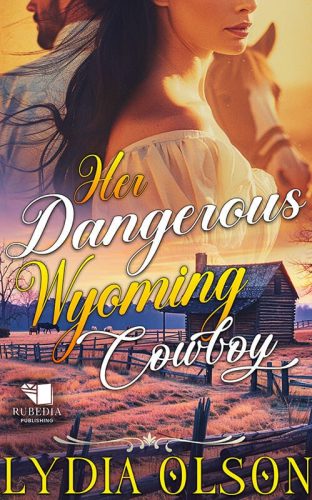
Her Dangerous Wyoming Cowboy
She was about to fall when a strong hand gripped her arm, steadying her.
Mae wasn’t ready for how close he was. She caught his scent—a musky mix of soap and leather—and her mouth watered unexpectedly.
“Careful,” he murmured, his voice low and strange.
Where is he? Mae Thornton thought anxiously.
But she would wait no longer. She would give a piece of her mind to one Luke Harrington for abandoning her at the train station.
As she finally reached the house, Mae heard the unmistakable sounds of men’s raised voices—and the persistent crying of a child.
The ad hadn’t said anything about children.
The door opened, and Mae prepared to unleash a verbal volley. Before she could utter a single syllable, however, she found herself face to face with something most unexpected: the barrel of a gun thrust in her direction, staring her down.


Prologue
Strangely enough, it wasn’t the scrabbling, scratching sound that woke Mae Thornton. She’d grown accustomed to that over her lifetime. The constant sound of rodents scrambling about in the dilapidated cabin she shared with her brother, Micah, was ever-present. She’d harbored a fantasy once about getting a cat, but she and her brother couldn’t even afford that meager luxury.
No, what finally woke her was the tugging on her long braid. Her green eyes flew open, the only source of light the moon shafting in through the window. There, caught up in her black hair, was a fat rat. She stared at it for a moment, its beady little eyes shining in the dark. It froze, its sharp little paws stilling as Mae’s eyes locked onto it.
This can’t be my life, Mae thought dimly, her mind still slow from sleep and hunger. The rat, however, was not so slow, and it began yanking and pawing to try to free itself again.
Mae’s disgust caught up with her then, and a sharp wave of revulsion goaded her into action. She bolted upright and swatted the foul rodent away as hard as she could.
“Oh—eww!” she squealed when her hand made contact with the warm, wriggling rat. Her swat dislodged it, and it flew against the wall of her small bedroom with a soft thud.
That did it—she pulled her knees up and buried her face against them, wrapping her arms about her legs and shrieking with something between anger and panic. There were many things that she could abide—there were many things that she had abided throughout her life—but a rat nesting in her hair was beyond the pale.
Her bedroom door, which was really just a flimsy piece of wood with ambitions of being a door, flew open. Mae didn’t need to look up to know who it was.
“Mae? What is it, Mae?” Micah demanded. From her limited vantage point, she could see that he had brought one of their lanterns with him, the wick turned low to avoid using any more of their precious stock of oil than necessary. It threw out a small, dim circle of warm light.
Still in the protective shelter of her arms, Mae pointed vaguely to her left in the direction the rat had been flung. “Rat!” she said, flapping her hand.
“Oh,” Micah said, sounding a little deflated. “Is that all?”
Mae looked up at Micah sharply, glaring into his green eyes, a gift they’d both inherited from their mother. “It was in my hair! In. My. Hair!” she cried, grabbing her long braid and thrusting it in his direction for emphasis.
“Eww,” Micah said, his lip curling slightly.
“Exactly!” Mae said. She pulled the thin quilt up around her shoulders, shuddering slightly. “Nasty little things.”
“Well, seeing as rats are about the only callers we get these days, I’d normally hate to throw out a visitor,” Micah said lightly, putting the lantern down on the side table. “But I can’t abide a guest getting overly familiar with my sister, and I do believe making a nest in a lady’s hair qualifies as overly familiar.”
Micah stepped over to where the rat had smacked against the wall, bent, and retrieved it, holding it up by the tail. Mae watched all this with her eyes barely peeking over the quilt pulled tightly up to her chin. When Micah lifted the rat, she recoiled.
“I think you broke its back,” he said with a low whistle. Calmly, he withdrew from her room. She heard the back door open and shut, presumably as he tossed the rodent out.
Mae buried her face in her quilt, wishing for just a moment that she was anywhere else. She heard Micah moving through their little home again, and then her bed depressed slightly as he sat on it.
“Are you all right?” he asked gently, his jovial tone gone.
“Yes,” Mae replied, her voice muffled by the quilt. “No. I don’t rightly know anymore.”
“It’s okay,” he said softly, patting the outline of her foot under the quilt awkwardly. “It was just a rat. We’ve dealt with them plenty before.”
“It’s not ‘just a rat,’” Mae retorted, lifting her head to rest her chin on her knees. “It’s everything. It’s the damp floor, the crumbling walls, the roof that leaks. We can’t keep living like this.”
Micah turned his face away from her, but Mae still saw the worried expression that crossed his face. She sat up a bit straighter and took in the sight of him more fully. He wore a gray shirt and dark trousers, the suspenders pulled up over his shoulders.
“Why are you still dressed?” she demanded. Realization dawned on her, and she straightened her legs under the quilt. She leaned forward and grasped his forearm. “Surely, you’re not being asked to work this late. It’s inhumane, asking a man to work in the middle of the night.”
“If that’s when the work is, that’s when it is,” Micah answered, gently removing her hand from his arm. “We’re not really in a position for me to get uppity about work just now.”
Mae leaned back, her cheeks warming. She knew what he meant: It had been two weeks since Mrs. Donovan had dispensed with her services minding the children. She couldn’t blame her; a cousin had arrived from the East and would do the work for free. Times were hard in their speck of Kansas. Still, the loss of even that meager wage had been detrimental to the Thornton siblings.
“I’ll find something,” Mae insisted. “I always do.”
Micah nodded absently, his eyes distant. He fidgeted, lacing and unlacing his fingers together. “I… I might have a place for you.”
“You do?” Mae leaned forward again.
Micah nodded again, looking down at his hands. “It’s… well, you can see for yourself,” he said, lifting up to withdraw a scrap of newspaper from his back pocket. He held it out to Mae without meeting her eyes.
She accepted it suspiciously, her brow furrowed at her brother. She unfolded it, tilting the paper to catch the dim light.
“Rancher with good prospects seeking work-minded woman with an eye to matrimony,” Mae read aloud. She blinked a couple of times, then stared in disbelief at Micah. “It’s an advertisement for a wife!” she said accusingly, bristling a little at the implication that she was a commodity to be shipped off.
Micah held up his hands defensively. “Hold, sister,” he said. “If you read on, it says this fellow is a man of some means, with his own land. He’s not some bumpkin.”
Reluctantly, Mae continued reading the ad. Micah was right—the rancher in question was a landowner with a working ranch to his name. There was also a mention of family, which put Mae slightly more at ease. Still, she wasn’t about to give in to such a hare-brained scheme so quickly.
“And I’m expected to… what? Be this man’s housekeeper and helpmate, sight unseen? And it says that he has brothers and a father to look after—I’d be a scullery maid and a drudge. How delightful,” she said dryly, handing the ad back to Micah.
Micah gently pushed it back to her. “It isn’t like that,” he insisted. “If this rancher takes a liking to you, it’s a chance at a real life, in a real home. It’s not some temporary situation. You could be safe and secure.”
The notion of a real home struck a chord within Mae. She glanced around her room—the rough-hewn walls and the dirt floor. Their parents had built this sod-brick cabin themselves, but it was only ever meant to be a temporary measure. Her whole childhood, they’d both worked themselves to the bone in an effort to scrape together enough money to purchase the lumber needed for even a simple floor.
But the soil was stubborn, too full of sand and refusing to yield up its bounty easily. Pa Thornton had bought it cheaply and thought he was getting a bargain, when in reality he was merely purchasing an anchor about his neck. There had never been a spare two pennies to rub together, let alone the money needed for a real wood-frame home—and then there were two graves behind the house instead of two parents.
Mae bit her lip as she thought. The house was damp, and the idea of another winter spent in their miserable little cabin lay her low.
Would it really be so different? she mused. I’m already a dogsbody for anyone who needs an extra hand. At least I’d be in the same place for more than a few weeks at a time, and if I’m to be a laundress, I’d rather it be my own laundry.
It wasn’t just the work that loomed ahead of her, however—there was an aspect that she doubted Micah had considered.
“Micah,” she said hesitantly, “I don’t see any mention of a woman in this ad. It’s just men living out there.” Micah stared at her blankly, and she sighed, giving him a significant look. “I’d be living with a houseful of men who aren’t my relations before I’m to be married, unless they intend to do the ceremony right there on the train platform,” she explained slowly. “My reputation would be in tatters. I wouldn’t be able to get a respectable place in this town ever again if this doesn’t work out.”
Micah held up his hands. “Well,” he said, pulling the ad from Mae’s fingers and standing. “I understand. It was too much to ask of you—I never should have—”
“It’s fine,” Mae said, cutting him off with a shake of her head. “We number few commodities between us, and I suppose we’d be fools to ignore the fact that a pretty face is valuable currency out here.”
Micah wrinkled his nose at that. “I don’t want you to feel like I’m trying to put you in a compromising situation.”
Mae shook her head again. “You aren’t,” she reassured him. “Lord knows you’ve carried the bulk of the burden of supporting us for long enough.”
“No, sister, no,” Micah said, darting to her side and taking her hand in his. “You are not now, nor have you ever been, a burden. Besides, you work twice as hard as any man I know.”
Mae smiled weakly at him. The light of the lantern guttered slightly, the oil running out. It was a very tangible reminder of the fragility of their situation. Her eyes flicked to the lantern, to Micah’s face, and then back down at her lap. The dim light threw his face into sharp relief, highlighting the sharp cheekbones and hollows beneath them. His hair, black like Mae’s, was just a tad too long, curling over his collar.
Sometimes, Mae felt as if she’d never really seen her brother’s face; she couldn’t remember a time when it wasn’t carved out by hunger. His frame, though wiry and strong like her own, was also a product of hard physical labor and never enough bread to fill his belly. Mae stared down at her own hands, her thin forearms visible below the sleeves of her nightrail.
Though it was April, winter hadn’t fully lost its hold on Kansas just yet, and the nights were still cold. Her nightrail was thin and worn, the cotton more a nod to modesty than to any warmth. The quilt, stitched decades ago by her mother and grandmother, was thin and hardly a bulwark against the sharp prairie winds that knifed through the gaps around the window in her room. She had been cold for so long that her body had given up shivering.
Mae’s teeth found her bottom lip again. Really, what wouldn’t you give up for the chance of a real house, the security of food in your belly every day? she asked herself.
She sighed and looked about her room with eyes sharpened by possibility. Down in the corner where the wall met the floor, there was a small hole—no doubt the entrance the rats were using to get in, clawing and gnawing their way through, no matter how many times it was plugged.
“I’ve got limited prospects,” Mae said softly, her eyes still fixed on the rat hole. “I’m not a fool—I know that I can’t ever hope for a gentleman in a fine carriage to take me away from all this. I’m the daughter of a dirt farmer with too much learning and not enough meekness to make a good wife. I’m not naïve enough to hope for love, either—that’s something I was never going to be able to afford.”
“Mae, that’s not—” Micah began.
She looked up sharply, meeting his gaze directly, her jaw firm and her shoulders squared. “I’ll do it,” she said, her voice low but steady. “Come on,” she said, swinging her legs out from under the quilt, her straw mattress rustling as she did so. “Pass me my shawl. Let’s see if we can’t cobble together some sort of reply that will make me sound more appealing than the village nag.”
Chapter One
Mae tilted the fabric in front of her so that the seam would catch the light. She inspected the stitches, frowning, and willed the bodice to take shape. She had been sewing nearly non-stop for days now, eschewing most other tasks to focus on piecing together some sort of acceptable ensemble. She didn’t mind—she found the mindless repetitiveness of felling seams and whipping wool braid onto the hem soothing. If nothing else, it kept her distracted from her hunger.
She and Micah had scraped together every last coin they could to buy the essentials so that Mae wouldn’t arrive like a pauper. Mae didn’t have much, but she still had her dignity, no matter how battered it was. They’d managed to haggle for a length of handkerchief-weight linen so that Mae could make herself a new chemise and a plain nightrail. They’d also had a stroke of luck when Mae found a second-hand charcoal-gray traveling suit for sale, and she was working it over to fit her properly.
“All right, let’s see how you lay now,” she murmured, standing and shaking the bodice out. She slipped her arms into the sleeves, which whispered up and settled into place perfectly. Quickly, she fastened the dozens of hooks and eyes up the pleated front, satisfied when the bodice closed around her snugly.
Holding her breath, she went to stand in front of the mirror that had belonged to her mother. She turned this way and that, hardly recognizing herself. The suit made her look taller, the swaths of fabric in the skirt hiding how thin she was. The padded bustle at the back made the drapery of the skirt hang elegantly. The bodice, a two-toned affair, had a playful bit of skirting that rested perfectly atop the bustle. She wished for a moment that her skin wasn’t so tanned from working out in the sun, but dismissed the thought as foolish.
Mae turned this way and that, trying to assess the fit. She frowned as she spotted a bit of puckering between the bust and shoulder. She pulled the shoulder up, then shook her head—there was nothing for it.
More padding it is, she sighed inwardly. Though it was the accepted norm to use a bit of padding at the hips and bust to ensure a smooth silhouette, Mae’s constant hunger meant that she had to use more of it than most.
Mae slid out of the bodice, resumed her perch on her stool, and began to pad-stitch more batting into the area that had gaped awkwardly. She tried to console herself with the knowledge that at least she would be warm on the train and in the wagon from the station.
Her stomach clenched nervously at the thought of travel. She’d never been so far from home, from her brother. Though she was eager to be gone from their hard-scrabble life, there was more than a little apprehension. Moreover, she’d never set foot on a train—there’d never been a need, let alone the money. The ad had said that the ranch was in Wyoming Territory, even farther west than their patch of grass.
The price of the train ticket hung over her head. Even now, Micah was out looking for any bit of work he could to cover the costs. She’d spotted him chopping wood yesterday as she’d gone to town to buy a spool of thread. It made her uneasy, both of them investing so much time and their precious little money in a venture that might not even work. They hadn’t even had a reply yet.
Mae pricked her finger with the needle and winced before popping it in her mouth. She shook her head, trying to remain optimistic, and focused a bit more on the needle as it slid smoothly through the gray cotton and white lining.
I’ll have a decent suit regardless, Mae reasoned. In the very worst-case scenario, perhaps I can go to Dodge City and convince a cowboy to marry me.
That thought made her chuckle. She knew that there was no shortage of men looking for wives, and for good reason. She had no intention of tying herself to some ruffian, no matter how desperate her situation—of course, she might be doing that very thing regardless. She had no inclination as to this rancher’s true character. She frowned, swallowing past a nervous lump in her throat.
The door to the sod cabin opened suddenly, letting in more light and a gust of cool spring air as Micah entered. He was carrying a number of parcels, which made Mae look at him with alarm.
“What in the Sam Hill is all this?” she asked, rising to help him as he balanced things awkwardly.
“Just some more essentials,” Micah answered, letting her take a few of the brown-paper-wrapped boxes. “I got to speaking with Mrs. Tierney, and she said that a bride should never go to her new place without a pair of good gloves, and she should always smell pleasing.”
Mae stared at her brother, who nudged two of the smaller boxes in her direction, looking pleased as he could be. She sat back down on her stool at their plain wood table and unwrapped the first box, revealing a pair of burgundy kid leather gloves. They had been burnished to a dull shine, the leather supple and soft. Mae stared down at them, hesitant to even touch them.
“Micah, how could you ever afford these?” she breathed.
“Never you mind,” Micah said, stacking some more of the boxes on the small kitchen cabinet. “We can’t have you looking like a street urchin when you arrive at your new life.”
“Micah, we don’t even—” she began, but Micah cut her off by pulling an envelope from his inner jacket pocket with a flourish. He held it out to her, and she took it gingerly by the fingertips.
“He answered?” she said, her voice sounding strange to her own ears.
“Unless you know someone else in Wyoming Territory, I do believe he did,” Micah said, grinning at Mae. She stared up at him, then back down at the envelope, then at her brother again. Her fingers tingled, and she had stopped breathing at some point.
“He replied,” Mae said, scarcely believing it.
“Are you going to read it?” Micah asked, pulling up his own stool to the table.
Mae nodded, her throat feeling strangely tight. Quickly, she slid a finger under the flap of the envelope, hoping that Micah didn’t see how her hands trembled. “It could be a rejection,” she murmured.
Micah gave her a dour look, and she turned her attention back to the envelope. She pulled out the small letter, and as she did so, a small train ticket fell out onto the table. Mae stared down at it, scarcely believing what she was seeing.
“Some rejection,” Micah said at last.
Mae looked up at him slowly, and before she knew it, the corners of her mouth were pulling upward in a grin. Micah answered her with a smile of his own. Relief flooded Mae—though she was apprehensive about the journey and this new life, it was only then that she realized staying was far more devastating.
“It worked,” she breathed. Without warning, she threw herself at Micah, wrapping her arms around his neck and nearly toppling him off his stool. He recovered quickly, standing and twirling her right off her feet. Mae laughed, feeling lighter than she had in weeks. Micah laughed too, then set her back down.
“I had a feeling it would,” he proclaimed, still grinning widely. “I brought us a little something to celebrate.”
He turned to the parcels he had stacked on the counter and withdrew a small basket covered with a bit of cloth. Affecting a grand air, he placed it on the table with his nose in the air and whipped off the checkered cloth with a flourish and a bow. Mae rolled her eyes at him in amusement, then stared down into the basket in disbelief.
“Oh, Micah, no,” she murmured. Nestled within the basket was a loaf of real white bread, a can of tomatoes, and a whole smoked sausage. It was extravagant beyond belief for them.
“Oh, come now, Mae, surely we deserve to celebrate your new life just a little,” Micah argued. “Let me treat my sister before she’s whisked out of my life entirely.”
“You know that’s not true,” she protested. “If this ranch is as good as Mr. Harrington claims, I’m sure there will be work for you.” Her voice tightened as she made this last point, her tone far more insistent than was necessary. She wasn’t entirely sure who she was reassuring—her brother or herself.
Micah waved her off. “We’ll worry about that when you get there. Be a good girl and let me spoil you a bit. Besides,” he added with a playful jab in her ribs, “we can’t send poor Mr. Harrington a stick for a bride.”
Mae swatted at Micah, who ducked, laughing through his nose. She glanced down and caught sight of his hands, raw and red from days of endless work. A wave of guilt washed over her: here he had bought her a pair of gloves so that her hands might be soft and pleasing when his own were worked to the point of bleeding. She reached down and ran a finger over the gloves, their buttery texture making her sigh.
“Very well,” she relented. “But you stay away from that stove—I’ll not have you ruining that sausage with your attempts at cooking. Lord only knows how you’ll eat when I’m gone.”
“I’ll have you know that I can feed myself just fine, thank you kindly,” Micah objected.
Mae rolled her eyes and pointed him to the wash basin while she cleared the table of her traveling suit. “Burnt toast and a bit of cheese isn’t cooking,” she said as she tied on her apron.
“It does if it fills the belly,” Micah said as he shucked his jacket and rolled up his sleeves.
Mae snorted derisively as she stepped out the back door of their cabin. The sun was beginning to set behind her, the sky already going inky toward the east. She went to their little vegetable patch that struggled for life and rooted up some wild garlic and a stringy parsnip. It was hard to coax any vegetables at all from the poor dirt, but Mae took pride in the fact that her meager garden had kept them from starvation on more than one occasion.
Inside, she quickly washed the vegetables and began to carefully slice them. Micah had already stirred their humble iron stove to life. Mae placed the skillet atop the stove and scraped their last bit of lard from the tin into it. She watched it melt, feeling strangely distant—as if she were already gone and looking back at this small life from somewhere far away. Automatically, she scraped in the vegetables and sliced sausage.
Behind her, Micah hummed a bit of doggerel as he laid out their plates and flatware. He was in fine spirits, and Mae was too, in her own way. It was a surreal feeling, being allowed such excesses in the face of her impending departure. She glanced at Micah as she stirred the contents of the skillet, his manner jaunty as he slapped the iron can opener on the can of tomatoes and rotated the handles.
Her heart squeezed at the thought of leaving him alone. She teased him, but she truly did worry about how he would care for himself.
At least it will be just him now, she realized. He won’t have to bother with feeding you—he might be better off.
Mae shook her head and arranged her face into a smile. If Micah could be happy for her, then the least she could do was not add to his cares with a bunch of maudlin fears.
***
When the train pulled into the station early the next morning, hissing and belching smoke and steam, Mae had a moment where she couldn’t help but picture it as a great dragon. She shook her head—she had no time for flights of fancy. The brakes were engaged, and it squealed to a stop before her, releasing one last breath of steam that washed over her feet.
She passed her small valise from hand to hand, full of nervous energy. Unable to stand still a moment longer, she began to pace and caught her reflection in one of the large windows of the little train station—she resisted the urge to stare. She could hardly recognize herself: this young lady in a modest traveling suit, poised on the edge of a new life.
“Mae?” Micah said quietly. He was wearing his best suit, which amounted to a pair of faded black trousers and an old frock coat that was likewise faded. He was watching her move about with a lightly furrowed brow under the brim of his gray hat.
“I’m well,” she replied automatically. She forced herself to stay still, watching as the rail workers refilled the water tank and took on additional wood and coal. An old man, bent by age and work, emerged from the station carrying a bucket of sand, which was carefully funneled into a compartment near the wheels.
“Sand?” Mae asked, shooting Micah a dubious look. “Why do they need sand?”
Next chapter ...
You just read the first chapters of "Her Dangerous Wyoming Cowboy"!
Are you ready, for an emotional roller-coaster, filled with drama and excitement?
If yes, just click this button to find how the story ends!
Great preview.
💘
I look forward to reading the rest of this book!
❤️❤️❤️
Looking forward to reading what comes next for Mae and Micah, great introduction!
Thanks a lot for your comment, Anne!💕
great read so far, cannot wait for more.
😇😇😇
Very good Lydia, can’t wait for the next chapter
💜💜💜
Can’t wait for the book. The Prologue and Chapter One pulled me in and kept my attention.
❤️❤️❤️
Exciting preview. I look forward to following Mae on her adventures.
Hope you loved the book, Kathy!🥰
I loved the preview.
😍😍😍
sounds really good!! cant wait to read it!!!
😘😘😘
I love it can-t wait to read it all
⭐🥰💖
This is starting to be an excellent book. Looking forward to reading it. But, how much is it? It says .99 on AMazon, but when you go to order it, it says 2.69. Please clarify. I do not want to miss it, but need to know.
So sorry for the late reply, Donna, and for the confusion! Prices can sometimes shift depending on the store or region, but I truly hope you were able to grab it and enjoy the story. If this wasn’t resolved, please email at [email protected] so that I can look into it!💜