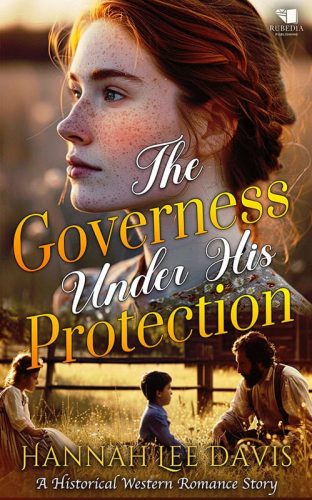
The Governess Under His Protection
“I’ll protect the children”, he promised.
“At what cost?”
“Any.”
Olivia Anderson has devoted her life to protecting children. She becomes a governess for a loving family—until tragedy strikes and leaves the children orphaned. Refusing to abandon them, Olivia steps into a role far bigger than she ever intended, determined to keep them together. Olivia knows love is a luxury she can’t afford—not when everything could be taken from her in a single stroke.
That belief is tested the moment Nolan Thompson returns to Elko. Nolan is determined to protect the children, haunted by his guilt for abandoning their father when he needed him the most. But Olivia is the battle he never prepared for. Her courage draws him closer than he intends, her approval something he aches to earn.
“I don’t trust easily,” she tells him.
Nolan meets her gaze. “Then let me prove I’m worth the risk.”
When the only way to keep the children together and save them from a corrupt orphanage is a marriage of convenience, feelings tangle with duty. Will Olivia and Nolan risk their guarded hearts to keep the family together—or lose everything they’re fighting for?


Chapter One
Elko, Nevada
1880
The canvas-topped mud wagon lurched to a stop. Leather thoroughbraces groaned under the strain, and iron wheels skidded, throwing Nolan forward against the hard bench.
He braced himself, knuckles going white as he gripped the strap.
The lack of motion hit harder than all the bumping and rocking had. For two weeks, the rattling of the wheels and the crack of the driver’s whip had been enough to drown out the noise in his head.
His stomach churned, twisting a knot of acid and bile that had nothing to do with the rocking motion and everything to do with the destination. He stared at the canvas roof. A jagged tear in the fabric let a beam of sunlight slice through, illuminating the dust motes swirling in the stagnant air.
They looked like prison ash.
He gripped the leather strap until the rough grain bit into his palm. Every muscle in his back locked up, rejecting the arrival, urging him to signal the driver to whip the team into a frenzy and drive until the Pacific swallowed them whole. But he stayed put. He breathed in the scent of stale tobacco and dry sage, letting the reality of Elko settle into his lungs like silt.
Now, he had to think again.
Being here again made the life he’d left behind—the sales, the racket of New York, and the ever-repeating daily routine—such as it had been, even more appealing than when he’d originally left this place.
He shoved the wagon door open.
The moment he stepped down, his polished city shoes sunk into horse manure. Then the cursed alkali grit assaulted him.
He spat.
The saliva hit the dust and vanished instantly, sucked dry by a thirsty earth that remembered nothing and forgave less. A gust of wind whipped his coattails around his legs, slapping the heavy wool against his shins. It carried the scent of burning mesquite and the metallic tang of the copper mines up in the hills—odors that clawed at the back of his throat and dragged memories of callused hands and aching backs to the surface.
He narrowed his eyes against the glare. The sun hammered down on the boardwalks, bleaching the wood white and turning the shadows into pools of ink. Nothing hid in this light. Every scar, every mistake, lay exposed for the vultures to pick apart.
The dust, tasting of salt and sour lemons, coated his tongue and settled into the weave of his wool sack suit, turning the black fabric grey in seconds.
A waste of good tailoring.
Four years of trying to scrub this place off his skin frittered away.
Heat pressed down on him, sucking the moisture right out of his lungs. Back East, the papers liked to romanticize the air in the West, but, in reality, it stank of the very manure he’d just stepped into and the sulfur of Central Pacific engines idling at the depot. Yet he’d rather live in a shed here than in a mansion back East. He really should’ve come back sooner, shame and guilt be damned.
Old place hasn’t changed one bit.
Nolan stepped up onto the boardwalk, putting a few feet of distance between himself and the mud wagon.
He nearly reached into his vest pocket before he caught himself.
Despite all the effort he’d put into it during his time in New York, he still hadn’t fully beaten the reflex to reach for his silver cross when he got nervous. Even though he’d promised to sell it, melt it down, or toss it into the Hudson the first chance he got, he still held it at the bottom of the lining.
Metal burned against his hip. The sharp edges of the crucifix dug through the thin lining of his pocket, branding him with a faith he had abandoned years ago. He thumbed the traverse bar. Cool silver turned hot under his touch.
Selling it meant severing the last artery connecting him to a mother who smelled of lavender and a father who smelled of rain. Keeping it meant carrying the weight of their ghosts.
He withdrew his hand as if the metal had bitten him and jammed his fist into his trouser pocket instead, clenching his fingers until the nails cut crescents into his palm. A man couldn’t build a future with a graveyard in his pocket, yet he lacked the grit to empty the plot.
However, he’d sworn he would never wear the damn thing again.
God hadn’t saved his parents from pneumonia, and He certainly hadn’t saved Isaac. Of course, Nolan shared that hypocrisy. Of all the letters Isaac had sent him—and, as best friends tended to be, Isaac had been relentless about it—Nolan had only ever written a response to one, and then he hadn’t sent it.
Now, Aaron’s letter burned a hole in his other pocket, and Nolan hadn’t been able to ignore it when he’d seen that Isaac’s foreman had sent it instead of Isaac himself.
Isaac is gone. Miriam, too.
He should have burned the letter.
He should have stayed in New York, hawking cheap fabric to people he didn’t give a damn about, living that hollow, invisible life he’d built for himself. As miserable as that existence made him, at least it kept everyone safe from this… curse that followed him.
Or, at least, it had until he got Aaron’s letter.
So, Nolan hadn’t burned it.
He had considered not coming back. Writing Aaron to tell him to find someone else. A distant cousin. A lawyer. Anyone but Nolan. Anyone without a vulture circling his head. But then he’d remembered the way Isaac had looked that night in the barn, bleeding and terrified, risking everything to save Nolan’s worthless hide from a crime Nolan had committed.
Nolan owed a debt he could never repay.
Least I can do is do right by those kids.
Nolan tucked his chin against his chest and pulled the brim of his bowler hat low as he moved down Commercial Street.
The walk had become second nature to him long ago.
He’d perfected it in the yard at the state penitentiary. Shoulders squared. Arms loose at your sides but ready to snap up. Take up enough space that nobody bumps into you, but move fast enough that nobody talks to you.
I wonder how long it’ll take someone to recognize me.
He’d grown out of the scrawny and starving stray dog the sheriff had dragged off ten years ago. The hard labor in prison had packed muscle onto his frame that expensive tailoring couldn’t quite hide.
He’d lost some of it in New York, but not much.
So—as much as he wanted to be a ghost and slip through before anyone realized the prodigal mistake had returned—the moment someone put two and two together was only a matter of time.
Up ahead, a broom moved against wooden planks with a scratch-scratch-scratch. Nolan recognized the sweeper—Elias, the old grocer who used to chase him off for loitering long before he went to prison—and clenched his fist.
“Well, I’ll be.” Elias stopped sweeping and leaned on the handle. “Didn’t know they was lettin’ robbers back in the county.”
Nolan stopped in front of him. “Move.”
“Figured you’d be dead or hangin’ by now.” Elias spat in front of Nolan’s shoes. “But a bad penny always turns up, don’t it?”
Nolan shifted his heavy leather valise and resumed his walk, slamming his shoulder into Elias’s. The old man scrambled backward, letting his broom clatter against the planks, and Nolan swept past him without a backward glance.
Let him talk. Let them all talk.
Anything they could ever say to him, he’d already heard six inches from the mirror every morning for the last four years. Criminal. Bum. Liability. The town would see a pest in him, and, for once, the collective wisdom of Elko would be right. Only one man had ever looked at Nolan and seen something other than a waste of space, and Nolan had repaid that loyalty by letting his letters stack up on a boarding house desk.
Veering off the sidewalk, Nolan made his way to the livery stable at the edge of town.
He tossed a handful of coins to the boy dozing on a stool—enough to rent a swaybacked roan—and swung into the saddle. Then he turned the horse’s nose west, away from storefronts and judging eyes and toward the open range. His hand drifted to his vest pocket again, fingers grazing the hard outline of the silver cross through the wool, only for him to shove the metal down deep.
With a long exhale, he kicked the mare into a trot.
***
Nolan stared at the door of the ranch house he co-owned with Isaac.
Well, did co-own. I suppose Isaac’s share belongs to the little ones now.
The years had worn down the rough-hewn pine. Back when Nolan had built it with Isaac, they had both been young enough to believe that sweat and blisters could build a decent life. Now, the varnish was peeling and flaking off under his thumb like dead skin, and he would never speak to Isaac again.
You’re going to get them killed, too.
He could be back in Elko before sundown. On a train by morning. Let the lawyer handle the estate. Let someone with a clean soul raise these kids. Someone who wouldn’t poison them just by standing in the same room. But his hand betrayed him. His thumb pressed the iron latch down, and he shoved the door inward.
Racket exploded from within.
A wail cut through the air like a steam whistle signaling a prison riot—relentless, high-pitched, and grating enough to rattle his teeth—and forced him to cover his ears. The heat radiating from the massive cast iron stove slammed into him. The air tasted of scorched milk—like something had boiled over hours ago and been left to burn—mixed with the moisture of drying wool.
The floorboards had turned into a minefield.
Overturned baskets spilled fabric across the path to the kitchen. Wooden blocks and a discarded metal ladle lay waiting to break an ankle. The volume of clutter made the small house press in against his shoulders like the solitary punishment cell Nolan had stayed in far more times than he would have liked.
Something small barreled straight toward him.
A boy—skinny, maybe eight years old, with Isaac’s dark hair—shoved past Nolan’s leg without so much as looking up. Nolan had expected grieving orphans, but this one looked more like a cornered animal lashing out. The boy stormed into the back bedroom and slammed the door so hard the glass chimney on the kerosene lamp rattled in its bracket.
As impressive as that is for a young’un that little, that boy needs discipline.
The slam reverberated through the floorboards, but it ceded to the screaming from a crib. The infant—a girl, judging by the lace on her soiled nightgown—had nearly gone purple in the face with how hard she shrieked. Then, Nolan glanced at the corner. A little girl huddled there, near the woodbox, hugging her knees to her chest. She clutched a tattered rag doll and stared at the floorboards without blinking.
In the middle of the wreckage stood a woman, holding her head and looking around as if she couldn’t decide what to focus on first.
She had a slight frame—too thin for this kind of work—and wore a plain grey dress that hung on her shoulders as if it were two sizes too big. Her chestnut hair was escaping its ribbon, strands of it sticking to the sweat on her neck, and all sorts of stains littered her apron.
She was failing to soothe the baby, hadn’t cooked a meal, and couldn’t hold the house together. This kind of woman belonged in a library or a church pew, not out here fighting a cast iron stove and three traumatized kids.
Who the hell was she? Some do-gooder from the church? A hired girl Isaac had found before he passed?
Isaac had built a stronghold, and this stranger had turned it into a circus. Oh, he’d known coming back would be a mistake, and looking at the wreckage of his best friend’s life in front of him only proved that everything Nolan got close to—or considered doing so in this case—rotted away.
Then a gust of wind whirled in from behind, and the woman finally turned toward him.
Her gaze found him, and he gulped. Those hazel irises bore into him as if they looked at his soul. As if she could see all of his mistakes and judge him for them. Then she glanced at his coat, bowler hat, and jaw, and scrambled backward until her back pressed against the crib railing. Spreading her arms, she reached for a sauce-stained wooden spoon—and Nolan would be asking why she’d left it next to the crib in the first place later—and raised it at him.
Good.
She hadn’t screamed, only sought to protect the baby first. With the girl in the far corner and the boy in the other room, the baby faced the most immediate danger. Nolan had to give credit where credit was due; the woman had good instincts.
“We ain’t got nothin’ left.” The woman swung her spoon like a cavalry saber. “If you’re here for the bank, or the mine, or whatever snakes are crawlin’ out the woodwork, you can tell ’em there ain’t no blood left in this turnip. Now, git.”
Nolan exhaled slowly.
Old habits died hard, especially ones born in the prison yard. Despite seeing with his own eyes that a woman threatened him with only a spoon, he had to force his muscles not to twitch and his fists not to clench. He would not snap that spoon like a dry twig, and he would not kick her out of the house without so much as a conversation.
You’re better than that, Nolan.
“You deaf, mister?” She took a shaking step forward. “I said clear out!”
“Milk’s scorchin’.”
“What?”
He took a deep breath. Usually, this would be the point where he introduced himself and took off his hat to show his respect. But how could he do that when he didn’t respect her? It would be nothing more than lying, so he just looked towards the stove, where a saucepan currently foamed over the rim, and the metal hissed where the liquid hit it.
“Milk. You’re burnin’ it.” He stepped in and closed the door. “And you best tend to that young’un before she bursts a lung.”
Chapter Two
The milk hissed against the cast iron grate, and the woman stared at Nolan.
So, he sighed and stepped past her, the scent of lye soap and sweat smacking his nose, and grabbed the saucepan’s handle with a callused hand. Then, with a grunt, he shoved it to the cooler side of the stove.
Remove the heat, stop the damage. Simple enough.
If only everything else in life worked like that.
He turned back around. The woman had backed against the wall, trembling as her chest heaved, and the fabric of her dress strained with each breath. She eyed him the way a rancher eyed a wolf that’d just unlatched the gate.
“Ain’t here to pick the carcass.” Nolan shook his head. “Sure as hell ain’t here to rob the dead.”
She narrowed her eyes. “Then who are you?”
“Nolan Thompson.”
Her grip on the spoon tightened. As she opened her mouth, shaped a word, and closed it again, her face flared red so fast he thought she might spontaneously catch fire.
She knows.
Of course, she knew. Isaac wouldn’t have kept his mouth shut. He’d have spun tales of their youth, painting Nolan as some misunderstood saint instead of the anchor that had nearly dragged them both to the bottom of the river.
“You—” She glanced at the bedroom door and then at the girl huddled by the woodbox. “Outside.”
He scoffed and pointed at the baby.
“Eve, honey, stay with Lucy.” She clenched her fists as she made her way past him. “Sing her that song she likes.”
Nolan followed her.
Need some fresh air anyway.
He closed the screen door behind him and approached the woman. Up close, she looked even more fragile with the dark circles under her eyes.
“You have enough brass to sink a ship.” She wrung her apron like a chicken’s neck. “Waltzin’ onto this porch after the dirt’s already settled on their graves?”
Nolan reached into his vest pocket.
He needed to smoke. Only, his fingers brushed the tobacco pouch and dove deeper, finding the cold edge of his silver cross. He ran his thumb over the traverse. Metal bit into his thumb.
“I rode out the minute I got word.” He fixed his eyes on the sagging fence line. “Ain’t my doing that Aaron’s letter took the scenic route.”
“He penned that letter before the fever fully took hold.” She poked his chest. “Isaac wrote you. Week after week, year after year. Miriam wrote you when the babies came. And you? Silent as the grave.”
Her words struck him like a lash. He focused on the warped planks of the porch floor, tracing the grain with his eyes to keep from looking at the accusation burning in hers. A muscle in his cheek jumped. The air in his lungs turned heavy, suffocating him with the scent of sage and regret. He wanted to shout that silence had protected them, that his distance had served as a shield, but the words died in his throat, choked off by the bile rising from his gut.
Nolan stared at the horizon, where the mountains cut a jagged line against the blue. “I was busy.”
“Busy?”
“That right.”
“What were you busy with?” She raised her chin. “What was so important that you couldn’t spare a thought for the brother who died asking why you hated him?”
Nolan’s jaw locked. A muscle feathered in his cheek. She had no right to talk about things she knew nothing about. Not that he would explain anything about his history with Isaac right now. No need to open that can of worms. Isaac, rightfully, had kept her in the dark, and so would Nolan.
“I’m here now.” Nolan looked her up and down. “And from the looks of it, it’s a good thing I am.”
“That right?”
“You’re in over your head, ma’am, and you’re sinkin’ fast. House is a bedlam, fences are leanin’ like a drunk on payday, and I reckon the stock is halfway to the Utah border by now.”
She flared her nostrils. “I am holding this place together with spit and prayer.”
“Well, the prayer ain’t working, and you’re fresh out of spit. Isaac would be sick to see the spread like this.”
Nolan pulled the cross out of his pocket. He didn’t mean to. It just happened. His fingers needed to move, to manipulate something, or he was going to put his fist through a support beam.
“Isaac…” She shook and breathed hard. “Isaac would be ashamed to know he called you kin.”
Nolan flipped the cross again. Over. Under. Over. Under. The silver flashed in the sun.
“Maybe,” Nolan muttered. “He ain’t here for us to ask him.”
Then a shout came from the door. “Well, we don’t want you here!”
Nolan turned.
The boy stood against the screen, pressing his face to the wire mesh. Then he kicked the door open and stomped out. He was small and scrawny, like Isaac had been at that age, but he had Miriam’s fire in his eyes. The same stubborn tilt to his chin. Nolan might as well have been looking in a mirror that showed the past.
A phantom pain flared in Nolan’s ribs, a memory of the scuffles he and Isaac had engaged in as boys, wrestling in the dirt until the sun went down. The kid had the same stance. Feet planted wide. Shoulders hunched. Hands trembling not from cold, but from the adrenaline dumping into his small system. Nolan swallowed hard. He recognized the look in the boy’s eyes, the cornered animal ready to bite the hand reaching out to help.
The woman reached for him. “Jack, go back inside and—”
“No!” Jack balled his tiny hands into fists. “Papa said he was his friend, but he ain’t.”
“Go inside, kid.” Nolan’s gut twisted. “Grown folks are talkin’.”
“This is my house! Get off my porch!”
Behind the boy, the little girl—the woman had called her Eve—snuck out and, avoiding Nolan as much as she could, hid behind the woman and clutched her skirt. She looked at Nolan like he was the boogeyman come to eat them all.
Maybe I am.
Nolan sighed. “I ain’t goin’ nowhere, Jack.”
“We don’t need you!”
Jack lunged. It happened fast. The kid went for Nolan’s hand. Nolan could have stopped him, of course. He’d survived prison riots and gang fights. He could have easily sidestepped or grabbed the boy’s wrist.
But grabbing the boy could bruise him.
So, Nolan let Jack’s little fingers claw into his hand and rip the silver cross from his grip.
The woman stepped forward. “Jack, no!”
“I hate you!” Jack wound his arm back and threw the cross. “Go away!”
The silver glinted as it arced through the air and landed at the toe of a polished black boot. Then a callused hand reached down and picked it up.
Nolan’s breath hitched.
He knew those knuckles. The scar running white across the back of the thumb, a souvenir from a branding iron back when the ranch was just dirt and dreams. The gun belt the man had always refused to change, and a face weathered like old leather left out in the rain.
Aaron.
The man who had slept on the dirt floor of Nolan and Isaac’s first shack right alongside them so they could afford feed for the cattle. Isaac had called him a foreman on the payroll, but he’d been the only father either of them had ever really known.
Grey had invaded Aaron’s beard, taking over the black bristles Nolan remembered. Deep canyons lined the corners of his eyes, but the irises hadn’t changed. Blue, sharp, and currently softening as they landed on Nolan.
Aaron straightened and stopped in front of Nolan. “Filled out some.”
Before Nolan could nod or offer a hand, Aaron surged forward and wrapped his arms around Nolan. The scent of horses, tobacco, and sweat slammed into Nolan. He stiffened. His muscles coiled, ready to shove and strike. In the yard at the pen, a grab like this meant a shiv in the kidney.
“You wandered back to the herd.”
Nolan forced his arms to stay at his side. “Aaron… It’s good to see you.”
Aaron pulled back and held out the cross. “Drop somethin’?”
Nolan took it and shoved it back into his pocket. “Somethin’ like that.”
“Jack.” Aaron turned to the boy. “Barn needs mucking. You know the rules about chores before outbursts.”
The boy’s jaw worked. He shot one last venomous look at Nolan—a face that promised knives in the dark—then stomped off the porch, kicking up dust as he rounded the corner of the house.
“Mornin’ to you, Miss Olivia.” Aaron tipped his hat. “Lawyer kept me. Apologies for the delay.”
Olivia breathed out and smoothed her apron, though her hands still trembled. “I… lunch is nearly ready. Though it might be a bit scorched.”
“We’ll be in.”
She ushered the little girl inside and slapped the screen door shut behind them.
Nolan watched the mesh settle. “She’s got a temper.”
“She’s got grit.” Aaron walked to the rail and leaned against it. “Only reason those kids ain’t wards of the state yet.”
Nolan joined him at the rail, looking out at the sagebrush stretching to the mountains. “Pay her out, Aaron. Give her what she’s owed and send her packin’. I can hire a hand that don’t look at me like I’m a disease.”
Aaron chuckled. “Ain’t that simple, son.”
“Greenbacks usually make things simple.”
“Lawyer laid it out for me plain this mornin’.” Aaron clicked his tongue. “Beatrice Pritchard been circling the spread like a coyote on a limpin’ calf. She wants them kids. Claims the orphanage is a sight better than a spinster governess livin’ in squalor.”
The name brought the taste of bile to Nolan’s throat.
“I can take ’em. I’m practically family. Isaac must’ve named me in the will, too.”
“State of Nevada don’t see ‘practically’.” Aaron spat over the rail. “And they sure as hell don’t see ‘ex-convict’ as a suitable guardian. Lawyer said with your record, a judge would laugh you out of the courtroom before you even sat down.”
Nolan’s fingers curled into fists at his sides, his nails digging into his palms until the sharp bite of pain grounded him. His pulse hammered against his collar. He focused on a single rusted nail in the porch railing, staring until his eyes burned and watered, fighting the urge to smash his fist through the weathered wood.
“So that’s it?” Nolan clenched his jaw. “We lose them?”
“Grub first.” Aaron pushed off the rail. “Empty belly makes for a foolish head.”
***
The stew tasted of burnt milk and charred potatoes.
Nolan forced the spoon into his mouth, swallowing the lump without chewing. Across the table, Lucy slept in a basket, her tiny chest rising and falling in a rhythm that seemed too fragile for this world.
Jack refused to eat. He just sat there with his arms crossed and stared at the wall. Eve picked at her bowl, her eyes darting to Nolan every time his spoon scraped the ceramic. Olivia stood by the stove and scrubbed a pot hard enough to scrape the metal.
Aaron mopped up the last of the brown sludge with a heel of bread. “Alright, nap time.”
Olivia turned, drying her hands on her apron, and herded the children into the back room with hushed whispers and gentle hands.
The door clicked shut.
Olivia returned to the table and sat opposite Nolan.
Aaron cleared his throat and put a folded document on the table.
“Daniel Reed is a good lawyer.” He drummed his fingers on the paper. “But he can’t work no miracles. The law is black and white. Miss Olivia, you ain’t got a claim. No blood relation. No husband. No property.”
Olivia flinched. “Please… I promised Miriam I wouldn’t let them go to that… that woman.”
“Nolan.” Aaron shifted his gaze. “You got a claim ’cause of the will and joint ownership of the ranch. But—”
“I was in prison.” Nolan leaned back his chair onto two legs. “You said that already.”
“Beatrice’s filed a petition already.” Aaron shook his head. “Has a judge in her pocket. She’ll cry neglect and moral failin’, and she’ll win.”
“Give me the good news, Aaron, or stop talkin’.”
Aaron smoothed the paper flat. “Law favors a stable home. A Christian home. Father to provide, mother to nurture. If the kids are in a legal family unit, the state backs off.”
Nolan stared at the paper. “There ain’t no stable home. Isaac and Miriam are gone.”
“Yes. We need to make one.”
Olivia frowned. “What’re you gettin’ at, Aaron?”
“You two need to get married.”
“No.” Olivia jumped up. “Absolutely not.”
Aaron pinched his nose. “Olivia—”
“He’s a criminal. He’s as rude as a rattler and twice as mean. He abandoned them!”
Nolan frowned. “I ain’t dyin’ to hitch my wagon to yours, either.”
This woman looked at him with undisguised loathing. No, she’d have whatever Isaac and Miriam owed her and be gone. He and Aaron would find another way to keep the children.
“Listen to me.” Aaron leaned forward. “You ain’t gotta like each other. You ain’t gotta share a bed. You ain’t even gotta talk civil.”
Nolan and Olivia both opened their mouths to speak.
“However—!” Aaron slammed his palm against the table. “You must sign that paper, or you can explain to Jack and Eve why they’re sleepin’ in a dormitory at Beatrice Pritchard’s place come Saturday night.”
Next chapter ...
You just read the first chapters of "The Governess Under His Protection"!
Are you ready, for an emotional roller-coaster, filled with drama and excitement?
If yes, just click this button to find how the story ends!
Looking forward to the rest of the story and what’s going to happen to those children.
I hope you liked where their path led, Pat!✨