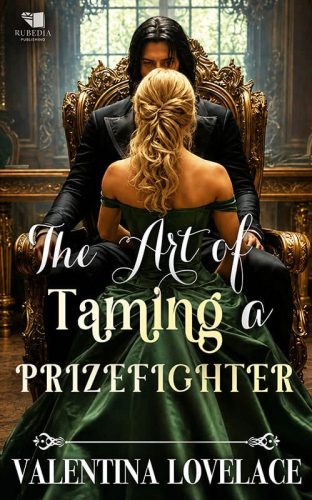
The Art of Taming a Prizefighter
“Teach me to be a gentleman.”
“Only if you stop looking at me like you’re not.”
What happens when a runaway lady becomes the maid of a prizefighter turned baron?
Lady Helena Winford would rather scrub floors than marry the man her family has chosen. Disguised as a maid, she takes refuge at Rowan Hall, where England’s newest baron is proving just as out of place as she is.
Isaac Rowan may have inherited a title, but no amount of wealth can erase his brutal past in the boxing ring. To survive society’s ruthless games, he needs someone to teach him how to be a gentleman. He never expects to fall for the mysterious maid who seems to know the aristocracy’s every secret.
As stolen lessons turn into forbidden temptation, Helena’s carefully built disguise begins to crumble. When her true identity is revealed, they’ll have to choose between the lives they were born into… or the love that could ruin them both…


Chapter One
Ashwood House — London
1814
The Ashworth ballroom blazed with a thousand candles, their light multiplied a hundredfold in the mirrors lining the walls, until Lady Helena Winford could hardly tell where the true light ended and its reflection began. It was, she thought, rather like everything else in this room: nothing was quite as it appeared.
“Lady Helena. You look radiant this evening.”
She turned, schooling her face into the pleasant, unreadable expression she had perfected over six seasons.
She inclined her head to Mr Pratt, a baronet’s second son with damp palms and an unfortunate habit of discussing his hunting dogs at length.
“You are too kind, Mr Pratt.”
“Might I hope for a dance later in the evening?”
“My card is rather full, I’m afraid.”
It was not entirely a lie. Her card was full of names her father had all but written there himself.
Mr Pratt bowed and retreated, and Helena allowed herself a breath before the next approach, the next bow, the next careful exchange of nothings dressed up as conversation.
Across the room, her father stood in conversation with Lord Ashworth and two other gentlemen she did not recognise.
Even from this distance, she could read the set of his shoulders. Her father was watching her. He was always watching her now.
“You are doing that thing again,” murmured her aunt, appearing at her elbow with the particular grace of a woman who had spent thirty years learning to move through crowded rooms without seeming to move at all.
“What thing, Aunt Margaret?”
“Looking as though you would rather be anywhere else in England.”
Lady Margaret Pembroke’s fan snapped open, as though she were brandishing a shield. “Smile, my dear. Everyone is watching.”
“Everyone is always watching.”
“Which is precisely why you must smile.”
Helena smiled.
Over the years, she had learned that a smile cost her nothing and gave her nothing, a currency she spent freely because it meant so little.
She let her gaze drift across the ballroom while her aunt exchanged pleasantries with a passing acquaintance.
It was, by any measure, a spectacular turnout, nearly every family of consequence in London in attendance. The room hummed with the particular energy of a hundred private calculations being made behind smiling faces. In one corner, a mother steered her daughter toward a cluster of unmarried viscounts with all the subtlety of a woman driving cattle to market. In another, two gentlemen bent their heads together, and although she could not hear what was being discussed, she knew well enough: a woman’s dowry, a man’s income, an estate’s acreage. These were the true subjects of every ballroom in London, however prettily they were dressed in the language of music and dancing.
Helena wondered, not for the first time, what it might be to attend such an evening for no purpose beyond enjoying it. To dance because she wished to dance, and not because a partnership had been quietly arranged between her father and some other gentleman’s father weeks before.
She thought of the books hidden at the bottom of her trunk, accounts of places she would likely never see, women who had crossed deserts and sailed uncharted seas, and felt the familiar ache of wanting something she had been raised to believe she could not have.
Such thoughts were foolish. She knew this. A woman of her position did not choose her own life.
“Helena.”
Her father’s voice, low and controlled, sounded at her shoulder. She had not seen him cross the room.
“You have not danced with Mr Hartley.”
“He has not asked, Papa.”
“He will. When he does, you will accept.”
It was not a request. Richard Winford, Earl of Winford, did not make requests of his daughter; he issued instructions and expected them to be followed.
For twenty-four years, Helena had followed them, mostly because it had never occurred to her that she might not.
“You turned away Lord Pelham in the spring. You turned away Mr Ainsworth not two months past. I begin to wonder, Helena, whether you intend to be a wife at all, or whether you mean to make a spectacle of this family’s patience until I have no choice but to consider you unmarriageable.”
“Papa—”
“You are four-and-twenty. You are not a girl fresh from the schoolroom, to weigh every suitor against some notion of a storybook affection. Mr Hartley is respectable. His family is old, his income is sound, and he has expressed a particular admiration for you.”
Ahh, admiration, she thought. One always admires what one doesn’t understand.
“I will not have you refuse him for want of a feeling that has no place in a match of consequence.”
She wanted to tell him that it was not a storybook affection she wanted, only the smallest assurance that the man she married might one day look at her as something other than a favourable arrangement of assets.
But her father’s face held the particular closed expression that meant the conversation was concluded, whatever she might wish to add to it.
“Yes, Papa.”
“Good,” he said. “I do this for your sake, Helena, whatever you may think of me tonight. The Season is nearly done. I would see you settled before it ends.”
***
The evening continued as such evenings always did.
Helena danced with Mr Hartley, whose conversation ran chiefly to the superiority of his stables. She talked with a colonel recently returned from the Peninsula, who at least had the decency to be interesting, if overly fond of recounting his own valour. She smiled until her face ached with it.
It was during a rare lull, while her aunt was occupied with an old friend and her father had disappeared into the card room, that Lord Nathaniel Crawford found her.
She knew him before he spoke, knew him by the murmur that rippled through any circle of young ladies he approached, half admiration and half warning, and by the particular way he moved through a room as though he had already decided it belonged to him.
He was handsome, she would grant him that much, with his golden hair and easy smile. He had the kind of practised charm that made mothers herd their daughters subtly away even as those same girls glanced back over their shoulders.
Helena had met him perhaps a dozen times. She had never once liked him, though she could not always have said precisely why, only that his compliments felt less like admiration and more like appraisal, the way a man might admire a horse he intended to purchase.
“Lady Helena.” He bowed. “You are wasted on wallflowers and dowagers this evening. Might I have the honour?”
“I fear my next dance is promised, My Lord.”
It was, in fact, unpromised, but the lie came easily, and she offered it with the same smooth courtesy she offered everything else tonight.
Crawford’s mouth curved, unbothered. “How fortunate for whichever gentleman claims you. Another time, perhaps.”
“Perhaps,” she said.
He inclined his head and moved off toward another cluster of young ladies, leaving her to breathe out slowly and hope she would not be obliged to invent another excuse before the evening ended.
Just then, her sister, Clara, appeared at her side, pale beneath her rouge and pressing a gloved hand to her stomach.
“Helena, I feel dreadfully unwell.”
“Clara.” Helena took her sister’s arm at once, all thought of Crawford forgotten. “Sit down, here.”
“I only need air, I think. It is so very warm.” Clara sank into the offered chair.
Aunt Margaret arrived a moment later in a rustle of silk, already reaching for her niece’s wrist to check her pulse.
“Smelling salts,” her aunt said. “Helena, in the carriage, Simmons will have them in my dressing case. Go quickly, and tell no one why, or we shall have half the room believing your sister has been overcome by scandal rather than heat.”
Helena did not waste time as she turned and made her way through the crowded corridors, murmuring apologies as she slipped past clusters of guests too absorbed in their own conversations to notice her passing.
The carriage yielded the salts easily enough, and she was making her way back through the entrance hall when a young maid stepped into her path, a slight, dark-haired girl in the Ashworth livery, her expression tight with urgency.
“Lady Helena?” The girl bobbed a hasty curtsy. “Begging your pardon, my lady, but your sister has stepped into the conservatory for air, and your aunt bid me to fetch you straightaway.”
“Is she much worse?”
“I couldn’t say, my lady, only that your aunt looked most anxious.”
Helena thanked the girl and hurried in the direction she indicated, the salts clutched in her hand.
The conservatory, when she reached it, was a different world from the ballroom she had left. It was dim where the ballroom blazed, quiet where it roared, the air thick and green with the smell of orange trees and damp earth rather than candle wax and perfume.
A handful of lamps burned low along the far wall, casting more shadow than light among the potted palms and trailing vines. For a moment Helena stood in the doorway, blinking, trying to find her sister among the greenery.
“Clara?”
No answer came. She took a few steps further in, scanning the shadowed benches, the arched glass overhead, dark from the London night.
“I’m afraid your sister isn’t here, Lady Helena.”
She turned sharply to find Lord Crawford standing near the far wall, half-hidden in shadow, a glass of something amber in his hand.
Lord Crawford regarded her with an expression she could not quite name. Amusement, perhaps, with something colder beneath it.
“My Lord,” she said carefully. “I was told my sister had come here for air. I must have been misdirected, forgive me.”
She turned to leave, but as she did, he moved, unhurried, into her path.
“There’s no need to rush off. I only sought a quiet corner myself, away from all that noise and heat. You look as though you might benefit from the same.”
“I thank you, My Lord, but I am needed elsewhere.”
She stepped to go around him. He shifted, not quite blocking her path, but near enough that she would have had to press against him to pass.
“If you’ll excuse me.”
“You work so very hard to be excused from my company, Lady Helena.”
His voice had dropped, low and warm, the murmur she imagined he used on a great many young ladies in dim rooms.
“I find myself wondering why. I’ve watched you all evening dancing with men who bore you, smiling at men your father has chosen for reasons that have nothing to do with you. It seems a great waste, a woman of your spirit married off to whichever fortune serves her father’s purposes best.”
“You mistake yourself, My Lord, if you believe that is any concern of yours.”
“Perhaps I only think you deserve a husband who sees you. Who appreciates something beyond a dowry and a family name.”
He took a step nearer. There was nothing in his posture she could name as improper, and yet, every instinct in her rose at once, sharp and certain.
“I could be such a man, Helena, if you would allow—”
“I would not.”
Her voice came out harder than she intended, all the polish stripped from it.
“You presume a great deal, My Lord, for a man I have declined to dance with not a few minutes prior. Now stand aside, if you please. I have no wish to continue this conversation.”
Something flickered across his face, irritation, perhaps, that she had not softened as he expected, but he only smiled and reached out, catching her wrist as she moved to pass him.
It lasted no more than a moment. Then she pulled free, stepping back with her heart hammering and her wrist burning where his fingers had closed around it.
She opened her mouth to tell him precisely what she thought of him.
But before she could, the doorway filled with light and voices, and she saw her aunt’s face among them.
Helena froze.
She knew what it looked like. Unchaperoned in a dim conservatory with London’s most notorious libertine.
The silence that followed was worse than any sound could have been.
“Helena.” Her aunt’s voice, when it came, was barely a whisper, but it carried across the sudden hush like a shout.
Behind her stood two women Helena recognised at once, Lady Danvers and Mrs Colquhoun, the two most efficient conduits of gossip in all of London, along with three gentlemen whose names she could not, at that moment, recall.
“Aunt Margaret.” Helena took a step toward the door. “This is not…I was told Clara had come here, that she was unwell, I only just arrived, nothing has—”
“Lady Helena.” Crawford’s voice, behind her, was infuriatingly calm. “Do forgive me for keeping you from your party. I had not realised the hour.”
He said nothing else. He did not explain that she had been summoned by a false message, did not mention the maid or the mistaken directions or the wrist he had caught for a single unwelcome moment. He simply inclined his head and walked back into the ballroom, leaving Helena standing alone amid the wreckage of her own reputation.
“It was a message,” Helena said, her voice shaking. “A maid told me Clara had come here unwell. I only just arrived, Aunt, I swear it to you!”
“Not here.”
Her aunt’s hand closed around her arm, gripping hard enough to bruise, and steered her firmly toward the door.
“Not another word until we are home.”
By the time they crossed back into the ballroom, it had already begun. Helena felt it the way one feels a change in weather, a shift in the air, heads turning a fraction too quickly, conversations dying and resuming in lower voices as she passed.
She kept her chin level and her back straight, because it was the only defence she had left, and because her mother had taught her, long ago, that a Winford did not let the world see her bleed.
But she felt every glance like a small blow, and by the time she found her father, already moving toward her, his face was carved from stone.
“We are leaving.” Her father did not raise his voice. He did not need to. “Now.”
“Papa, if you would only let me explain…”
“Not here.”
The same words her aunt had used, but somehow worse coming from him, because beneath the command she could hear something she had never heard in her father’s voice before. It was the particular flatness of a man too angry, or too afraid, to trust himself with more words than were strictly necessary.
The carriage ride home was conducted in silence.
Clara sat pale and wide-eyed across from her, clearly having gathered enough from whispered fragments to understand that something terrible had happened.
Aunt Margaret stared out the window with her hands folded tightly in her lap. Her father said nothing at all, his gaze fixed on some point beyond the carriage glass, his jaw set in a hard line. Helena had only seen him this way perhaps twice before in her life. Once when her mother died, and once when his own brother had disgraced the family with debts that had taken years to quietly repay.
It was only when they had reached Winford House, once Clara had been sent upstairs and her aunt had withdrawn to her own rooms with a look that was almost apologetic, that her father finally spoke.
“Tell me what happened.”
Helena told him. When she finished, he was quiet for a long moment, studying her with an expression she could not read.
“I believe you,” he said finally. “I do not think you invited this, Helena. I do not think you did anything improper.”
“Then—”
“It does not matter.”
He said it heavily, as though the words cost him something to speak aloud.
“Do you understand that, Helena? It does not matter what happened. It matters only what was seen and what will be said. By morning every drawing room in London will have heard some version of tonight in which you were found alone with Nathaniel Crawford under circumstances no innocent explanation will overcome. By tomorrow evening it will not matter that a maid misled you, or that Crawford laid a hand on you for less time than it takes to draw breath. It will only matter that you were seen, and that is the only truth society requires.”
“That is not fair.”
“No,” he agreed. “It is not fair. It has never been fair, to women least of all. But fairness will not save your reputation, Helena, and neither will the truth. Only marriage might do that now, and quickly, before the gossip hardens into something even a wedding cannot undo.”
Helena said nothing, but in that moment she understood that whatever future she might once have imagined for herself, whatever quiet hope she had carried that she might someday choose a husband for reasons beyond alliance and income, had ended. Ended in a dim conservatory that smelled of orange trees, in the space of a single moment.
Later, in her room, Helena sat at her window long after the candles had been extinguished. She looked out over the dark garden below, thinking of the girl she had been only that morning. But Helena did not weep for that girl. She only sat and watched the darkness.
And as she sat, Helena understood, with the particular, exhausted clarity of a woman whose life had changed forever, that nothing about tomorrow would resemble anything she had once expected of it.
Chapter Two
Hounslow, West London
1814
The field outside Hounslow smelled of trampled grass, tallow smoke, and the particular sourness of several hundred men who had been drinking since noon.
Isaac Rowan stood at the edge of the makeshift ring, four posts driven into the earth, a length of rope strung between them, nothing so grand as the purpose-built rings some promoters favoured these days.
He let the noise of the crowd wash over him without truly hearing it. He had learned long ago not to listen too closely before a fight.
The shouting, the wagering, the men calling his name as though they owned some piece of him for having bet their week’s wages on his fists, none of it mattered once the first blow landed. Only the ring mattered then. The ring, and the man across it, and the simple, brutal arithmetic of who would still be standing when it ended.
“Isaac,” Tom said. “Are you listening to me?”
Isaac blinked, turning his head to find his oldest friend watching him.
Thomas Mercer had been built for the ring himself once, thick through the shoulders, hands like ham hocks, a nose broken so many times it had given up any pretence of straightness. But a decade of London’s poorest neighbourhoods and one bad knee had retired him from fighting and installed him permanently at Isaac’s side instead.
“I heard you,” Isaac said. “Coleman’s been training with a Bristol man. Favours his left.”
“I said that ten minutes ago,” Tom chided. “What I said just now was that Lord Palgrave’s put two hundred pounds on you, and if you lose he’ll likely have my kneecaps for it.”
Isaac said nothing as Tom squinted at him.
“You’ve got a face on you like a man walking to his own hanging, Isaac. What’s the matter?”
Isaac looked past him, out over the crowd assembling along the roped perimeter. Dockworkers and costermongers stood shoulder-to-shoulder with gentlemen in coats too fine for a field outside Hounslow. They were all drawn by the same hunger to watch two men beat each other bloody for their entertainment and their coin.
He had fought in front of crowds like this a hundred times. He could not have said, if asked, precisely why tonight felt different. Except that lately, it always did.
“I keep wondering,” he said slowly. “Whether this is all there is. Whether I fight Coleman tonight, and some other man next month, and another after that, until my hands won’t close into fists anymore or someone younger puts me on my back for good, and that’s the whole of it. The whole of what I’ve made of myself.”
Tom stared at him for a long moment, then shook his head.
“God’s teeth, Isaac. You’ve got two hundred pounds riding on you tonight and half of London’s underworld watching, and you’ve chosen this moment to have a philosophical crisis?”
Next chapter ...
You just read the first chapters of "The Art of Taming a Prizefighter"!
Are you ready, for an emotional roller-coaster, filled with drama and excitement?
If yes, just click this button to find how the story ends!
An interesting story is about to develop here about a young lady and a boxer who will rise above his current position! It should be a good one
They had quite the story to tell, didn’t they, Henri?🤗