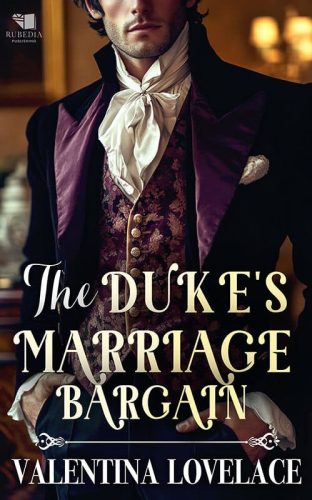
The Duke's Marriage Bargain
“I have mastered every weakness I possess.” His gaze darkened. “Except, it seems, you.”
What happens when the coldest duke in London marries the one woman who dared deceive him?
Lady Arabella only meant to save her friend from London’s coldest duke—not trick him into proposing.
Impersonating her companion to repel the formidable Duke of Ravenscroft should have ended in scandal. Instead, her sharp tongue captures his interest, binding them in a marriage of convenience neither trusts and neither can resist.
But beneath watchful society, stolen kisses ignite, jealousy sparks, and one devastating lie threatens to ruin them both.
In a world ruled by appearances, love may be the most dangerous risk of all…


Chapter One
London, 1816
Arabella Finch had always believed that a window was the most honest companion a house could offer.
It did not pretend to be anything more than it was. A window was a way to look out upon the world.
From the narrow seat tucked into the drawing room alcove, she could observe London without being observed in return. The glass was faintly warped with age, softening the edges of passing carriages and blurring the faces of pedestrians into indistinct motion.
She liked that. The truth was that in all the years of life she’d come to learn that distance almost always improved everything.
A book rested open upon her lap, a circulating library novel, its spine already cracked by many hopeful hands. She had read the same paragraph three times without absorbing it. The heroine was declaring eternal devotion. Arabella found herself studying the seam of her glove instead, recently turned and restitched at the fingers.
Outside, a milk cart rattled past. Two boys darted between wheels with the fearless recklessness of the very young. A lady in a plum pelisse stepped delicately around a puddle, lifting her hem just enough to preserve propriety.
Life went on, brisk and indifferent.
She turned a page she had not truly read.
Then, from the adjoining morning room, came the low murmur of voices.
Her father’s tone carried first, warm, coaxing, faintly amused in the way of a man who believed persuasion superior to fact.
“My dear Eleanor, you distress yourself unnecessarily. The matter is not so dire as you imagine.”
Arabella’s gaze did not lift from the page.
Her mother’s reply was softer, but it did not waver.
“A gentleman does not send a footman with threats if the matter is trifling, Thomas.”
The word gentleman was edged carefully. A coil tightened in Arabella’s chest. She had heard that tone before.
She adjusted her posture against the window cushions, angling herself just slightly closer to the thin wall. The Finch townhouse was modest; privacy was a courtesy more than a guarantee.
“There are always men who posture,” her father continued. “It is the fashion among creditors. One must appear formidable.”
“And is he formidable?” her mother asked.
A pause.
Arabella imagined her father smoothing his cravat, a habitual gesture when pressed.
“He is persistent.”
“Persistent?” Eleanor repeated. “He called here. To this house.”
The words seemed to settle heavily in the air. Arabella’s fingers tightened around the edge of her book. She had not known that.
Her father lowered his voice, though not sufficiently.
“I did not wish to alarm you.”
“You have not alarmed me,” her mother said quietly. “You have exhausted me.”
Silence followed, and it was longer this time. Arabella stared blindly at the page before her. There had been a time when such conversations ended in tears. In apologies sworn with trembling sincerity. In vows never to gamble again.
She could recall being sixteen, peering down from the staircase as her father clasped her mother’s hands and promised reform. That season of reform had lasted precisely four months. Now there were no vows. Only excuses.
“You must trust me,” her father insisted. “I have nearly recovered the losses twice over this month. One turn of luck—”
“One turn of luck,” Eleanor echoed, and something in her composure fractured. “You have wagered on turns of luck for six years.”
Six years.
Arabella let the number settle.
Six years since the larger house in Kensington. Six years since dinners with twelve guests and fresh flowers ordered weekly. Six years since she had believed new gloves an ordinary purchase rather than a calculation.
Her mother spoke again, and now the strain was unmistakable.
“We have sold the silver. I have dismissed two servants. Arabella’s gowns are turned until there is scarcely fabric left to turn. What remains to wager, Thomas? The roof?”
“You exaggerate—”
“Don’t you dare,” Eleanor interrupted. “It is I who sits in this house all day long doing everything I can to make sure we do not starve. While you are out there, spending money that we do not have.”
Another silence followed.
Outside, a carriage rolled past bearing a crest upon its door. A symbol of bold and unapologetic wealth. Arabella watched it until it vanished around the corner.
Marriage, she thought—not wistfully, but clinically.
It was the only arithmetic that might alter theirs.
But what gentleman sought a bride with no dowry and a father whispered about in gaming hells? Charm could not outweigh debt. Wit did not erase rumour.
She was three-and-twenty. Not yet desperate, but no longer naïve.
From within the morning room, her father spoke again, his tone sharpened now by wounded pride.
“You speak as though I would willingly endanger my family.”
“You already have.”
The words fell cleanly. Arabella closed her book. There it was…the truth no one wished to articulate in daylight.
She did not despise her father. That would have been simpler. He was affectionate, attentive when present, capable of great warmth. But warmth did not steady a household. Warmth did not settle accounts.
She wondered, not for the first time, whether love was meant to feel so much like maintenance.
Footsteps approached. Arabella quickly adjusted her posture, lowering her gaze to the novel as though absorbed in its tender declarations.
The door opened.
Her mother passed through the drawing room without noticing her at first. Eleanor Finch was not a woman prone to display, yet the strain showed plainly now. Her complexion had blanched; a faint tremor touched the hand that adjusted the fall of her shawl.
She halted upon seeing Arabella.
For the briefest instant, something like apology flickered across her expression, as though she regretted that her daughter must inhabit such conversations, even indirectly.
“My dear,” she said, gathering composure with visible effort, “you will be late if you do not begin dressing.”
Arabella marked her page carefully before rising.
“Yes, Mama.”
“You are to call upon Lady Violet at eleven. It would not do to keep her waiting.”
No… It would not do to keep one’s well-born friends waiting. Connections must be preserved. Appearances maintained.
Arabella crossed the room and kissed her mother’s cheek. The skin felt cool.
“Shall I have Cook send up tea?” she asked quietly.
Her mother managed a small smile. “Only if we possess any.”
Arabella returned the smile. “We always possess enough.”
It was not strictly true. But it was what they had, and for now, it would suffice.
Arabella left the drawing room and headed upstairs. Her bedchamber was small but orderly, its slanted ceiling evidence of an upper-floor compromise made when finances had first begun their quiet retreat. She set her book upon the narrow escritoire and crossed to the wardrobe.
There were, in truth, only three gowns suitable for visiting. One too faded. One too warm for the mild spring morning. And the third, pale blue muslin, carefully laundered and pressed, its hem let down twice and stitched again with patient hands.
She chose the blue.
It suited her colouring, or so her mother insisted, warming the hazel of her eyes and softening the seriousness that too often claimed her expression. The fabric was no longer new, but it fell gracefully enough when tied with care.
She fastened it herself before the small mirror.
Her hair, a warm brown with threads of honey when caught in light, she arranged simply. A few curls softened her temples despite her attempts at discipline. She considered pinning them more severely, then did not.
Lady Violet’s household would gleam today. It always did.
Arabella allowed herself one moment before the mirror. It was not vanity, precisely.
Softly pretty, she had once overheard a gentleman say.
Not striking or remarkable. Yet she did not resent it. Striking beauty attracted scrutiny. Scrutiny invited inquiry. Inquiry led to uncomfortable discoveries about fathers and debt.
Softly pretty was survivable. The front door closed behind her with a careful click.
London greeted her with the scent of damp stone and horseflesh. Carriages rolled past in varying degrees of polish. A costermonger called out strawberries newly arrived from the countryside. Somewhere distant, a church bell marked the quarter hour.
Arabella walked. It was both out of economy and habit.
As she neared Grosvenor Square, the air seemed to change. There was less coal smoke and horse manure. The townhouses grew taller, prouder, freshly painted. Windows reflected sunlight without distortion. Flowers bloomed in the small gardens.
Lady Violet Pembroke’s residence stood among the most elegant of them. Its façade pristine, its brass knocker polished to a mirror shine.
Arabella paused only briefly before ascending the steps. A liveried footman opened the door before she had fully raised her hand.
“Miss Finch.”
He did not hesitate over her name…which meant she was expected.
The entrance hall glowed with quiet opulence. Marble underfoot. A console table adorned with fresh lilies. The faint, unmistakable fragrance of beeswax and citrus oil. There was warmth in that house, not merely of temperature, but of abundance.
She removed her gloves carefully.
Lady Violet awaited her in the morning room, rising at once. “Arabella!”
Violet was delicately fair, her pale blonde hair arranged in artful curls that would never dare collapse. Her gown, made of the most fashionable primrose silk, shimmered in the light from tall French windows.
She embraced Arabella with genuine affection.
“You are late,” Violet accused gently.
“By three minutes,” Arabella returned. “I trusted you would forgive me.”
“For you—always.”
They seated themselves. Tea had already been laid. Not the careful rationing of the Finch household, but a spread. Delicate sandwiches trimmed precisely. Seed cake. Sweet biscuits dusted in sugar. A small dish of strawberries, impossibly early in the season.
Arabella’s stomach betrayed her with the faintest flutter. Still, she did not reach immediately. She knew better than that.
A maid poured tea from a porcelain pot. The cups matched…a luxury Arabella had not taken for granted until hers no longer did.
Violet watched her. “You must eat,” she said quietly.
“I intend to,” Arabella replied, selecting half a sandwich with measured composure. She took small bites and chewed slowly. The truth was that, as hungry as she was, she could not allow it to take over.
One did not devour in Grosvenor Square.
For several moments, they spoke of ordinary matters. A musicale, a mutual acquaintance newly engaged, the latest on-dit circulating at Almack’s.
Then Violet’s cheer dimmed. “There is something I must tell you.”
Arabella set down her cup. “That is rarely an encouraging beginning.”
Violet’s fingers twisted in her lap, a breach of her usual poise.
“My mother has arranged an introduction.”
“Another?” Arabella asked lightly.
“Not just any other.” Violet swallowed. “The Duke of Ravenscroft.”
The name held weight. Even in Arabella’s modest circles, Benedict Ashcombe, the Duke of Ravenscroft, was known. Not for scandal precisely, though whispers lingered, but for severity. For his distance and for a manner so controlled it unsettled those accustomed to charm.
“He is… older,” Violet continued carefully. “Four-and-thirty, I believe. Reserved. Devoted to Parliament. It is said he does not dance.”
“How alarming,” Arabella murmured.
Violet did not smile.
“The arrangement was made through my uncle. His Grace seeks a wife. It is considered… advantageous.”
“For your family,” Arabella finished.
“Yes.”
“And for you?”
Violet hesitated.
“I do not think he would be unkind,” she said slowly. “But I cannot imagine him being… anything else.”
Arabella understood. A marriage of duty. Of cold civility.
“You may refuse,” Arabella said gently.
Violet looked almost stricken. “You know I may not. Not directly. To reject a duke without cause would be—” She broke off. “My mother would never forgive such impudence.”
“So, you must attend,” Arabella said. “Surely a single meeting over tea will not be too terrible to endure?”
Violet’s fingers tightened around her teacup. “You do not understand,” she said quietly.
“Then enlighten me.”
Violet hesitated, not theatrically, but with genuine unease. “They say he ruined a woman.”
Arabella stilled. “Society ruins women daily,” she replied carefully.
“Yes—but this was… different.” Violet lowered her voice. “She was not foolish. Nor improper. Yet after some attachment—which he acknowledged—she disappeared from invitations. No engagement followed. No defence offered.”
Arabella absorbed this.
“And he did nothing?”
“That is precisely the point.” Violet’s composure thinned. “He did nothing.”
The quiet condemnation lingered.
“I could refuse more easily if he were cruel,” Violet admitted softly. “At least cruelty is visible, understandable. But indifference—” She shook her head. “To be placed beside such a man, admired for my posture, consulted for nothing of consequence, expected to produce heirs and remain silent while he governs the world…”
She trailed off.
Arabella watched her friend closely now. Violet was not romantic. She did not dream wildly of love matches. She understood the machinery of aristocratic marriage. But she feared erasure.
“You think he would not see you,” Arabella said.
“I think he would see only what is required.”
The admission was painfully honest.
“And you would prefer a husband who feels?” Arabella asked gently.
“I would prefer one who might be persuaded,” Violet replied. “One who might argue. Laugh. Err.”
“Err?” Arabella smiled faintly.
“Yes. A man who errs can be reached.”
A silence settled between them.
Violet’s voice dropped further. “My mother says it is an extraordinary opportunity.”
“And you disagree.”
“I think it is an extraordinary confinement.”
Arabella studied her friend, the fine silk gown, the flawless hair, the security Arabella herself could not claim.
And yet fear was fear, regardless of upholstery. It was not wealth Violet lacked, but agency.
“I have never known your mother not to get what she wants,” Arabella said.
“It is true.” Violet leaned forward suddenly. “Which is why I am hoping you might help me.”
Arabella narrowed her eyes. She loved her friend. But she also knew her, knew how her mind worked. Violet was beautiful, but it was a fragile beauty. Her friend had always been prone to nervousness, and it had always been Arabella who had come to her aid in times of need.
“Help how?”
“It is only a brief meeting. In the park. Informal. Perfectly respectable.”
“Violet.”
“He needs only to find me disagreeable.”
Silence stretched.
“You cannot mean—”
“I do,” Violet insisted. “If he withdraws of his own accord, no offence is given. No refusal spoken. It is merely… incompatibility.”
“And how,” Arabella asked carefully, “does this involve me?”
Violet reached across the table and seized her hands.
“Attend in my stead.”
The words hung absurdly between them. “Absolutely not.”
“It would be simple!”
“It would be a lie.”
“It would only be a conversation!”
“With a duke,” Arabella returned crisply. “One known for noticing everything.”
Violet pressed on. “You are clever. You could vex a saint.”
“And that is supposed to encourage me? Besides, saints are not members of the House of Lords.”
“He must only lose interest.”
“And if he does not?” Arabella demanded.
Violet faltered.
“He will.”
“You ask me to impersonate you before one of the most powerful men in London.”
“It is not as though he knows me!”
“That is rather the point.”
Arabella rose and crossed to the window, pulse unsteady. The risk was not theatrical…it was real.
If discovered, Violet’s reputation would suffer. Arabella’s would shatter. Association with deception, especially involving a duke, could render her unmarriageable entirely.
And yet…
She thought of the ledger and of her mother’s pale face…Of limited options.
“What precisely would you have me do?” she asked at last.
Violet brightened with desperate hope. “Contradict him. Speak too freely. Display… opinions that I myself would not be able to do without blushing horribly and giving myself away.”
“My dearest Violette, I had no idea you could be so scandalous.”
“Be unsuitable.”
Arabella turned slowly. “You wish me to sabotage myself.”
“Only briefly,” Violet pleaded. “One meeting. I shall feign illness. You shall attend as Lady Violet. If he departs disenchanted, the matter ends.”
Arabella studied her friend.
Violet was not cruel; she was merely frightened.
And Arabella… Well, Arabella had very little left to lose. Her social standing was already precarious. Her dowry nonexistent. If whispers followed her, they would only confirm what society suspected—that she was not an advantageous match.
Compared to Violet, she was expendable. The realisation did not wound as it once might have. “You understand,” Arabella said slowly, “that if this is discovered, I bear the greater consequence.”
“I would never permit that,” she insisted. “And I would do it myself, if I wasn’t such a terrible liar.”
“You may not control it…the outcome.”
Violet’s grip tightened.
“Please.”
Loyalty was a stubborn thing. Arabella exhaled. “One meeting,” she said firmly. “I shall attend once. I shall offend him beyond repair. And the Duke of Ravenscroft will withdraw of his own will.”
Violet nearly wept with relief.
“You are the dearest creature alive.”
“I am,” Arabella replied dryly, “a fool.”
But even as she said it, a curious flicker stirred beneath her apprehension.
The coldest duke in London.
She wondered what precisely it would require to thaw him, or whether frost might prove more interesting than fear. And thus, with tea barely tasted and fate lightly provoked, the matter was settled.
Chapter Two
Arabella had never before dressed with the deliberate intention of being objectionable.
It required more calculation than elegance ever had.
She stood before her narrow mirror and surveyed the available arsenal of modest rebellion. The pale blue muslin was set aside. Too flattering, she thought.
Instead, she selected a gown of soft dove-grey. It was perfectly respectable, recently pressed, but paired it with a sash of faded rose that did not quite complement it. The colours did not clash; they merely disagreed.
She chose gloves a shade lighter than fashion dictated.
Her bonnet she tied a fraction too snugly, so that one curl escaped insistently at her temple. She made no effort to correct it.
Appropriate, but careless.
She studied her reflection. There was no scandal in it. It was merely… disappointing.
“Forgive me,” she murmured to the looking glass. “I am about to behave abominably.”
The park was lively by the time she arrived. Her chaperone, one of their house maids, Mrs Friedricks, stood a few paces behind her.
Carriages lined the edge of the path. Ladies paraded in calculated circuits. Gentlemen bowed. The air smelled of damp grass and horses, faintly sweet beneath the morning sun.
Arabella did not hurry. She knew precisely how long she was late. Ten minutes, sufficient to register. Insufficient to insult beyond recovery.
A small table had been arranged beneath a stand of trees. A footman stood discreetly nearby. And seated with perfect stillness beside the tea service was the Duke of Ravenscroft.
He rose when she approached. Even prepared, she felt it.
Not warmth, or charm. But a presence.
The Duke was tall and sparely built. He wore an immaculately cut dark coat, and his posture suggested not stiffness, but control. His dark hair was worn neatly, and his steel-grey eyes had settled upon her with quiet assessment.
He did not look irritated, and that unsettled her more than if he had.
“Lady Violet,” he said, inclining his head. His voice was low and without ornament.
Arabella did not curtsy as deeply as she ought. “Your Grace.”
She did not apologise for being late. A beat passed, and then he gestured toward the chair opposite. She seated herself without waiting for further invitation and leaned back. Not indolent, but comfortable.
His gaze sharpened. “You encountered no difficulty on your way?” he asked.
“Oh, dreadful traffic,” she replied lightly. “One must expect such inconvenience when venturing out.”
She accepted the cup of tea the footman poured—without waiting for Benedict to lift his own.
She took a sip and then another. The sandwiches were neatly arranged—cucumber, watercress, thinly sliced ham. She selected one immediately.
“It is fortunate the weather held,” Benedict began.
“Yes,” she said, and bit into the sandwich before he had finished.
It was excellent. Soft bread. Fresh butter. She swallowed, not quite fully, and added, “One grows weary of rain.”
A crumb escaped onto her glove, and she brushed it onto the tablecloth without ceremony. His gaze dropped briefly and then returned to her face. He lifted his cup at last. She reached for a second sandwich.
“You are fond of the park?” he asked.
“Not particularly.”
“No?”
“Too many people pretending to admire one another.” She chewed thoughtfully… and continued speaking. “I find the spectacle exhausting.”
A faint pause.
“Society functions upon such spectacle.”
“Then society must be very tired indeed.”
She smiled, not sweetly. He studied her as one might study an unfamiliar language. “Your mother speaks highly of your accomplishments,” he said.
“Does she?”
“She believes you possess a disposition suited to—”
“Marriage?” Arabella supplied.
She reached for a strawberry, though none had been offered, and bit into it without elegance. Juice stained her fingertip.
“I confess I do not share her enthusiasm.”
The silence that followed was not awkward, but measured. “You object to marriage as an institution?” he asked.
“I object to being arranged like furniture.”
She reached for her teacup again, but she misjudged the saucer and tipped the liquid forward. A dark spill bloomed across the pristine linen.
The footman shifted instinctively.
Arabella glanced down. “Oops.” She dabbed at it with her napkin, spreading the stain into a wider, uneven shape. “That is unfortunate.”
She set the damp napkin aside.
Benedict had not moved. “Shall I request another cloth?” he asked calmly.
“It seems unnecessary,” she replied. “It will dry.”
He regarded the spreading stain. “As you wish.” He attempted again. “You have been much admired this Season.”
“How tedious.”
His brows lifted slightly. “I beg your pardon?”
“Admiration rarely concerns itself with accuracy,” she said, selecting another sandwich before he had taken one. “It is generally based upon proximity and novelty.” She swallowed. “You, for example.”
The faintest flicker crossed his expression.
“Indeed?”
“You are admired because you are distant…mysterious even.”
“And you disapprove of mystery?”
“It is better to know more about one’s future partner, I believe. Not less.”
She leaned forward now, closer than custom permitted. “You have been described as cold.”
“I have?” His tone did not alter.
“Frequently.”
“And what is your assessment?”
She met his gaze directly. “You appear… controlled.”
“And that displeases you?”
“Immensely.”
A lady passing nearby glanced at them with interest.
Arabella laughed, too loudly for the setting, at nothing in particular. The sound lingered. Benedict did not flinch.
“You seem determined,” he observed quietly, “to find this meeting disagreeable.”
She waved a dismissive hand. “Oh, not disagreeable. Merely unnecessary.”
She gestured vaguely between them.
“Our families have decided this must be evaluated. We comply. We drink tea. We discuss weather and virtue. It is quite efficient.”
“And you would prefer inefficiency?”
“I would prefer choice.” She reached for the teapot. “More?”
Without waiting, she poured, sloshing slightly this time. A second, smaller spill joined the first, but she did not acknowledge it.
“You speak rather candidly,” he said.
“I dislike concealment.”
“Even when it is prudent?”
“Especially then.”
He regarded her for a long moment. “You do not appear concerned with my opinion.”
“I am not.”
The words fell without adornment. The breeze shifted, stirring the leaves overhead.
He leaned back slightly now, mirroring her earlier posture. “And if my opinion were decisive?”
Next chapter ...
You just read the first chapters of "The Duke's Marriage Bargain"!
Are you ready, for an emotional roller-coaster, filled with drama and excitement?
If yes, just click this button to find how the story ends!