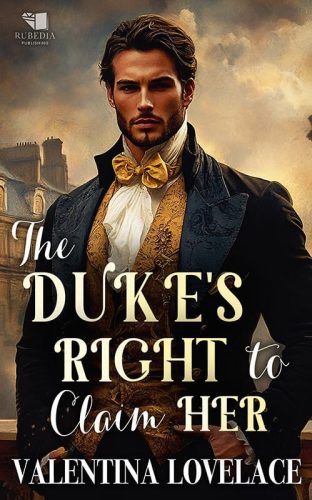
The Duke's Right to Claim Her
“I left you untouched,” he said. “Do not mistake that for lack of hunger.”
What happens when her husband returns to claim what he never touched?
For a year, Lady Elowen Hale has been a duchess in name only. Her husband left after their wedding, and she learned to live without his presence or his bed.
But Duke Severin Ashcroft Hale returns home.
He needs a wife now—visible, obedient, convincing. What he does not expect is a woman who no longer bends. Forced into proximity and public devotion, their carefully maintained distance collapses into something sharp, intimate, and volatile.
A marriage ignored can be endured.
A marriage suddenly claimed is far more dangerous…


Chapter One
Whitmarsh Hall, Dorsetshire
April 1816
Elowen, Duchess of Whitmarsh, awoke with a start, her breath hitching in her throat.
Outside, morning broke at Whitmarsh Hall not with light, but with a low moan of wind across the marshes, a sound that had grown familiar to the Duchess—less like a cry, more like a warning long since spent. The April skies had not yet decided if they would offer fog or rain, and the windows of her chambers wore a silver sheen, blurred and uncertain.
The canopy of her bed, a towering thing of oak and faded brocade, drew shadows across the pale linens as she sat upright. The air held the damp chill particular to ancient houses whose stones refused to be warmed, no matter how many fires were laid. One burned low now in the hearth, the embers still clinging to life.
As she looked around her room, the remnants of her dream clung to her like a second skin, vivid and unsettling. She could still feel the phantom touch of her husband, Severin Hale, Duke of Whitmarsh, his hands roaming her body with a familiarity that was both thrilling and terrifying. Their marriage had been one of convenience, a union of two noble houses, and it had never been consummated. Severin had been absent for a year, and Elowen had grown accustomed to the emptiness of her bed.
She tried to dismiss the dream as meaningless, but her body betrayed her. Her nipples were hard peaks beneath her silk nightgown, and a throbbing ache pulsed between her legs. She bit her lip, torn between the desire to relieve the tension and the propriety that dictated such acts were unseemly. But the dream had left her restless, and she found herself slipping her hand beneath the hem of her nightgown, her fingers tracing the sensitive skin of her inner thigh.
Elowen’s breath hitched as her fingers found her wet folds. She was already slick with desire, her body aching for release. She circled her clit with her fingertips, her hips bucking at the sensation. She imagined it was Severin’s hand between her legs, his fingers teasing her, driving her wild. She moaned softly, her free hand gripping the sheets as the pleasure built within her.
But the fantasy was not enough. She wanted more. She wanted to feel a man’s touch, to feel him inside her. She wanted Severin. The realisation was startling, but the ache between her legs was undeniable.
Just then, a noise from the hallway startled her. She pulled her hand away, her heart pounding in her chest. She listened intently, her breath held, but there was no sound. She let out a shaky breath, her body still trembling with unspent desire. She knew she couldn’t leave it like this. She needed release.
“Your Grace?” came a soft voice from the other side of the door.
She exhaled shakily.
“Come,” she instructed.
The door opened as Elowen threw off the covers and stood up, her body glowing with a sheen of sweat. She walked over to the full-length mirror in her bedroom, and her eyes roamed over her reflection.
Anna, her lady’s maid, entered carrying a steaming basin and a folded linen towel over one arm. A narrow girl of twenty, all elbows and earnestness, Anna moved with quiet efficiency—setting the basin on the marble washstand, uncapping a bottle of rosewater, and placing warming stones beneath Elowen’s slippers without having to ask.
“How did you sleep, Your Grace?” Anna asked.
“Lightly,” Elowen said, dipping her hands into the warm water. The scent of roses was faint, but clean. “The wind makes itself known.”
Anna wrinkled her nose. “Worse than a fox in the henhouse, that wind. Whines like it means to be pitied.”
Elowen allowed herself the smallest smile. “Even the wind must wish to be heard.”
She cleansed and dried her hands, then seated herself at the dressing table—its surface polished to a dull sheen, framed by twin brass candlesticks and a small glass dish filled with hairpins. Anna moved behind her, fingers deft in their work.
“Your hair’s holding better these days,” she noted. “Shall I twist it as I did yesterday?”
“No. Something simpler. A single coil. I’ve no wish to impress the parlour chairs.”
Anna snorted softly. “If they could be impressed, they’d be halfway in love with you by now, ma’am.”
Elowen met her own eyes in the mirror. Grey-green, calm. A face composed not for beauty but for restraint. Her hair, dark as ironwood, with only the barest suggestion of curl, was drawn back with deliberate simplicity, baring her pale brow.
“I’ll wear the grey gown today,” she said.
“The one with the storm-blue sash?”
“No sash. Only the grey.”
Anna hesitated, then curtsied. “As you wish, Your Grace.”
Discipline guided Elowen’s choices. Colours too bright whispered of desperation. Styles too fine suggested a woman striving to prove herself. Neither would suit a duchess whose husband had not written in over a year, whose title was a formality rather than a marriage.
She dressed without ceremony. The grey muslin clung where it ought to, its sleeves modest, its lines unadorned. She wore no jewels. A single pin secured her hair; a pearl comb lay unused on the tray. She preferred to walk the estate in the early hours, when most were still abed, and appearances mattered only to the crows.
Once dressed, she crossed to the tall window overlooking the eastern grounds. Below, Whitmarsh stretched bleak and solemn—a sprawl of low stone walls, wind-scoured fields, and half-tamed marshland. The hall itself loomed like a monument to some older, sterner century. Ivy clung to its northern walls, and the leaded panes of the long gallery caught no light at all.
The tenants would be expecting her in the outer field before noon. A delivery cart was due from the village. Letters would need answering, the steward’s books reviewed. Routine, her shield against speculation.
Her marriage had been whispered about, of course. A wedding without a ball. A duchess without a duke. But Whitmarsh ran smoothly under her hand, and Elowen offered no comment. She had learned long ago that silence could be mistaken for dignity.
A clock struck eight.
Anna stepped back. “Shall I have the breakfast tray sent up, ma’am?”
“No. I’ll take it in the blue parlour.”
“Aye, Your Grace.”
Elowen turned once more toward the mirror, then reached—delicately—for her gloves. Outside, the wind rose again, whistling low along the stone. A sound like memory. Or an omen.
***
Elowen descended the main staircase slowly, her gloved fingertips trailing lightly along the worn bannister. The walnut wood that had been polished for generations was as smooth as sea-stone beneath her hand, dulled in places by the passage of time and touch. Beyond the tall windows to her left, mist still clung low to the marshes. The sky was pale as ash.
The house stirred around her, faint noises beneath stone and timber. A footman in livery passed silently below, bowing his head. Somewhere in the west wing, the maids were opening shutters, the thud of old hinges echoing faintly through the long corridors. Whitmarsh Hall did not bustle so much as breathe, slowly, solemnly, like a creature ancient and half-asleep.
She entered the blue parlour.
It was a restrained room by noble standards, panelled in pale wood, with sky-blue wallpaper faded to silver near the windows. The fire had been lit, though it smoked a little in the grate. A small table had been set beside the hearth with a linen cloth, a silver pot of tea, and two settings.
As always.
Elowen moved to the window and stood with her back to the warmth, watching the mist shift over the east lawn. A single magpie stalked the gravel path, its wings twitching in the damp.
She ought to have felt comfort in the stillness. Routine was, after all, her preferred weapon against uncertainty. But this morning, something sat unevenly beneath her skin, like a seam snagged beneath a corset.
She blinked slowly, exhaling.
It was a dream. That is all.
Just then, the door opened behind her.
“Have the ghosts begun keeping you company at breakfast now?” came a bright voice. “Should I be worried?”
Elowen turned, the corners of her mouth lifting just slightly. “Only the civil ones.”
Lady Rowena Hale swept in with the self-assurance of someone who had never once worried whether she belonged. She was dressed in a lemon-coloured morning gown trimmed with white piping, her golden curls only half tamed by a ribbon. There was a smudge of ink on her wrist, and a sprig of rosemary pinned haphazardly at her bodice.
“I woke early,” Rowena said, claiming the chair opposite Elowen. “The sky looked poetic, so I tried to write. The result was rather a disaster. I’ll spare you the details.”
“You rarely do.”
“That’s friendship, my dear Duchess.” She leaned forward to pour herself tea. “You look pale. More so than usual. No offence intended.”
“None taken,” Elowen replied dryly, taking her own seat. “You only ever offend deliberately.”
“Very true.”
Their plates were filled modestly, bread still warm from the oven, butter, poached eggs, and a light honey preserve. Elowen added tea to her cup, the scent of bergamot rising delicately in the steam. Her fingers, she noticed, were slower than usual. Her appetite absent.
Rowena watched her closely between bites. “You’re quiet this morning.”
“I’m always quiet.”
“You’re unnaturally quiet. Even for you. And you just buttered a slice of bread and then forgot to eat it. So either you’re unwell—or someone’s written to announce their intent to elope, die, or call upon us for the entire summer season.”
Elowen’s lips twitched. “None of those.”
Rowena raised a brow. “Then what is it?”
There was a pause. A hesitation, not rare for Elowen, who prized deliberation over impulse.
“I dreamed,” she said finally. Her voice was even, but her gaze dropped to the table. “Of your brother.”
Rowena nearly choked on her tea.
“Oh no. No no no—Elowen, you may be a duchess, but I will throw this napkin at your head.”
“I didn’t say it was that kind of dream,” Elowen said quickly, though heat had crept into her cheeks.
Rowena narrowed her eyes. “But it was, wasn’t it?”
Elowen made the critical mistake of looking up.
Her blush deepened.
Rowena gasped. “Madam! I must protest! I am far too delicate to hear improper fantasies involving my brother. What would the vicar say?”
“He would say you’re scandalous and ought to be locked in the east tower for a week.”
“That again! I liked the east tower. I read three novels and drank a stolen bottle of sherry. Best week of my adolescence.”
Elowen shook her head, half-laughing despite herself.
Rowena leaned forward again, eyes sparkling with delight. “So. You’ve been reading too many of those novels again, too, haven’t you? The kind where brooding lords confess their secret yearning between thunderclaps and waistcoat fittings.”
“I haven’t the time for novels.”
“You say that,” Rowena said, “but I know for a fact there’s a copy of The Ravished Heiress hidden behind your embroidery basket.”
Elowen arched a brow. “I was inspecting it for literary merit.”
“Of course. Purely academic. That’s why you turned down the corner on the kissing page.”
“I did no such thing.”
“You did, and I adore you for it.” Rowena grinned, then softened. “Truly, though. Are you quite well?”
Elowen hesitated, then nodded once.
“It was just a dream,” she said.
But as she reached for her tea, her fingers trembled faintly against the porcelain.
Outside, the fog was beginning to lift.
***
By mid-morning, the fog had cleared, revealing the marshes in their muted, melancholy glory. Silvered grass and blackwater pools stretched beyond the low stone boundary walls. Inside Whitmarsh Hall, the hearths had been stoked, the halls aired, and the scent of beeswax polish hung faintly in the air.
Elowen sat in her study, the smaller of the two, the one she had quietly claimed as her own.
The room was panelled in dark cherrywood and lined with shelves bearing ledgers, estate records, and rows of tidy correspondence boxes, each labelled in her fine, slanted hand. A window overlooked the southern lawn, and from her desk she could just see the old sundial sunk slightly into the ground, leaning westward, as though time itself had grown tired of being counted.
A footman entered, dressed in the formal livery of Whitmarsh Hall, a dark bottle-green coat trimmed in silver braid, white breeches, and stockings so clean they might have been starched. A linen cravat sat crisp at his throat, and the brass buttons of his waistcoat caught the firelight as he bowed, holding a shallow wooden tray with practised care.
“Your Grace,” he said with a bow. “The morning post.”
“Thank you, Peter. You may leave it.”
He withdrew, and the door clicked softly shut behind him.
Elowen folded back the muslin cloth over the tray and began to sort the letters with practised ease. A missive from the steward at the Westbrook tenant farms—repaired fences, lambing rates, a note about the need for new shingles on the gamekeeper’s cottage. Another from the housekeeper regarding the order of spring linens. A third concerning a late delivery from the apothecary in town. She opened each, read swiftly, and made notes in the margin with a firm, clean hand.
Increase oat supply. Speak with Hensley regarding the stone masons. Invite the parson’s wife to review new nursery books.
The work grounded her, as it always did. While Whitmarsh bore the name of its absent duke, it was Elowen who kept it whole. She had earned the quiet deference of the staff, the careful gratitude of tenants, and the wary respect of those who had once expected her to fail. She did not speak often, but when she did, people listened. Her authority was a quiet, polished thing, unshowy, but unshakable.
She reached the end of the stack and paused.
The final envelope was heavier than the others. The wax seal, formal and uncompromising, was one she had not seen since her wedding day.
The ducal arms of Whitmarsh.
Not addressed to Lady Elowen or Her Grace, the Duchess.
No, this letter bore the formal address:
To the Estate Office of Whitmarsh Hall, Dorsetshire.
Private.
She stared at it for a moment. Then she slit the seal with her letter knife, careful and precise.
The paper was thick, expensive. The hand was unmistakably his, elegant, spare, a script taught to conceal rather than express.
To the Office of the Estate at Whitmarsh,
I am to return on the fifteenth day of April and will arrive by private coach. Accommodations are to be prepared as appropriate.
S.A.H., Duke of Whitmarsh
That was all. No explanation. No greeting. Not even her name.
Elowen lowered the letter. Her hands remained perfectly still atop the desk. Only the tightness at her throat betrayed her.
For a moment, the study around her seemed to hush, books, ledgers, the brass clock on the mantle—all waiting, as if to see how she would respond.
She stood slowly, the letter still in her hand, and walked to the open door.
“Peter,” she called evenly. “Please send for Lady Rowena.”
Rowena entered a short while later, still nibbling on what looked suspiciously like a stolen biscuit.
“I know that tone,” she said lightly, slipping into the study. “Have I forgotten to write another thank-you note or ruined yet another pair of riding gloves?”
Elowen simply held out the letter.
Rowena took it, read it, blinked, and then read it again.
“He’s returning?” she said, eyebrows rising. “Just like that?”
“So it seems.”
“But he hasn’t written in—Elowen, this is today.”
Elowen inclined her head. “It doesn’t say what time.”
Rowena gaped as she looked down at the letter again. “He couldn’t manage so much as a Duchess. I trust this finds you well?”
“No.”
“Well,” Rowena muttered, folding the letter sharply in half. “That’s romantic.”
Elowen exhaled, quiet and controlled. But her fingers were cold.
“I haven’t seen him since the week after our wedding,” she said. “I barely knew him then. I know even less now.”
“And yet you’re meant to dine with him by candlelight in less than eight hours.” Rowena moved to her side and placed a hand gently on her arm. “Do you want me to stay?”
“Yes. But not here. I need you to check with Mrs Ellison about the state of the green guest rooms—and have them made ready in case he arrives with staff.”
Rowena hesitated, then nodded.
“And Elowen?” she said softly. “He’s the one returning to your house. To the home you’ve kept. You don’t owe him silence. Or softness.”
Elowen looked toward the window.
Mist still curled along the edge of the southern lawn, thinning in the morning light.
“I don’t know what I owe him,” she murmured. “But I will greet him. With courtesy. And clarity.”
Rowena studied her for a long moment, then offered a wry, fond smile.
“If he walks in here thinking the quiet duchess hasn’t grown teeth in his absence… he’s in for a very educational evening.”
Elowen’s lips curved faintly.
But when she turned back to the desk, she rested her palm flat on the cool surface—pressing down, grounding herself.
Her husband was coming home.
And she had no idea whether to brace for a reunion…or a battle.
Chapter Two
Portsmouth, Hampshire
April 1816
Severin Ashcroft Hale, Duke of Whitmarsh, dismounted his horse outside the pub in Portsmouth.
The pub was old. Stone-walled, low-beamed, and crowded in the corners with quiet men who never looked up. It was their usual meeting place, but Severin hadn’t been there for a year. He had only just arrived back in England, but of course, he was already here, meeting with his handler.
Severin stepped inside without hesitation.
He didn’t need to ask where Marcus would be; the back room was always kept open for men who asked nothing and tipped well.
The room smelled faintly of woodsmoke and spilt porter. Low voices murmured beyond the door, but the table between them sat in practised silence.
Marcus Ellery sat at the far table, coat off, waistcoat loosened, and a folded paper resting between two empty glasses.
Marcus Ellery. To anyone else, he would have looked like a weary civil servant, the sort who kept ledgers in Whitehall and complained about drafts in old corridors. His hair had silvered at the temples long before his time, his spectacles perpetually sliding down the bridge of his nose, his clothes respectable but unremarkable.
But Severin knew better.
Marcus Ellery had once served his father.
Not as a friend, not then, but as a legal attaché and Crown intermediary, assigned to the Hale household when Severin was still learning how to bow correctly and hold his tongue at table. He had been present in the gallery on the day Severin’s father was condemned. Had stood at the back of the chamber when the verdict was read. Had been the one man in the room who did not look away.
It was Marcus who had first approached Severin afterwards, not with sympathy, but with an offer.
A choice.
Survival, in exchange for service.
Not in the army. Not in diplomacy. But in the quiet, invisible work that preserved crowns without staining their hands.
Marcus had argued his case before men who would have happily stripped Severin of both title and name. He had insisted the son should not answer for the father’s politics. Had presented Severin not as a liability, but as a weapon, one shaped by betrayal and therefore immune to it.
The Crown had listened to Marcus, and Severin had learned then that loyalty was not granted by blood, but brokered by men like Marcus Ellery.
Since that day, Marcus had been his handler, his advocate, and — in the strangest, most unspoken way, his guardian. Never gentle. Never indulgent. But unwavering.
He didn’t rise when Severin entered.
“You’re late,” Marcus said, without looking up.
“You’re always early,” Severin countered.
“I have to be,” Marcus replied, finally glancing up. “You’re harder to track than a French sympathiser in a stolen carriage.”
Severin took the opposite seat and pulled his gloves off with the slow precision of someone who didn’t care to be rushed.
“You summoned me home,” he said flatly. “I assume that means something’s gone wrong.”
Marcus slid the paper across the table. “Wrong might be generous,” he said. “And I did not summon you; the Crown did.”
Severin unfolded it. Names. Family crests. Observations. One in particular underlined in a sharper hand: Fairleigh. Aligning support through trade and property.
“This is your idea of a threat?” Severin asked. “Adrian Fairleigh?”
“Not just him,” Marcus said. “It’s the people lining up behind him.”
Severin leaned back, scanning the room automatically, not because he expected trouble, but because he had been trained never to assume there wasn’t any. The tavern’s back room was dim, the windows shuttered, the door half-closed. Low voices drifted in from the main floor, but no one here dared to listen.
“Fairleigh is a problem,” Marcus continued, lowering his voice, “because he knows how not to look like one. He’s charming. Polished. Quiet. But behind him? There’s a trail of fervent allies.”
“The Evangelical set,” Severin said, his voice neutral.
Marcus nodded. “And they’re growing. Young peers. Minor clergy. A handful of merchant families looking to buy their way into old houses. He’s begun styling himself as a kind of moral authority, part businessman, part reformer.”
“And the Crown doesn’t like reformers,” Severin said.
“Not ones with influence. Not ones related to the throne — however distantly.”
That drew a flicker of Severin’s attention.
Marcus poured a splash of porter and let it settle. “His mother’s cousin married into the Cumberland branch. Fifth in line and falling, but close enough to drop the right name at the wrong table. It makes him untouchable in polite rooms. And dangerous in the impolite ones.”
“Has he declared anything openly?”
“Of course not,” Marcus said. “That’s the point. His public platform is virtue. Philanthropy. Moral restoration. ‘Return to values,’ and all that pious rot. But his gatherings are growing more exclusive. His letters are more encrypted. And more than one estate that declined his investment offers has found itself suddenly entangled in land disputes or trade delays.”
Severin’s jaw tightened slightly. “And the Crown?”
“Nervous,” Marcus replied. “They don’t want to provoke him. But they also don’t want him carving out a kingdom of believers with money and names. So they’re watching. And they want you in place, solid, respectable, unflinching, to remind the rest of the peerage what loyalty looks like.”
Severin said nothing for a moment.
“So, they aren’t planning a movement against him?” he asked.
“No,” Marcus said. “They won’t move against him. Not yet. Not unless they think he’s positioned to turn sympathies or poison trade routes.”
Severin set the paper down. “So that’s why I was summoned back?” he asked. “To play house?”
Marcus looked at him directly. “No,” he said. “It’s because the wrong kind of people have begun asking questions about Whitmarsh.”
Severin went still.
“About your absence. Your marriage. Your allegiance.”
“I’ve been on assignment.”
“For a year,” Marcus said. “Without a public appearance, without a household presence. Without a wife.”
Severin narrowed his eyes. “So what exactly am I supposed to be doing?”
Marcus leaned forward, voice low and sharp. “The Crown wants your house visible again. They want you planted firmly at the head of your estate, in a home that looks loyal, married, and immovable.”
Severin’s hand tightened slightly on the rim of his glass.
“And what else am I expected to do?” he asked.
“Keep an eye on Fairleigh,” Marcus said. “Get close to him, we need a set of eyes on the inside.”
“Babysit Fairleigh?”
Marcus’s jaw tightened.
“Let me remind you,” he went on, “that your title exists because the Crown let you keep it. After your father’s execution, no one expected Whitmarsh to pass intact. But you offered them something better.”
“My service,” Severin said flatly.
“Your silence. Your ruthlessness. Your willingness to disappear into the darker corridors of their power and never ask why.”
“And in return,” Severin said, “I kept my name. My lands. My sister.”
Marcus held his gaze. “And you got a wife.”
There was a silence between them then, heavier than before.
“She was part of the bargain,” Severin said at last.
“An alliance. A respectable match. Quiet lineage, fading family, excellent discretion.”
Severin didn’t speak.
Marcus leaned forward again.
“It’s essential we keep everything quiet,” he said. “No one who isn’t essential should know.”
Severin nodded.
Marcus leaned forward, his expression softening. “The Crown needs you,” Marcus said. “But it doesn’t love you. If you can’t be useful and spotless at the same time, they’ll find someone who is.”
Severin nodded once, slow and deliberate. “Then I suppose it’s time I went home.”
He rose, gloves in hand, and left the pub.
Next chapter ...
You just read the first chapters of "The Duke's Right to Claim Her"!
Are you ready, for an emotional roller-coaster, filled with drama and excitement?
If yes, just click this button to find how the story ends!
Wow, it will not be what he is expecting when he gets home!!