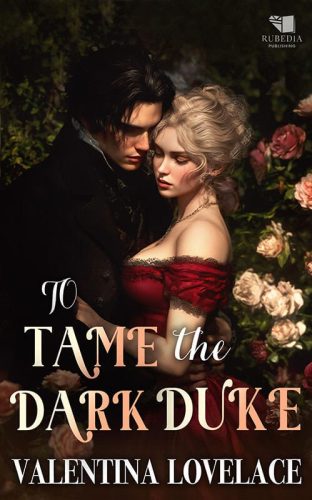
To Tame the Dark Duke
“Do you take pleasure in defying me?”
“Only when you look at me as though you’d rather punish than kiss me.”
“He swore our marriage would be one of duty. He forgot that desire doesn’t obey vows.”
When the poet who captured her heart is unmasked as a fortune-hunting fraud, Lady Charlotte refuses to let heartbreak define her. To save her name—and her pride—she makes a shocking offer to the one man colder than scandal itself: the reclusive Duke of Duskbourne, Cassian…
Cassian agrees to wed for convenience alone. Love destroyed him once, and he will not open his heart again. But his new bride is no meek society ornament. Charlotte’s wit cuts sharper than her smile, and her touch burns hotter than propriety allows…
Behind the doors of Duskbourne Hall, passion becomes their undoing. Yet when Charlotte’s past deception comes to light and Cassian’s buried grief threatens to consume them, they must decide whether to retreat into safety… or risk ruin for a love that blazes brighter than the dawn.


Chapter One
Lady Charlotte Montclair set down her quill and regarded the ink-splattered page with a wistful smile.
How many letters were there now? Twenty? Thirty?
Enough that her desk drawer had become a trove of secrets bound in wax and ribbon, for they were all confessions she dared not speak aloud, sentiments she could only entrust to Edmund Larke’s elegant hand.
What foolish happiness his words brought her. Lines of poetry so tender, so understanding, they seemed to draw the very marrow of her soul onto the page. At last, someone had seen her; not Lady Charlotte the dutiful sister, nor the pious spinster hiding behind charitable causes, but Charlotte herself, with her secret longings and unspoken dreams.
One day soon, she told herself, she would no longer have to hide. Edmund would come. He would walk through the great doors of Hawthorne House, bow to her brother, and with the gravity of a gentleman declare his honourable intentions. And then… then she might live as other women did with a husband who cherished her, a household of her own, a life no longer bound to waiting.
The thought swelled in her chest until she could scarcely contain it. Folding the sheet with careful precision, Charlotte pressed her seal into the warm wax and held it a moment longer than necessary, as though to capture the promise within.
“Safe with you,” she whispered, as if Edmund himself could hear her.
She slipped the letter into her reticule, tucked beside her prayer book and a sprig of lavender. To the world, it would seem only another simple note sent on behalf of her charities. No one, not even Nicholas, who fancied himself so perceptive, would guess how fiercely her heart beat within those modest folds of paper.
Charlotte tied the ribbons of her bonnet beneath her chin with fingers steadier than her heart. She smoothed the folds of her pelisse, which was pale blue trimmed in ivory, and regarded her reflection in the looking glass. Composed and serene, she was the very picture of dutiful propriety. No one would suspect she carried a secret so precious, it felt at times like a flame hidden beneath her ribs.
Then, a brisk rap upon the door startled her from her thoughts.
“Come in,” Charlotte called, gathering her gloves from the writing table.
The door swung open to reveal Aunt Beatrice, upright and formidable as ever. Her silver-streaked hair was arranged in a tidy coiffure that seemed impervious to weather or time. Her sharp and assessing eyes swept Charlotte from bonnet to hem.
“And where, my dear, are you bound so early in the day?” Aunt Beatrice asked with curiosity.
Charlotte hesitated only a breath before replying, “To the village. I have a letter to send.” However, she could not stop the blush that crept up her neck.
“Ah.” A knowing gleam lit her aunt’s eyes. She crossed the chamber with a rustle of skirts and perched herself on the edge of the bed, clearly in no hurry to depart. “Our family does seem unusually fond of correspondence these days. First Nicholas and now you. I begin to wonder whether you are writing a love letter.”
Charlotte blinked, torn between laughter and indignation. “Aunt!”
“Oh, do not bristle so,” Aunt Beatrice said, patting her hand. “I merely tease. Lydia is as dear to me now as though she were my own daughter. Indeed, I cannot imagine Hawthorne House without her.” Her smile softened as the sharpness in her tone dissolved into genuine fondness. “But you must admit that your brother’s choice took us all by surprise. Society will never cease to chatter about it.”
Charlotte’s lips curved despite herself. “And yet, I daresay, Nicholas is far happier for it.”
“Quite so,” Aunt Beatrice conceded. “Which is why I shall not protest should you decide to follow in his footsteps. Though…” Her brows lifted archly upon those words. “If you intend to shock us, do at least have the courtesy to find a man with a tolerable fortune.”
Charlotte forced a laugh, though her cheeks were still warm beneath her aunt’s scrutiny. If Aunt Beatrice only knew the truth behind the folded parchment in her reticule, she would not jest so lightly.
So, she slipped on her gloves, smiling with as much composure as she could muster.
“You needn’t worry yourself, Aunt,” she said lightly. “My errand is a dull one. There are no scandalous secrets to be wrung from it, I assure you.”
Aunt Beatrice narrowed her eyes in mock suspicion, though her lips twitched with amusement. “Mm. That is what your brother once told me when he galloped off to London on business. He returned with a wife. Mark me, Charlotte, I am growing quite expert at detecting mischief in Montclair blood.”
“I leave the mischief to Nicholas,” Charlotte replied, gathering her reticule. “Good day, Aunt.”
Before her aunt could further detain her, Charlotte swept from the chamber and down the stairwell. She could feel her pulse quickening with each step. The manor’s marble hall gave way to the crisp air of morning, and soon she was mounted in her carriage, with the familiar road winding toward London.
The streets on the outskirts of town lay quiet beneath a soft autumn haze. Shopkeepers arranged baskets of apples and bolts of fabric, a blacksmith’s hammer rang faintly in the distance, and children darted through narrow lanes with shrill laughter. Yet few looked her way, and fewer still recognized her. Years of absence from society’s whirl had rendered Lady Charlotte Montclair a ghost of sorts. Her name was remembered more readily in whispers than in greetings.
To be quite honest, it was oddly liberating. To walk unremarked upon, to vanish into the common current of village life, felt more like freedom than disgrace.
At the post office, she slid her sealed letter across the counter, her breath catching as the clerk tucked it into a waiting satchel bound for Bath. Her heart thudded with the certainty that, within days, Edmund would read her words, her hopes, her devotion. Perhaps this letter would be the one that would summon him at last.
But she did not linger. To do so would draw questions, and Charlotte had long ago perfected the art of slipping from scrutiny.
Her steps carried her on to St. Bartholomew’s, the modest stone church that had become the centre of her quiet labours, outside the confines of Hawthorne. The air smelled faintly of beeswax and woodsmoke, and the echo of her footsteps accompanied her as she crossed the nave to the vestry, where a stack of parcels awaited her attention. Bolts of cloth, baskets of bread, jars of preserves, they were all the makings of relief for those whose lives knew little of comfort.
Charlotte loosened her bonnet and set to work, pinning up her sleeves with practiced efficiency. The vestry was already alive with the scent of flour and wool, the air cool despite the faint autumn sunlight streaming through the high windows.
“Careful with that, Meg,” she said gently as one of the village girls struggled with a heavy basket of bread loaves. “If the crusts break, they’ll grow stale before the week is out.”
“Yes, my lady.” Meg flushed, lowering the basket more carefully this time.
Charlotte smiled in encouragement before turning to the other girl, Anna, who was folding blankets into neat piles. “Those are for the orphanage, Anna. See that each one has a lavender sachet tucked inside. Children sleep better when comfort is close at hand.”
Anna’s eyes brightened. “Like the one you gave me last winter, my lady? It smelled so fine I kept it in my pocket for months.”
“Just so,” Charlotte replied, a quiet warmth filling her chest. “We must not think only of keeping bodies warm, but hearts as well.”
She moved to the small desk tucked against the vestry wall and unfolded her list, running a finger down the carefully inked columns.
“Widow Davies is to have her pension today,” she murmured, half to herself, half to the room. “And the poorhouse must have its stores of candles before the evenings grow too dark. I will not have the poor stumbling about in shadows.”
Meg ventured a shy smile. “It is good of you, Lady Charlotte. Most ladies wouldn’t bother themselves with such things.”
Charlotte looked up from her ledger, her gaze softening. “Most ladies are occupied otherwise. But I have time, and time is a gift, Meg. One must use it wisely.”
The girls nodded solemnly, and Charlotte returned to her lists, though her thoughts wandered as her pen traced names. Here, in the dust and quiet bustle, she shed the weight of her family name. No one cared that she had once been a darling of London society, nor that whispers now cast her as a pious recluse.
Needing another ledger, Charlotte slipped toward the door that led to the storeroom. There, in the back storage room, a group of townsmen were stacking firewood and shifting crates brought in by a cart. She stepped lightly, skirts brushing the floor as she reached for the door handle, then froze.
Her name drifted to her through the half-open door.
“Yes, Lady Charlotte Montclair,” a man said, and the syllables stretched with amusement. “Poor, prim creature thinks herself clever, but she swallowed every word I gave her.”
Charlotte’s breath stilled in her throat, but she still tried to suffocate it with her hand on her lips. The voice… she knew it. Smooth, lilting, with that faintly theatrical cadence that had enchanted her in his letters.
It was Edmund.
Another man chuckled. “Is it true, then? You’ve been courting her?”
“Courting?” Edmund gave a sharp laugh. “Hardly. I wrote her a sonnet or two, strung some moonlit phrases together. She lapped it up, like a kitten after cream. Foolish, desperate thing, ready to fall into any man’s arms, so long as he promised her devotion.”
The words struck her like a blow. Charlotte pressed her back against the wall, gripping the stone as though it alone could keep her upright.
“You mean to wed her, then?” the second man pressed.
“Wed her?” Edmund scoffed while his voice was full of contempt. “I’ve no wish to yoke myself to a spinster nearly on the shelf. But a Montclair fortune?” His tone turned sly. “Ah, that I might have endured for a season. She’s naive enough to believe a gentleman poet would risk his heart for her. Imagine, Lady Charlotte, dreaming of marrying a commoner. What a jest!”
The men laughed in a sound that was rough and merciless, echoing through the storeroom.
She staggered back from the door, her heart pounding so loudly she feared they might hear it. All the warmth of the church, the comfort of her work, seemed to drain away, leaving only a cold hollowness spreading through her chest.
She could not stay… not a moment longer.
Turning swiftly, Charlotte gathered her skirts and fled down the vestry corridor.
The girls called after her. “My lady? Are you unwell?”
But she could not answer, nor could she risk her voice betraying the anguish tearing her apart. She pushed open the church’s side door, stumbling into the pale daylight.
The air struck cold against her cheeks, and only then did she realize they were wet. Tears coursed freely, blurring the familiar outlines of the village street as she hurried away. She cared nothing for who might see her, though few glanced up at all. Lady Charlotte Montclair had so long vanished from society’s view that even her distress went unnoticed.
Her carriage waited where she had left it. Climbing inside, she sank into the corner. Her chest rose and fell in broken sobs, grief and humiliation warring with each shuddering breath. Edmund’s cruel and mocking words rang in her ears, stripping bare every hope she had dared to nurture.
Foolish. Desperate. Naive.
The wheels jolted into motion, carrying her back toward Hawthorne House. Outside the window, the countryside blurred into a wash of autumn gold and fading green. Inside, Charlotte bowed her head into her gloved hands and let the tears fall unchecked, each one a testament to a heart betrayed.
By the time the manor gates came into view, her eyes burned and her throat ached with the force of her weeping. She knew she had to compose herself before facing Nicholas or Lydia, but in that moment, all she could feel was the hollow ache of a dream shattered, an ache so sharp it seemed it might never leave her.
Chapter Two
A month had passed since Charlotte Montclair’s heart had shattered in a church vestry, and in that month, she had learned the art of silence, of stillness, of stone.
Once, she would have trembled with anticipation at the thought of rejoining society after so long an absence. Once, she would have whispered secret hopes into her looking glass, wondering whether love might find her. But that Charlotte was gone, buried with her foolish letters and girlish dreams.
Now she found herself sitting before her dressing table, her face reflected back at her in the tall oval glass. The maid fastened her gown with brisk efficiency. It was ivory silk with a modest train, almost severe in its elegance. Charlotte had chosen it deliberately. Not the frothy pastels of youth, nor the girlish fripperies she once adored. Ivory was austere, unyielding, unromantic.
Her hair, coiled into a smooth chignon, gleamed like spun gold beneath the comb of pearls her maid secured. No ringlets tumbled loose, no playful curls framed her face. There was nothing to soften her.
Charlotte regarded the woman in the mirror. She scarcely knew her. Her eyes, which were once bright with hope, were cool now, narrowed with determination. Her mouth, once quick to smile, pressed in a line of composure. She looked as though she had been carved, each feature honed into restraint.
“Very fine, my lady,” her maid murmured as she adjusted the fall of the gown’s sleeve.
Charlotte inclined her head, but her thoughts remained inward. Very fine indeed, but for what purpose? She did not seek admiration, nor affection. She sought a name, a title, a shield against the humiliation of her own gullibility. If marriage must be her lot, then let it be a union of duty. Let her stand secure as a duchess or marchioness, respected if not loved.
Never loved.
The words coiled bitterly in her chest. Love was folly. Love was weakness. Love was the hand that struck her down and left her gasping in the dust. She had believed in sonnets and promises, and for her belief she had been mocked, deceived, ruined in all but name.
Not again.
She rose from her seat, with the ivory silk whispering about her ankles like the rustle of armour. Her maid stepped back, curtsying as Charlotte drew on her gloves with steady fingers.
“I am ready,” Charlotte said in a voice that was clear, composed, and utterly devoid of tremor.
Exactly an hour later, she found herself standing in Lady Evelyn Whitmore’s ballroom, which glittered with the strength of a thousand watchful eyes. The hum of conversation rose and fell with the music, punctuated by the rustle of fans and the sharp titter of laughter.
It was just as Charlotte remembered… and just as dull.
She moved through the crush with her brother Nicholas at her side. Eyes turned toward her. She could feel them curious, calculating, assessing. For years, she had been absent, spoken of in whispers as a reclusive spinster or, worse, a woman fallen so far as to be of no consequence. Now she stood in their midst again, unveiled, and their stares carried the bite of judgment.
“Lady Charlotte,” one of her old companions drawled as they met in passing. The woman’s smile was polished, her eyes anything but. “We had begun to think you meant never to return.”
Another leaned close, fan fluttering as though to mask her words. “And to return now, of all times. Why, the seasons have left you quite behind, have they not?”
Charlotte inclined her head, lips curving in a cool approximation of a smile. Their voices, once so dear to her, seemed shallow now; mere thin, brittle things that could not pierce her newly forged armour.
Let them whisper.
Let them measure her against their silken standards. She had no need of their approval.
She drifted on, her gaze seeking the familiar instead. At the far end of the room, she spied her sister-in-law, Lydia, as she conversed with Sebastian Graves and his wife, Emma. Lydia spotted her first, her smile blooming with such warmth that Charlotte’s guard wavered for just a heartbeat. Lydia held out a hand as Charlotte approached.
“There you are,” Lydia said. “I was beginning to despair of your finding us in this crowd of peacocks.”
Sebastian chuckled. “We do rather outshine the plumage, don’t we, Emma?”
“Oh, most certainly,” Emma said with a grin, slipping her arm through Charlotte’s. “I’ve missed you terribly, Charlotte. You’ve been too long away.”
Charlotte felt the tightness in her chest ease. Here, at least, she was not measured and found wanting. Here she was not a relic or a curiosity, but a sister, a friend. She allowed herself the faintest of genuine smiles.
“It is good to be back,” she said simply, though the words carried a weight none of them could know.
For while the ball unfolded around her in all its predictable patterns–the same gossip, the same music, the same hollow flirtations–Charlotte stood apart. She was no longer the girl who had once ached to belong to this glittering world. She would endure it, yes. She would even master it. But she would never again bow to it.
Charlotte was still standing with Lydia and Emma as a cluster of ladies descended, their tones syrupy with praise.
“Duchess, you must tell us, where did you have that gown made?” one asked Lydia, brushing her gloved hand across the delicate embroidery.
“And the cut of your sleeve! Simply divine,” another chimed in. “It is the talk of the room.”
Lydia’s cheeks flushed, though her smile remained poised. “You flatter me. They are my own designs. I could not ask others to wear what I would not wear myself.”
A ripple of admiration passed through the group. Charlotte felt a pang that was not envy but pride. Lydia had fought hard for her place in this world, and now it was hers by merit as much as by marriage.
As the ladies drifted away, Lady Evelyn Whitmore herself glided near. Her gown shimmered like midnight silk, and suddenly, her fan snapped open with the crispness of a blade. She leaned in conspiratorially, and Charlotte could not take her eyes off of the woman’s overly rouged lips.
“My dears, you cannot have failed to notice,” she whispered, her eyes darting toward the great doors. “The Duke of Duskbourne has arrived.”
Charlotte’s brow furrowed before she could school her expression. “The Duke?”
“Indeed,” Lady Whitmore purred, clearly savouring the stir she had caused. “Lord Cassian Oberon himself, here in my ballroom. He has not set foot in such a gathering in nearly a decade. Grief, they say… poor man. Since the death of his wife, he has cloistered himself away at that great moorland fortress of his. But…” She flicked her fan open again. “He makes an exception for charity. A noble soul, though far too cold for my tastes.”
Nicholas approached in time to catch the end of her remark. His tone was dry. “Coldness, Lady Whitmore, is preferable to the heat of idle gossip.”
Lady Whitmore only laughed, unoffended, but Charlotte barely paid attention to them, because her eyes were focused on something else. Or rather, on someone else.
The crowd parted just enough to grant her a clear view: a tall man standing near the edge of the dance floor, where conversation was at its thickest. He was enduring the attentions of several gentlemen and no small number of ladies, yet his posture betrayed indifference. His expression was cut from marble—just like hers. He appeared polite, but bored, his gaze drifting as though none of what he saw held the faintest interest.
Charlotte studied him. A dark, striking figure with angular features and a gravity that seemed to bend the air around him. He did not laugh, did not smile, not even when a lady brushed closer than courtesy required. His grey and glacial eyes missed nothing, yet warmed for no one.
“Every woman here is dreaming of becoming the next Duchess of Duskbourne,” Lady Whitmore remarked, fanning herself briskly at Charlotte’s side. “A duke widowed these many years, with no heir. He is, of course, the perfect match.” She leaned in, lowering her voice in scandalized delight. “But the trouble is, he will not look at any of them. Not truly. They say he has no heart left to give. Not since his poor Eleanor.”
Nicholas gave a snort of disdain and turned away, unwilling to indulge her further, but Charlotte’s eyes did not leave the Duke.
No heart. No interest. No need of love.
And suddenly, as though a veil had lifted, Charlotte saw it clearly. He was the solution she had been seeking all these weeks.
Cassian Oberon, Duke of Duskbourne, was precisely what she needed.
He was a man scarred by love, who would never again risk it. He was also a man above reproach in station, whose title would erase whispers of her spinsterhood. She was too old for the foppish heirs who sought pliant girls of seventeen. At six and twenty, she was steady and practical and would best suit a man who desired nothing but duty.
It was perfect: a marriage of convenience, a union of necessity. He would gain a wife who asked for nothing more than respect, and she would gain the shield of his name and the freedom to silence society’s wagging tongues.
There would be no passion, no sonnets and pretty lies, and most importantly, no heartbreak.
Charlotte’s lips curved with resolve. She would not wait. She would seize what security was left for her.
Charlotte scarcely heard Lydia’s voice beside her, nor Emma’s teasing remark about some hapless suitor attempting a bow too deep. Their laughter reached her as though muffled through water. Her gaze remained fixed on the man across the ballroom, the Duke of Duskbourne, standing solitary amidst the crowd.
Emma nudged her. “Charlotte, you’ve not heard a word, have you? I was saying I would sooner throw myself into the Serpentine than endure such clumsy devotion. Don’t you agree?”
“Mhm,” Charlotte murmured, gaze still lingering on the Duke as he shifted away from the crowd. Without ceremony, without excuse, he began to cross the ballroom toward the adjoining hall, disappearing into the corridor’s shadows.
Charlotte’s heart gave a sudden, decisive lurch. This was her chance.
“I must excuse myself,” she said quickly, not waiting for Lydia’s questioning look or Nicholas’s raised brow.
She gathered her skirts and slipped into the hall as quickly as she could. The air here was cooler, the candlelight dimmer, and her pulse impossibly loud in her ears.
She saw him turn down a side passage, one that led toward the retiring rooms. His stride was unhurried and utterly unconcerned with who might follow.
Drawing a breath that scorched her lungs, Charlotte followed.
The door clicked shut behind him. She stopped in front of the door, hesitating for a single moment, then she pushed it open, stepping into a panelled chamber perfumed faintly with tobacco and brandy: the gentlemen’s retiring room.
The Duke had just removed his gloves when he stilled. Slowly, he turned, his tall frame casting a long shadow. His eyes fell upon her, cold and assessing.
“You are in the wrong room, my lady,” he told her, sounding both surprised and annoyed.
Charlotte lifted her chin, summoning the stone she had become. “Perhaps. But I have a proposition for you, Your Grace.”
For the first time, something flickered in his gaze. It was not surprise, nor amusement, but the faintest narrowing of interest. His eyes swept over her once, almost as if in an effort to assure himself that she was a being made of flesh and blood, and not a ghost. Then, they settled back upon her face.
And the chamber seemed to hold its breath as silence stretched between them.
Next chapter ...
You just read the first chapters of "To Tame the Dark Duke"!
Are you ready, for an emotional roller-coaster, filled with drama and excitement?
If yes, just click this button to find how the story ends!