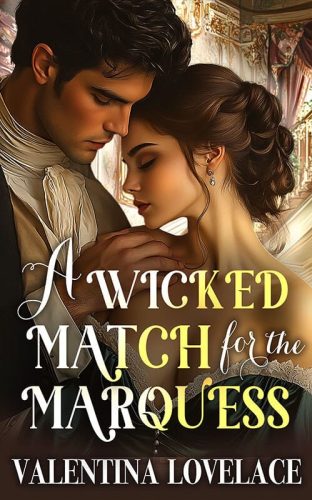
A Wicked Match for the Marquess
“It was only meant to be a bargain… Then he touched me like I was his.”
Jilted days before her wedding for the second time, Lady Catharine Fairbourne is ruined and desperate. To protect her family, she strikes a scandalous bargain with the town’s most notorious matchmaker… and agrees to wed a man no respectable woman would dare…
Alaric Vale, Marquess of Ravensedge, is entirely uninterested in love. He only needs to secure his fortune. Their marriage is meant to be cold and calculated. But her defiance stirs his blood…
Desire was never part of the plan. Now it may be their undoing… or their salvation.


Chapter One
“He is gone,” her father said flatly without so much as a glance in her direction.
Catharine Fairbourne did not immediately respond. She sat perfectly still on the damask settee with her back so rigid her spine might have been forged of iron, though her hands, which were hidden in the folds of her dove-grey muslin, were clenched tightly in her lap.
“He left in the night,” Mr. Fairbourne continued, pacing before the marble hearth. “With the merchant’s daughter… of all things.”
The word merchant seemed to linger on his tongue like something bitter. The fire crackled as if in mockery, casting flickers of orange across his sharply tailored coat, the high black collar shadowing his weathered face.
Catharine blinked slowly. Her breath had stilled in her throat, like frost settling on a windowpane. It wasn’t heartbreak this time, not quite. That had happened once before, and it had not come back the same way. What she felt now was something much more ancient.
It was a slow, spreading shame.
The pale silk wallpaper behind her seemed to close in as the silver patterns twisted and writhed less like vines and more like chains. The air smelled faintly of beeswax polish and crushed lavender. That had always been her mother’s choice, meant to soothe, but it did not soothe. Not today.
“He left you, Catharine.” Her father turned to face her now. “With no explanation but passion and impudence. Do you comprehend what this means? Three days before the wedding. The invitations are sent. The carriages ordered.”
She swallowed. The taste in her mouth was iron. “Yes,” she said softly. “I comprehend it.”
Mr. Fairbourne’s nostrils flared. “It’s the second time. The second. You must see how this reflects on you.”
She did not flinch, though a thin crack fissured through her composure. Just behind her ribs, something trembled, like porcelain struck by a sudden draft.
Her gaze dropped to the carpet. She tried to focus her sight on a pattern of woven roses, dusty with age and footfall. The first time had been Edmund Weatherby. She had been one and twenty. She was young and far too trusting, though everyone had said she was the clever one. And still he had left for a baronet’s daughter with dimples and no opinions.
And now the viscount. He’d left her for a woman who sold lace.
“Have you nothing to say?” her father asked.
Her fingers tightened around the folds of her dress until her knuckles whitened. “What should I say?”
“That you regret allowing this… this embarrassment to befall you. That you are ashamed. That you understand the difficulty this puts upon the family.” He spoke as if reading from one of his ledgers: no emotion, mere factual reason.
Shame. There it was, that word again. It hung in the room like a damp fog, clinging to the curtains, the walls, the very fabric of her skin, tainting her.
Catharine lifted her chin slowly. Her pale eyes, cool as moonlight, met her father’s. “I am ashamed.”
The words cost her more than she thought they would. Her throat felt raw around them.
Mr. Fairbourne gave a single nod, as if he had merely been waiting to hear the proper litany. Then he turned back to the fire, his hands still locked behind his back, as if signifying his impotence in the only affair that truly mattered to him.
“You will remain indoors until I decide what is to be done. No visitors. And for God’s sake, stay away from the windows.”
She stood up. “Of course.” Her voice was glass: thin, hard, and liable to shatter.
She walked from the drawing room with slow precision, her steps soundless against the thick carpet. The house was hushed, suffocating in its civility. Upstairs, in her rooms, she closed the door hastily and leaned back against it, almost as if in an effort to prevent shame from entering. But it followed her, nonetheless. It always would.
Her reflection in the mirror did not tremble. But she did. She had been left again. Fortunately, there was no love. It was mere pragmatism of the fact that, as the eldest daughter of three and twenty, she should marry and bring prosperity to her family. There was no romantic tragedy, only mortification, only failure, only the quiet certainty that whatever was wrong with her was not something she could name or fix.
That was when she broke. A single, fragile exhale trembled loose from her chest, like a bird caged for far too long. She moved towards the window with the slow deliberation of a sleepwalker, and when she could no longer bear the weight inside her, she sank to her knees before the chaise and pressed her forehead to the cushion.
The tears came then, sudden and ungraceful, scalding her cheeks with their heat. This was no silent, noble weeping. No. This was a helpless leaking of everything she had held in through her father’s words, through the firelight, through the empty click of the drawing-room clock that had sounded like the end of something.
A sob stabbed her with the fire of a knife, shameful in its honesty. And then she heard a knock.
The door creaked open before she could speak, and Margaret’s light, unmistakable tread crossed the room. “Catharine?”
Catharine scrambled up, too quickly. She wiped her cheeks with her sleeve, the wetness stubborn and clinging. “You shouldn’t be here.”
Margaret stopped only a few paces in. Her cheeks were flushed, her golden hair slightly windblown as if she’d been running up the stairs that, only a moment ago, had separated the two sisters.
“I… I heard Papa.”
Catharine turned her back, overwhelmed by shame. “Then you know.”
There was a pause. Then the rustle of skirts as Margaret approached. “May I sit?”
Catharine gave no answer, but Margaret did anyway, settling beside her on the chaise, careful not to crowd her. They sat in silence for what felt like an eternity. Catharine stared at her reflection in the dark window. Her face was blotched. Her nose slightly red. She looked like someone else… someone weak.
“I’m sorry,” Margaret said softly.
Catharine didn’t reply. Her throat was too tight. But Margaret waited, like she always did when she meant to be kind, with her hands folded neatly in her lap and her eyes wide and earnest.
It undid her.
With a breath that wavered and cracked, Catharine leaned forward, resting her elbows on her knees. Then she let her face fall into her hands.
“I can’t do it again, Margaret.” Her voice was low, hollowed out of a million anguishes. “I can’t attend another ball alone. I can’t smile at people who pity me. I can’t hear them whispering She is the one who was left, again.”
Margaret’s hand touched hers, featherlight.
“No one ever chooses me. They look, and they consider, but they don’t choose. Not really. Not when it matters.” Catharine swallowed back another sob. “And now they won’t even pretend to. I’m becoming a warning. A… spinster.”
Margaret’s voice was gentle but sure. “You’re not a warning. You’re not done.”
“I am.” Catharine’s voice sharpened, brittle with despair. “Who would want me now? I have two engagements behind me, both having ended in scandal. I’m not silly or charming or…” She paused, spitting out the rest, “like you.”
The words landed heavily. Catharine regretted them instantly. But Margaret didn’t flinch. Instead, she moved closer, wrapping her arm lightly around her sister’s shoulders. Catharine allowed it. Just this once.
“Catharine,” Margaret whispered, “you don’t have to face them tomorrow. Or next week. Or this year, if you don’t want to.”
Catharine gave a hollow laugh, wet with irony. “We don’t get to vanish, Margaret. Not women like us. We smile, and we go to teas, and we answer politely when someone asks what became of our future. And then we pretend we’ve never known longing.”
Margaret squeezed her arm. “Then don’t pretend. Not with me.”
Catharine sat back from Margaret at last, brushing the dampness from her cheeks with the heel of her hand. Her voice, when it came again, was quieter now.
“I’ve ruined everything.”
Margaret frowned. “Don’t say that.”
“It’s true.” Catharine folded her hands in her lap, her fingers knotting together with unconscious tension. “Do you think I don’t know what they’re saying already? I was jilted, Margaret. Twice. What suitor in his right mind would court into this family now, when the oldest daughter has turned scandal into a pattern?”
“You didn’t turn anything—”
“It doesn’t matter what’s true.” Catharine’s eyes flicked towards the dark windowpane again. “It only matters what’s believable. And right now, I am a burden to our name.”
Margaret reached for her again, but Catharine stood abruptly, pacing to the edge of the hearth.
“You should distance yourself from me,” she said, her back to her sister. “Fortunately, Eliza is already married. But you… you’re still young, still full of hope. But if they start whispering that it runs in the family, that Fairbourne women drive men away… what then? You’ll have your pick reduced to fortune-hunters and third sons with debts and nothing else.”
Margaret rose too, her voice tight with disbelief. “You cannot mean that.”
Catharine turned slowly. “I do.” She meant every word of it, even if it hurt to say it. Especially because it hurt. “I have no illusions left. None. But you… you still can have all the things I won’t. I’ll not spoil your chances by hovering behind you at garden parties with a smile too tight and a name too tarnished.”
Margaret stepped forward. “You’re not ruined, Catharine. You’ve just been unlucky. Society’s judgement doesn’t last forever, not if—”
“It does if you give them nothing else to talk about.” Catharine exhaled and let the words rise from the dark place in her chest where she’d buried them.
“Then… what?” Margaret’s voice cracked, as if herself afraid of the answer she had asked for.
Then what indeed? The answer was clear as daylight. A woman either married or remained a spinster and brought shame upon her family. In all honesty, there was nothing to think about, nothing to consider or reconsider.
“I will marry, Margaret. I don’t care if the groom is a widower or a tradesman’s son or someone with a title he won playing cards. I will not be paraded again as the girl who almost became a viscountess but couldn’t hold him.”
Margaret’s mouth parted in a silent protest. Then she hesitated but still decided to speak. “If you truly mean that, there is someone who might… help.”
Catharine blinked. “Help?”
Margaret looked down, then back up, her expression torn between mischief and fear. “It’s only a whisper, really. Something Lady Merton mentioned once at luncheon. About Lady Leclair.”
The name landed like a thunderclap in the room.
Catharine narrowed her eyes. “That… charlatan?”
“She uhm… arranges things,” Margaret said cautiously. “Discreetly. Especially for women in… well, in positions like yours. Or worse. It’s all rather clandestine and dreadfully unspoken, but she finds matches. Real ones. And quickly.”
Catharine didn’t move for a long moment. “I’ve heard she deals in transactions, not romance.”
“Well, who needs romance,” Margaret said, almost defiantly, “when one needs results?”
That gave Catharine pause. A strange, sharp calm began to unfurl inside her, like a new bodice laced too tightly around an unfamiliar shape. She didn’t want affection. She didn’t need sentiment. She needed salvation that was fast, clean, and most importantly, complete.
“How would I reach her?” she asked, her voice like a struck match.
Margaret lifted an eyebrow. “You’re serious?”
“I have three days,” Catharine said. Her chin lifted. “That’s enough time for desperation. And miracles. And not a moment more.”
Margaret hesitated. “She only sees women in the mornings. You’d have to leave before breakfast. I think she’s in Brackley Square.”
Catharine turned away and looked towards her armoire, already calculating what she would wear. It would have to be something plain, something that would allow her to conceal her identity, something dignified but not cold. The resolve settled in her chest like steel.
Then she looked back over her shoulder.
“Thank you,” she said and meant it.
Margaret came to her side again and touched her hand. “Just promise me one thing.”
“What is it?”
“That you won’t marry someone cruel. Even if they’ll have you.”
Catharine felt as if someone reached into her chest and grabbed her by the heart, squeezing tightly. “There’s no cruelty worse than what society is already doing to me.”
And yet, deep in the silent chambers of her heart, where pride had not yet killed every dream, she wondered if that were truly so.
Chapter Twoƒ
Catharine had never entered a home like this before. Not even in the grandest corners of Mayfair had she seen opulence this garish, this determinedly ostentatious. The entry hall alone glittered with gold-trimmed mirrors and sconces shaped like serpentine vines. Overhead, a chandelier of coloured glass dripped like fruit from the ceiling, casting jewel-toned shadows across the floor.
She swallowed hard, feeling her heart tapping quickly against her ribs.
The butler, a tall, impassive man with white gloves and a stare that looked right through her, was brief but not impolite.
“This way, Lady Davis.” He ushered her down the hallway.
Lady Davis.
The name still sat awkwardly on her tongue, for it was a makeshift disguise sewn from desperation. She had borrowed the title from an imaginary husband, a fictional country squire whose last breath had conveniently spared her the indignity of spinsterhood. The maid’s clothing, however, was not fiction. The gown she wore was one of Rose’s old uniforms: plain brown wool, a bit too tight at the waist and short at the wrists. She’d kept her hair tucked beneath a modest cap, her only vanity a single pin to hold it in place.
Every step forward made her more aware of the lie she was carrying. And yet she held her chin steady and reminded herself that there was no other choice.
Then they reached the parlour, and the door opened with a dramatic sweep.
Lady Leclair was already there, waiting. She did not rise to greet her.
She reclined on a velvet settee, one slippered foot tucked beneath her, the other dangling carelessly over the side. She was draped in layers of plum silk and midnight gauze with bangles stacked along her arms and rings glittering from nearly every finger. To Catharine, they appeared more like treasure than jewellery.
Her skin was warm-toned, smooth and theatrical, as though she’d been painted in oils and left half-finished. Her dark hair was wrapped in a towering silk turban, pinned with a glinting crescent moon that caught the light like a secret.
Her eyes were almond-shaped and lined with kohl, flicking up to Catharine with interest, not warmth.
“Lady Davis?” Lady Leclair purred at last, her accent fluid and unplaceable. She tilted her head slightly, her eyes roaming over Catharine’s plain gown. “I assumed you would come dressed discreetly. But I must say, this is a marvel of understatement. You could almost pass for someone unimportant.”
Catharine flushed beneath the barb, though she suspected it had been half a compliment. “I wished to be… unremarkable.”
“Oh, darling,” Lady Leclair drawled, waving a perfumed hand through the air. “No one comes to me to remain unremarkable. Sit.”
The parlour was saturated in colour and scent with incense curling sweetly from a brass burner on the mantel, surrounded by upholstery in a riot of peacock tones. Heavy velvet curtains dimmed the morning light to a kind of eternal twilight. It felt more like stepping into a stage set than a sitting room.
Catharine perched on the edge of the chair across from the matchmaker, her back perfectly straight despite the uneven stuffing beneath her.
Lady Leclair watched her for a long, silent moment. “So… another woman wronged.” Her tone was dry but not unkind.
Catharine kept her voice even. “I was to be married, but the groom fled with… someone else.”
A gleam of unexpected interest passed through Lady Leclair’s gaze. “And you still wish to marry?”
“I must,” Catharine said quickly, surprising herself with the urgency in her voice. “I will not endure another season as a subject of pity. I will not live in my sister’s shadow. I must marry, and I do not care for romance or rank.”
Lady Leclair leaned back, one ringed hand lifting to tap her chin. “So practical. And yet so… tight.” Her fingers made a vague gesture, as if Catharine were something bound up tightly in ribbon. “It’s always the ones like you who are most difficult to place. Not because you are unworthy. But because you carry a storm inside you. And most men prefer their wives silent as a portrait.”
Catharine stared back, unsure whether to bristle or accept the observation.
Lady Leclair sighed, the sound almost theatrical. “Very well. Let us see what we can salvage from the scandal. But I warn you, Lady Davis, I deal in matches of necessity, not fantasy. I find husbands. Not saviours. And the men who come to me… they often have their own reputations to mend.”
“I don’t care,” Catharine said, her voice cold as marble. “So long as the wedding happens.”
Lady Leclair grinned, allowing her white teeth to flash behind her painted lips. “Then let us begin.”
And with a flick of her hand, she reached for a ledger bound in red leather. To Catharine, it seemed thicker than a Bible and infinitely more damning. The woman opened the crimson ledger with a flick so practiced that it was almost theatrical. The pages whispered as she turned them, a chorus of doomed romances and desperate arrangements.
“Now,” she said, scanning her entries, “tell me again, how soon do you need this miraculous union to occur?”
Catharine lifted her chin. “Three days.”
There was a pause.
Lady Leclair slowly lowered the book to her lap, blinked once, then let out a bark of laughter. “Three days? My dear, this is a matchmaking salon, not the Second Coming.”
“I am quite serious,” Catharine said, as levelly as if she were ordering tea. “The guests are already invited. The banns were posted. The flowers have been delivered. If I don’t replace him, there will be whispers for decades, and not the sort one survives with her dignity intact.”
Lady Leclair stared at her, one brow arching so high it nearly touched the jewelled moon on her turban. “Do you wish for a wedding or a hostage negotiation?”
Catharine stood, straightening her modest skirts. “Fine. If you cannot help me, I shall take my leave.”
Lady Leclair opened her mouth, perhaps to make another quip, but Catharine had already turned. Her heart thudded heavily, each step towards the door louder than the last.
It had been foolish to come here. Foolish to hope.
“Wait.”
The word snapped through the air like the crack of a whip. Catharine paused, with her hand already on the doorknob.
Lady Leclair sighed, and when she spoke again, her tone had changed. There were fewer sparkles and a lot more steel.
“There is… one possibility,” she said slowly, as if regretting it already. “But I hesitate to suggest it.”
Catharine turned back. “Why?”
Lady Leclair tapped her lacquered fingernails against the arm of the settee, rhythmic and thoughtful. “Because he is not a man most women wish to marry. Not unless they are… very determined, or very desperate.”
“Both apply,” Catharine said dryly. “Who is he?”
There was hesitation, a silence that was filled with something akin to dread. Then words that shattered the silence.
“Lord Alaric Vale. The Marquess of Ravensedge.”
The name dropped like a stone into the silence.
Catharine’s breath caught, her spine tightening instinctively. “The beast of Hampshire?”
Lady Leclair gave a languid shrug. “I suppose that’s one of the kinder nicknames. But yes. One and the same.”
Catharine’s mind immediately conjured the gossip, the shadows, and scraps of scandal passed in drawing rooms like parlour games. He was a man with a vicious scar down his cheek, given to storming out of salons mid-conversation. He had a wild temper and unmatched crippling cynicism. He had been a recluse in the country for years until he’d recently reemerged, brooding and bristling, in an effort to mend his reputation just enough to sit in the House of Lords. Needless to say, it hadn’t happened yet.
“No one’s ever seen him smile,” Catharine murmured aloud.
“And with good reason,” Lady Leclair replied. “The poor man’s life reads like a gothic novel. Family tragedy, war injury…” She waved a hand. “You know how it goes. But. He is looking for a wife. For reasons that are no more romantic than your own. And he moves quickly, when he bothers to move at all.”
Catharine hesitated, the weight of the name Ravensedge thick in her mouth. “Would he marry a woman jilted by another man?”
Lady Leclair laughed softly. “My dear, he’d marry a foxhound if it cleared the path to the Lords. You, at least, have excellent posture.”
It was a jest. But not quite.
Catharine swallowed. Her hands were cold at her sides. “Would he agree to a wedding in three days?”
Lady Leclair tilted her head, eyes narrowing in calculation. “He might. But he’ll probably want something in return. Legitimacy, respectability. Obedience.”
“I’m not very good at obedience,” Catharine muttered.
“Excellent,” Lady Leclair said with an amused grin. “Perhaps you’ll bring out the worst in each other and find it… oddly companionable.”
There was a pause. Catharine looked down at her plain skirts, at the faint smudge of ash on her sleeve from the hearth at home. This wasn’t a fairy tale. It never had been. But it could still be a way forward, so she simply lifted her chin.
“Send word to him. Tell him Lady Davis is available. And ready to marry.”
Lady Leclair’s grin widened, sharp and strange.
“Oh, darling,” she said, reaching once more for her ledger, “this is going to be deliciously disastrous.”
“Why?” Catharine inquired curiously. “You cannot possibly mean to tell me that I am the worst case you’ve ever had.”
Lady Leclair laughed. It was an elegant trill, almost musical, but with something sly coiled beneath it.
“Oh no, darling. Not the worst. There was once a widow who tried to trade me her cousin in exchange for a viscount with gout. And another who showed up drunk with a parrot on her shoulder.”
Catharine blinked. “You’re joking.”
“I never joke about parrots,” Lady Leclair said solemnly. Then she leaned forward, folding her hands beneath her chin, the bangles chiming like tiny bells. “But you… you are one of the most desperate I’ve seen. And desperation,” she added with a knowing look, “makes people either terribly dull or very interesting.”
Catharine exhaled sharply through her nose. “I should thank you, I suppose, for such a rousing endorsement.”
“Take it as a compliment, Lady Davis,” Lady Leclair said, lounging back again. “You’re not simpering. You’re not lying to yourself about what you want. That alone sets you apart. But…”—she raised one long finger—“there’s a complication.”
Catharine stiffened. “Of course there is.”
Lady Leclair smiled. “You’ll have to approach Lord Ravensedge yourself.”
The room seemed to still.
Catharine stared at her incredulously. “You’re not going to make the introduction?”
Lady Leclair waved her jewelled fingers delicately, as if batting the very idea away. “I’ve worked with rogues, rakes, and the occasionally reformed highwayman, but he?” She gave a shiver for dramatic effect. “He’s volatile. And prickly. The last woman I sent his way left in tears and threatened to sue me for emotional assault.”
“That was… an option?”
“Only in Scotland,” she murmured, then fixed Catharine with a look. “Listen to me, Lady Davis… He’s not the sort who responds well to mediators. He hates games. He hates matchmaking. He despises me, though I suspect that’s because I told him his cravat looked like a dead squirrel once.”
Catharine swallowed hard. “And you expect me to go to him? Uninvited?”
“You’re not uninvited. You’re… unannounced. There’s a difference,” Lady Leclair said with a wink. “Go to his house. Be honest. Lay out your proposal plainly. Don’t fawn. Don’t flatter. He’s like an injured wolf: he’ll snarl, but he’s more afraid of you than you are of him.”
“I sincerely doubt that,” Catharine muttered.
Next chapter ...
You just read the first chapters of "A Wicked Match for the Marquess"!
Are you ready, for an emotional roller-coaster, filled with drama and excitement?
If yes, just click this button to find how the story ends!
Very interesting, can not wait to read rest of the book.
So far so good