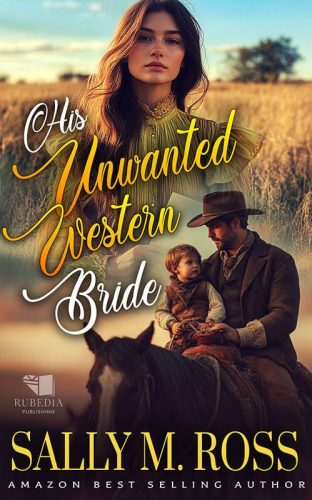
His Unwanted Western Bride
“You could’ve sent me away.”
“I still might,” he says, though his gaze lingers too long to be convincing.
Tess thought she knew what she was agreeing to when she answered a mail-order bride ad. But when she steps off the stagecoach in the dusty Kansas sun, the man waiting for her never sent for a wife at all…
“You weren’t the one who wrote those letters,” she says.
“No,” he says evenly. “Didn’t claim to be. But the deal’s still good if you want it.”
Rhett wanted his solitude. His sister’s plan gave him a wife instead—a stranger meant to help raise his silent son. Love isn’t part of the bargain. But Tess’s gentle courage slips past every wall he’s built, and soon, the one thing he swore off becomes the only thing he can’t ignore…
As the Kansas wind howls and secrets rise from the dust, jealousy and sabotage threaten everything they’ve built. To survive, Tess and Rhett must face the truth about what brought them together—and decide whether love born from chance can become a choice worth fighting for…
A letter unanswered.
A child’s quiet hope.
Two broken souls, one last chance—
to turn a bargain into forever.


Chapter One
Gold Springs, California, 1852
The sharp creak of the front gate jolted Tess upright in bed.
She froze, breath caught in her throat, straining to hear past the wind whining through the gaps in the shutters. The darkness inside the cabin pressed close, heavy as a wool blanket soaked through. For a moment, silence. Then a knock. Not loud, not hurried. Just one, firm rap on the cabin door.
She wrapped her shawl tighter around her shoulders, rising barefoot from the straw mattress. The quilt had slipped off during the night, leaving her cold, and the chill that touched her now wasn’t just from the air. The floor was icy beneath her feet, the wood warped and splintered from years of neglect and damp. She stepped carefully, half from habit, half from the sense that something—someone—might still be waiting.
She paused at the window, fingers lifting the corner of the worn linen curtain. Her hand trembled slightly. Outside, the world was bathed in silver and shadow. Moonlight spilled down the rocky path leading up from the road, illuminating the crude fence and the swaybacked gate swinging lazily on its rusted hinge. Beyond that, the pine trees stood like sentinels, their tall bodies swaying in the breeze.
Nothing moved. Not a soul. But that didn’t ease the tightness in her chest.
Being a woman alone out here, this far from town, this far from help, was something she’d grown used to. But used to didn’t mean safe. She had learned how to make do, how to sleep with one ear open, how to carry herself like she wasn’t afraid. But sometimes, in moments like this, when night pressed in, and shadows crept closer, the truth rose up like water through a cracked floorboard: she was vulnerable.
The kind of vulnerable that some men liked—those they preyed upon.
She let the curtain fall and turned toward the dresser, moving quickly now. Her fingers found the old Colt tucked beneath a stack of linens. It had belonged to her late husband, John. She remembered the way he’d polished it with care, the way it hung on his hip like it belonged there.
It felt strange in her hands. Heavy. Cold.
Tess didn’t know much about guns. John had meant to teach her, had promised to, once things settled. But things never had. He’d shown her how to load it once, years ago, before they even made it to California. Since then, it had sat in the drawer, waiting like so many other things he’d left behind.
She ran her fingers over the metal, breathing in the scent of oil and old iron. Her heart beat faster, not from courage, but from the uncomfortable awareness that if someone came through that door, this gun might be her only defense. And she didn’t even know if the bullets were still good.
But she held it anyway. Because the quiet outside didn’t feel right. Because fear was easier to carry when it had weight and form. Because being alone meant there was no one to stand in front of her but herself.
She stepped back to the door, careful not to let the floorboards groan beneath her. She pressed her ear against the wood.
Still nothing.
Only the faint sound of wind, like someone breathing low and steady just beyond the frame.
She waited. One breath. Two.
Then she turned the bolt and pulled the door open in a single motion, gun trembling slightly in her grip.
Moonlight poured across the threshold, illuminating the empty porch and the shadows that stretched beyond it. No one was there. Only the scent of sage and pine drifted in from the hills, mingling with the ever-present dust and woodsmoke. And then she saw it—a scrap of paper hung from the rusty nail on the doorframe. The ink was smudged, the letters uneven. But she didn’t need to read it twice.
“Time’s up.”
A shiver ran down her spine. Her hands, calloused and cold, trembled as she tore the note down. She stood there a moment longer, the wind tugging at her nightgown, the silence almost mocking. She glanced at the ground below the porch steps, and even in the dim light, she could see the fresh horse-prints in the soft soil.
She closed the door and slid the bolt across.
Her legs buckled under her, and she sat on the edge of the bed. The paper crinkled in her grip. She didn’t cry. She couldn’t. The tears had dried up months ago, leaving behind something brittle and hollow inside her.
Of course—it was William Reily.
William Reily was the proprietor of The Painted Lady, the saloon that bled this town dry. The man, her husband, John, had borrowed money from behind her back. The same man who now thought he owned her because of it.
She remembered the first time she laid eyes on him, nearly six months ago, just weeks after the accident, when grief still blurred the edges of her vision.
She’d gone to town to trade some sewing for flour and tobacco, her mind numb, her body brittle with exhaustion. The sun was low, spilling amber light across the crooked street as she passed the saloon. Its sign, The Painted Lady, hung from rusted chains above the batwing doors, swaying gently in the breeze. The building looked like a half-forgotten stage set—gaudy red trim, cracked windows, and peeling gold lettering that had once promised luxury—now just decay.
But the music from inside was lively, almost too much. A fiddle and a piano competing, laughter, the clink of glass. It was a place meant to distract men from how hard their lives had become.
She’d never been inside the saloon, not until that day.
The clerk at the general store had turned her away. Said John’s credit was no longer good. She’d been confused, humiliated, standing there with her hands full and her cheeks burning. “Maybe ask William Reily,” the clerk had said with a smirk. “Your husband sure did.”
She hadn’t understood what that meant until she walked into The Painted Lady.
The air inside was thick with smoke and perfume. The scent of spilled whiskey clung to the floorboards like a permanent stain. Gas lamps flickered against the walls, casting long shadows. At the far end of the saloon, a woman with rouged cheeks and too-bright eyes leaned against the piano, feigning laughter at something a miner said. Her corset was pulled so tight it looked like she might split down the middle.
Behind the bar stood a man in a dark vest and a smile sharp enough to cut glass.
William Reily.
He didn’t look like a saloon owner. Not at first. He looked like a banker, maybe. His hair was oiled back, and he had a gold chain across his chest that caught the lamplight when he moved. But there was something in his eyes—something calculating. Like he’d already sized her up the moment she walked through the door.
“Tess Carver,” he said before she even reached the bar. “Or should I say Mrs. John Carver?”
She paused. “I was told you might have some knowledge about my husband’s debt.”
“I do,” he said, smiling. “And now, so do you.”
He’d slid a glass of whiskey toward her without asking and leaned across the bar, his voice dropping low and intimate.
“John was a good man,” he said. “Prideful, though. Too proud to admit when things weren’t going his way. Came to me with desperation in his eyes and a ring in his pocket. Said he’d pay me back as soon as he struck gold. He was sure it was just days away.”
Tess’s stomach had twisted. “He never told me.”
“No,” William said softly. “Men rarely do when they’re failing.”
The words stung. Maybe because they were true.
“I’ll pay what I can,” she said. “From my sewing.”
He chuckled at that, a quiet, almost pitying sound. “You’ll never make enough with a needle and thread, sweetheart. Not in a town like this.”
“I’ll find a way,” she said, her spine straightening.
William watched her for a long moment, then stepped out from behind the bar. His boots clicked softly on the hardwood floor as he approached, stopping just short of her. He reached out as if to brush a stray strand of hair from her face. She flinched, and his smile sharpened.
“You’ve got a good face,” he murmured. “Soft voice. Graceful. You’d do well here. Better than you are now.”
She didn’t respond.
“You don’t have to work the floor,” he added. “You could pour drinks. Sing a little. Smile at the men. Just enough to keep them paying.”
Her jaw clenched. “No.”
“You’d be safe,” he said, ignoring her. “Warm. Fed.”
“No,” she said again, louder this time.
His smile faded then, and something meaner crept into his eyes. “Suit yourself. But time’s running out. You’ll be back—when the hunger gets louder than your pride.”
She turned and walked out, the sound of his laughter following her into the dust and heat.
Back in the present, Tess’s fingers curled around the note.
Over the past few months, he had shown up at the cabin every week looking for his money, and he always came with snake smiles and honeyed threats—offering her a place at his bar.
“You’re wasted here,” he’d said, eyes crawling over her like ants. “A pretty face and clever hands like yours could earn a fair sum—quicker than sewing patches for miners, anyhow.”
Each time, she’d slammed the door in his face.
But now—this.
She exhaled slowly and looked around the one-room cabin that had once felt like a promise.
The walls were cracked in the corners, spiderwebbed with age and weather. The fire in the hearth had long gone cold. A few potatoes sat in a wooden crate by the door, shriveled and soft. Her sewing table was cluttered with scraps, half-mended shirts, buttons waiting to be stitched, and thread wound around a spoon because the spindle had broken months ago.
She could see her reflection faintly in the cracked tin mirror above the washbasin. Hollow cheeks. Lips chapped and pale. Her long chestnut hair, once her pride, hung loose and dull down her back. She touched her face absently. Just twenty-three, and she looked older. Not from time, but from wear.
The dress she wore was one she’d mended twice already. The seams at the underarms were thinning again. Her boots, John’s last gift, were split at the toe and lined with wool she’d sewn in herself to keep the rain out.
She used to dream of a home filled with laughter. A garden with squash and tomatoes. A cradle in the corner.
She’d arrived in California with a heart full of fire, sitting beside John in a covered wagon, clutching his hand, eyes full of sky. He was the kind of man who believed in dreams—hers, his, anyone’s. She’d loved him for that.
And she still did, in some way. But love couldn’t patch roofs or chase away hunger. Love hadn’t kept him from going into that mine after his luck had turned. And love hadn’t paid the debt he left behind.
When word came of the cave-in, she’d run the whole mile barefoot, tripping through pine and brush. The foreman had tried to stop her before she saw the body. But it was too late. She remembered the mud on her nightdress. The rain. The smell of blood and rock and old earth.
Since then, every day had been a kind of slow drowning.
She worked. She sewed. She scraped by. That was her life now. Months of waking up early, stitching until her fingers ached, trading shirts and mended trousers for food she could stretch across days. She’d learned how to make soup out of bones and onion peel, how to patch threadbare linens so cleanly it looked like art. She’d learned how to say “I’m fine” with a smile that didn’t quite reach her eyes.
But none of it was living.
It was survival. Bare, raw, day-to-day survival.
Her world had shrunk to the four walls of this crumbling cabin, the same few customers, the sound of the wind pressing through the cracks, and the long, cruel silence that came after dark. Sometimes she wondered if she’d already disappeared. If the version of her who laughed with John in the wagon, who imagined a warm kitchen and a baby on her hip, had quietly withered away while she stitched strangers’ names into their collars.
Maybe she had.
Some days, she forgot the sound of her own voice.
Other days, she wished she could forget the sound of his—William’s—whispering threats, too smooth, too sure of himself.
“You’ll be back. When the hunger gets louder than your pride.”
She thought about that now, staring at the gun in her lap, the note still clutched in her hand like it might burn through her skin.
Time’s up.
The words seemed to echo in the cabin. In her bones.
Was this over? Was this the end of the fight?
She looked toward the hearth, where only ash remained. Her boots were by the door, cracked and caked in dried mud. Her last loaf of bread was down to crumbs. The debts were still there. The sorrow, too. And the only thing left for her in this town was a collar around her neck, whether sewn in silk or chained behind the saloon.
Chapter Two
Gold Springs, California, 1852
The morning broke gray and brittle, like porcelain waiting to crack.
Tess stood at the washbasin, fingers numbed by cold water as she scrubbed the soot from a dented tin cup. She’d meant to heat the water first, but the kindling was damp, and last night’s fire had died to cold ash. Still, she cleaned. Habit, maybe. Or stubbornness. Some days it was hard to tell the difference.
The floor groaned under her steps as she crossed to the hearth and stirred what little was left in the bottom of the flour sack. Enough for one last biscuit, thin and dry, but it would have to do. She worked the dough quickly, setting it on a flat iron pan over the flame she finally coaxed to life. As it baked, she packed her sewing kit into a satchel. A handful of mended shirts and one patched apron—enough to trade, if she was lucky. If not…
She didn’t let her mind finish that thought.
After dressing in her best blouse, the one with the least visible mending under the arms, she pulled on her faded green skirt and bent to lace her boots. The cracked leather had softened over time, almost shapeless now, and the left sole peeled slightly at the toe. She tied a strip of linen around it, hoping it would hold until she got back.
Breakfast was quick. Half the biscuit and the last of the chicory coffee, weak and lukewarm from yesterday. She ate standing at the door, watching the pale sky lighten with the creeping sun.
She tied her shawl snug around her shoulders, pulled the hood low, and stepped out onto the dirt path, the wind lifting the hem of her skirt as she went.
By the time Tess reached the edge of town, her feet ached. Every stone in the road seemed determined to find the thin spots in her soles, and the chill in the air had wormed through her shawl. She passed dry brush and wagon ruts, a few scattered shacks where miners lived, stacked two or three to a room. Some were already up, crouched around smoky fires, rubbing their hands and muttering about the weather, the gold, the ache in their backs.
Tess kept walking.
Gold Springs wasn’t much of a town, not yet. Just a wide road lined with clapboard buildings, false fronts making them look more important than they were. The church had no bell. The hotel had more rats than guests. And the saloon… well, the saloon was the brightest, busiest place on the street, with red curtains and music leaking out its windows day and night like it was the town’s beating heart.
She saw it before she saw him.
The Painted Lady loomed two buildings down, its front porch crowded with empty barrels and a broken sign swaying above the door. Two men leaned against the rail, laughing low at some joke Tess didn’t want to hear. And there, beside them, stood William Reily, his hands in his pockets, a cigar smoldering between his teeth, smoke curling around his slicked-back hair.
Tess’s breath caught in her throat.
He was talking to a wiry man with sunburnt skin and a pistol strapped low on his hip. Probably one of the men he sent to “collect.” William laughed at something the man said, his head tipping back, white teeth flashing in the morning sun.
She ducked behind a wagon just before he turned.
Her heart pounded in her ears.
She crouched low, her skirts brushing the wheel rim, the scent of horse sweat and old leather thick in her nose. For a moment, she just stayed there, holding her breath, as she pressed herself against the wood.
The fear didn’t surprise her anymore. She’d gotten used to how it lived just beneath her skin, always waiting. But still, it shamed her. She hated hiding. Hated the way her hands trembled—and her knees went weak—the way William had gotten to her—without ever having to touch her.
She knew exactly what he’d say if he saw her.
“Morning, sweetheart. You get my note?”
It was never phrased like a threat. That was his favorite trick. Like he was saving her from the wolves, when he was the wolf himself.
He was still talking, gesturing toward the saloon’s open door. Then, finally, he turned and went inside, his shadow swallowing the threshold as he vanished.
Tess waited a beat longer, then stood. Her legs ached from crouching, and she wiped her palms on her skirt to stop the trembling. She stepped quickly, not quite running, past the saloon, never looking back.
The wind picked up as the morning wore on, kicking up dust in little spirals along the road. Tess pulled her shawl tighter around her shoulders as she approached the general store.
The bell above the door gave a tired jingle as Tess stepped inside. The air was cool and smelled of coffee beans, kerosene, and the faint sweetness of molasses from the open barrel near the counter.
Shelves climbed nearly to the ceiling, crammed with everything a household might need. Tin pails, lamp chimneys, packets of needles, sacks of flour stacked heavy on the floor. Bolts of calico leaned in a neat row along the far wall, colors bright as spring blossoms.
A woman with a baby on her hip lingered there, fingering a length of yellow gingham, while two others bent over the sugar bin, heads close, their whispers carrying more than they meant them to.
Tess kept her eyes low, her shawl pulled close, moving briskly past them. She couldn’t afford to linger among fabrics or dry goods. Not when she was down to the last coins in her purse.
At the counter, Mr. Bates greeted her with his usual politeness. However, his eyes slid past her toward the women by the calico, as if he wished she hadn’t chosen this moment to come in.
“Morning, Mrs. Carver,” Mr. Bates said.
“Good morning,” Tess said. “Just these things, on account, please.”
Mr. Bates looked down, pursing his lips.
“Sorry, Mrs. Carver,” he’d said, not unkindly, but firm. “Can’t carry you any further. Not with times as they are. Best I can do is sell you what you’ve coin for.”
So she’d counted out the last of her money for a half-pound of flour, a scrap of salt pork, and a twist of thread. It was hardly enough to last more than a few days. The sound of the coins clinking against the counter had felt far too loud, a mark of how little she had left.
As she pushed open the door, she caught the glances of two townswomen standing near the bolts of calico inside, their whispers quick to follow her out. Pity was written plain across their faces. Everyone knew.
They knew her husband’s claim had failed. They knew about the debt William Reily still held over her. They knew her boots were cracked, her dress worn thin at the elbows.
She turned left, walking slowly, almost methodically, toward the next building—the dressmaker’s shop.
It was little more than a front room of an old house, with lace curtains in the windows and a small slate sign above the door: Mrs. Bertram’s Stitchery. A row of sun-faded dresses hung in the window display, each one pressed and pinned like it belonged to a better town, a better time.
Tess hesitated before knocking.
Inside, the bell tinkled as the door opened, and the smell of starch and camphor met her nose. Bolts of calico and wool sat stacked on rough wooden shelves. A pair of oil lamps burned low, though it was well past sunrise.
Mrs. Bertram was round-faced, ruddy, and as sharp-eyed as ever. She looked up from her stool behind the cutting table. Her gray hair was coiled into a bun that hadn’t shifted in twenty years.
“Tess Carver,” she said, not unkindly, but without warmth. “What can I do for you?”
Next chapter ...
You just read the first chapters of "His Unwanted Western Bride"!
Are you ready, for an emotional roller-coaster, filled with drama and excitement?
If yes, just click this button to find how the story ends!
cant wait to read the book!!!
can’t wait!
❤️❤️❤️
💕💕💕
Looking forward to the rest of the story A great start to the book.
🥰🥰🥰
Can’t wait for the book!
Hope you enjoyed it, Judy!💖
So looking forward to being able to read this book in its entirety
I hope the full story brought you joy, Vydel!✨
Desperate times calls for desperate measures and she is pretty desperate. Looking forward to see how this progresses.
Hope you enjoyed where the story led, Laurie!💫
Ms Ross your descriptive words painted a very good picture of Tess Carver’s life. I could see it clearly in my mind. I could feel for her. I can’t wait to see how you get her out of the predicament she finds herself in to becoming the unwanted mail order bride. I look forward to reading the rest of your book.
Your words truly touched me, Dawn!💛 I hope Tess’s full journey stayed with you long after the last page✨