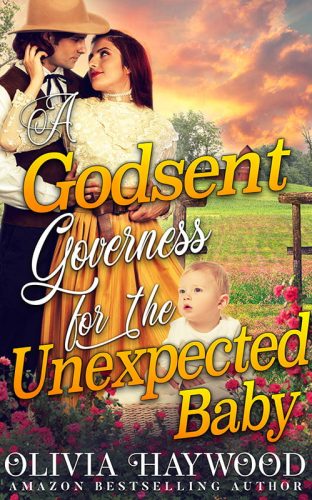
A Godsent Governess for the Unexpected Baby
He needs a governess for a doorstep baby. She follows the path God traced for her. How can they create a family when the odds are against them?
“Through God, all things are possible—no matter how impossible my situation may seem.”
After her heartbreak, Hannah flees West to forget about her past. With the love of God in her heart, she follows her destiny to the door of a grumpy rancher who needs her help. Becoming a governess is something she’s happy to do, but falling in love with the rancher that hires her is totally unexpected. How can she trust God’s will when she is afraid to open her heart again?
When Theodore finds a crying baby on his doorstep, he thinks God mocks him. After losing his wife and daughter two years ago, he isolated himself to his sorrow, and now the little girl brings painful memories again. Asking for a governess is his only solution, but he isn’t expecting to find love again. How can he see that this is his second chance in a family when his past is almost unbearable to handle?
Theodore and Hannah are becoming a family under the oddest circumstances, but when the baby’s siblings come to take her back, they need to fight together. How can they stay strong and follow God’s path when all the odds are against them?


4.3/5 (193 ratings)
Prologue
West Wyoming, 1870
Hannah Booker yawned hard into a deep stretch as she dusted off her boots and stepped into the parlor to look over the letter she had received out of the blue this morning. It arrived in town by way of a courier out east. Her life had its excitements, but a letter from out east was a rare treat. Was it, perhaps, a distant relative? Hannah had long believed that a hard day on the ranch and about town was well punctuated by an occasion to sit and read. She made her way to the table with ponderous excitement pushing her forward.
Life needed moments of rest like these for her; the only woman who worked her own ranch on this prairie in east Wyoming. Hannah knew how she had been described. They called Hannah the slender, fire-haired Sunday school teacher with soft brown eyes to tempt a sinful soul. Hardly how a rancher and true Christian woman wishes to be perceived.
Personally, Hannah shrunk from such remarks—humility being a goodly virtue. Still, she did her best to lead a good life. Hannah knew everyone in Sundance, and they had seen her do her honest best, despite all naysayers who felt she was a wanton woman and unladylike, merely by virtue of being unmarried and running a ranch. She was on a first-name basis with all her hands, none of whom had first expected to be working wholly under a woman.
Before, she might have split her attention between more than just the ranch and church. But ever since losing her father, she had been throwing herself into her work.
And into her relationship with Charles, the dashing lion-maned blonde ranch hand from out east who had entered a gentle, chaste courtship with her shortly after he arrived to work on her ranch. Charles’ easy charm and smooth talking had beckoned to her after the light of her life dimmed with the loss of her father. He’d taught her to ride, to ranch, and to shoot. He had also taught her to pray and place her faith in God.
She knew what the nattering busybodies said: that he’d raised her uncouth for want of a son to show his manly trades. But to her, it was just how she and Papa spent time together. Now, there was another man in her life that she could share this passion with.
She had a new garden, a budding romance—but, just like Eve in the garden of Eden, a snake was creeping up her arm as she looked down at the letter in her hand, set to poison this new life with Charles she pined for before it had even begun.
Hannah’s hands were cold as ice as her heart stopped, eyes racing down every word of the letter. Her soul careened through the storm clouds that darkened her gaze even as the warm Wyoming sun beamed down through the hickory framed windows into the parlor. A refined lacquered wooden table beneath her was spread with a brilliant white cloth, the shadow of the cross beams spreading the glass outlining the trinity before her even as her world was consumed by darkness.
She remembered the first time she folded that cloth. Charles’s strong, reassuring hands had helped her. How she had sodden it with her tears remembering joyful dinners with her family, the father she’d never laugh with again in this world. Charles Greer and his golden hair and barrel arms, his deep green emerald eyes burning out from a lion’s frame, was there to comfort her. He became her protector, her savior, her confidant.
This letter had seemed so promising, a quaint surprise to tell him about in their nightly ritual of catching up after a long day’s work while she fixed supper.
The words lit a cold fire in Hannah Booker. A cold fire that spread into an icy inferno as she crumpled the letter. She only waited a moment after finishing the missive before dropping the terrible, venomous words of truth to the ground. Then, she rushed for the door. She threw aside the curved, full saloon doors, carved with an angel holding the horns of a bull, and stormed out into the sun.
“CHARLES!” she screamed, her voice all wrath and thunder.
Dear Miss Booker, the lines burned behind her eyes as she walked down the path to the lane and through the opened gate. Her body heaved in the sun, and it shone like the fires of judgment in a dead heat you couldn’t help but sweat in. Each stride felt like her feet merged with the clay ground like her body was a sack of lead.
I am writing to inform you about Charles Greer, the words were so casual, as though an afternoon tea-time assassin of British candor and big city refinement had written to her. She crossed the short scrub, golden fields, and mellow rolling hills splayed out over the tranquil Wyoming horizon as the prairie reared its beautiful mane in the light of a terribly glorious day.
Whom you have been courting for some time now. For some time, indeed. She couldn’t escape the words as she approached the bright red barn door she’d opened and closed so many times, the stalls she’d mucked, the horses she’d fed and brushed, the fields of cattle she’d helped run.
She could hear him talking to someone inside, probably another farmhand.
“CHARLES! Come out here right now!” Hannah was not waiting for Charles to emerge, though. She barreled through the doors and caught sight of the tight-cropped blonde frame of his hair and beard turning promptly to face her, green eyes shining with a casual look of disconcern as he nodded to her. He had a long, green-yellow reed in the corner of his mouth and was talking to the six-foot-six Beckett, the other main hand on the ranch beside herself.
“I’ll be in in a—” her blood boiled so fast she overflowed. It didn’t matter Beckett would see, that the horses all around them could get spooked, that Beckett was holding the reigns on Chestnut who he’d just brought in, a proud and brilliant burgundy-coated mammoth to match the hand himself. It didn’t matter how brilliant this man she’d pined for, swooned for, and prayed for looked, framed against the horizon through the far barn doors which opened to the grass sea beyond. The fateful words of the letter revealing Charles’ betrayal were seared into her soul.
Is, in fact, my lawfully wedded husband.
The presence of others, the thought that they’d probably all just come inside the barn, was all swept away as the fury rose within Hannah’s lungs.
“You rake! You scoundrel! You’ve a wife and a family back east and you, just what, strung me along like some loose, kept woman? You think you can just treat me like a harlot and I won’t find out? This is the biggest disgrace in the whole of Green River history! Did you think to forge a bigamist’s life in the age of the pony express? We’re modern now, and you’re—!”
In her blind rage, Hannah had neglected more than the mere presence of Beckett. Every farm hand was inside the barn. They had been tending to saddles and tackle in the tack room or off shoveling hay and she’d not noticed them as they all peered in at the grim business transpiring.
Beckett, for his part, had put away Chestnut and was trying to, rather comically, make himself scarce behind the thin beams and narrow bars across the stalls, a Goliath in flight from the fury of a woman scorned.
Charles just stood there, his lion mane outlining his brilliant face, his form heavy with unease yet the spitting image of a motionless statue. He was like a too-perfect stone statue, who she had dreamed of one day seeing drop to one knee and propose to her. Their courtship had never escalated to anything beyond words, but his betrayal stung nonetheless.
Yet, with eye after eye turning to her, it was as if she was turning into a pillar of stone—a sense she was somehow in the wrong creeping up on her.
“Hannah, I…” he held up a hand and looked for all the world at that moment, wooden, like a mannequin. She had been deceived to imagine him the proper man to restore her family life, she had let him fill the void the loss of her father had brought about utterly undeservedly.
She didn’t need to see or hear more of him ever again. Flush with embarrassment and rage, cold fire gone to red humiliation, she turned and marched away in a flurry of dirt and straw. The words of the letter still ran through her mind.
I regret to inform you of this wretched deed, but I hoped to spare you the full shame of my circumstance. To think that my husband has courted another woman while writing so faithfully to tell me how he pines for me is its own tortuous existence. I pray this letter reaches you in good health and without his advances having gone even further than I have heard from afar.
But the worst words were the ending:
May God forgive us all,
Eliza Greer.
“Why do I need forgiveness? It’s his fault, his—!” She fell to one knee and struck the earth with a clenched fist as she heard the rolling of doors from the barn and the baying of horses. The herd of cattle was in the distance, well penned, and their braying was as a chorus of angels. Because at least they were not looking upon her with judgment. By this time tomorrow, the whole of town would know of this duplicitous affair, she was certain, and that she’d been made a fool.
She looked at the brilliant sun over the horizon and the distant hills and wondered idly, might God send me to build my city upon a hill elsewhere? But it was too terrible a thought, her heart was too full of sorrow and her face too flushed with indignation to think on it further.
The rest of the day’s affairs were seen to in sullen silence as tears ran down her cheeks again, red hot as the scar of her father’s death scabbed and broke upon under the cut of Charles’s deception. She refused at all times to even be in the same room as him. She was just as qualified a rancher as he, and so too were the others who now kept their distance—though she saw them conspire a time or two with Charles before turning their gaze to see her and walk away with a deep tip of their ten-gallon hats.
This is my ranch, and I’m the pariah? she thought with scorn.
The long shadow of the barn grew into a lumbering tower over the grass as afternoon gave way to evening, and evening surrendered to the night. All the while, Hannah’s heart was heavy as a stone in her chest.
With her work done and the stable empty, she quietly trod back over the grass, the swinging scrub twisting before each step, her body an unbound strand of a string compared to the tightly taut bowstring of her last march to the big red structure. Its arch formed a strident steeple overhead as she slid below the doors, dutifully sliding them back into place. The dark barn’s cool air was thick and its scent was pungent. Chestnut whinnied, and she approached the brilliant creature through the metal narrow bars girding the upper half of her stall.
With the grace and poise of the Holy Spirit, she glid to the tack room, took down a fine brush, and returned to Chestnut’s stall. She opened it up and entered the freshly mucked stall, there was just dirt and a bit of straw with some water to drink. Chestnut threw back her head and tail. She was a big, powerful creature. Beckett made her look normal in comparison, but to Hannah, a slender woman, Chestnut was a giant among mares. She approached with an open hand and kind lean to the familiar warmth of Chestnut’s brilliant mane.
“Oh, Chestnut. How cruel the day has been.” Her horse offered a kind, dark orb in the night by way of her gaze. It was as though her pupil was pouring out attention to her sorrows that Hannah so sorely needed. “I suppose I should be thankful that I have the time to count my sorrows.”
In the dark, she worked slowly, feeling through Chestnut’s long beautiful mane and brushing through it strand by strand. The dirt of the road and flakes of hay had infested it, and clearly, she had not received all the post-ride attention she deserved. Hannah poured herself into the work as she considered the tribulations she too had faced—not for want of attention but from ill-directed attention.
The attention of another woman’s husband that had fallen upon her had tangled the mane of her spirit. How could she face the Reverend on Sunday, much less God in prayer, having sinned so? Even if out of ignorance, she had tempted another woman’s husband.
“I’ll simply have to pray for her and put one foot before the other. There’s no sense in dwelling overlong on such matters.” She spoke very much to herself, needing sorely to hear any words of sense.
To clear her head and soothe her troubled soul’s many questions, she stroked her dear Chestnut, returned to the tack room, and had the horse ready to ride in short order. With a stout, red-brown leather saddle atop the horse, Hannah pulled herself up and gave her a gentle click. She knew if she dug in her heels Chestnut would bolt, so sensitive was she to her training in that regard.
A flick or a tightening of the reins here or there, a minor nudge to either side, controlled her with ease. Some of the hands took a while to get used to Chestnut, and Adam had been thrown from her on his first ride on the “giant beast” as he termed her.
But with a skilled hand at the ripe old age of twenty, Hannah pulled into the second decade of her life with heartbreak upon her soul and a horse beneath her legs. When she was finally clear of the fence she gave a spirited “hyah!” and dug in her heels. No spurs needed—Chestnut broke into a dead bolt, and Hannah leaned in to let the air ripple across her hair and let Chestnut’s mane flap about by her face.
“Just you and me, Chestnut. You, me, God, and the city upon the hill we’re riding for out here.”
Hannah leaned into the horizon. Into the promise dying in the sunset. Toward the gently rolling hills catching the final beams of day’s light. That was what was riding toward.
No longer was she feeling cold rage. No longer did the fire burn. She was neither warm nor cold, no matter what the hair on the back of her neck or sweat pooling on her hands said. She was a rancher, and like the best of them, would take this in stoic stride. As her father had taught her, so would she do.
The ride took her to the creek at the edge of the ranch. She rode with one leg to either side, something that oft set the tongues wagging of those deeming it ‘unladylike’. She could feel the full buck and speed of her mount below her. A veritable little forest ran along either side, with many easy crossings and a low burbling stream between heavy set rocks, fallen logs, and a sliver of water a few inches deep yet running through.
The creek was low, and the rain had been faint. The grass was starting to show strain, and Hannah felt plunged now into a drought of her own. One that had, perhaps, lasted longer than she first realized. How long since I have known rain? The thought stung.
But the rain always comes, she thought, smiling a sad smile to herself. And so the water came—as tears flooded her eyes—and the last feeling she could muster was an odd relief. She felt as though events were beyond her now, and yet she had faith that she was in good hands.
Chapter One
West Wyoming, 1870
Hannah brushed the final strand of her long red hair and got up to leave. As she was sidling out the door, her skirt caught just a bit on the carving of the bull’s horns grasped by the angel. It kicked up to show her trousers below, mannish attire in the eyes of the town to be sure. She grimaced and worked it free, careful not to tear anything. She stepped out heading toward the town’s dusty main drag.
Just over a month ago, the tumultuous storm of Charles Greer’s inequity toward her had seared a hole in her heart. She walked upright but her spirit yet limped from the wound. Her smile did not crest her cheeks and she held her head low as she made her way through town. While she wanted to stay at home, she knew she couldn’t hide away from town any longer. She had even skipped church a few times, unthinkable before the incident.
What’s father thinking up there? She thought, turning her head past the wooden boarded siding and clear windows of the leaned-together town buildings rimming the main walk. Pa taught me to take pride in my work, and myself. I won’t hand my head over the wrongs of another. I have done everything right with my conscience. She reassured herself, and let her reasoning blossom across her body and strengthen her stance. With head held high, she made for the general store with renewed vigor.
But, as she walked by the tilting timbers of the two and even three-story buildings, stacked deep in the town’s heart, she heard talk through the windows. Eyes turned to her, ladies tossing their water and heading to draw from the well gawked, alongside children and grown men. She felt their gazes upon her but did not lower her brow.
She did not deviate from her course until she overheard a certain too-loud whisper saying, “and I’m sure she’s with child. What type of life that Greer child can expect to have, born from a fallen former Sunday school teacher, I cannot venture to say. Oh hadn’t you heard? The Reverend is certainly telling her that her voluntary services are no longer required. After all those ‘services’ she gave to Charles, how could I let my children have anything to do with her? How’s she supposed to teach anyone about the Bible and being a good Christian when she’s living in sin?”
Hannah had hardly produced cause for true blame. Physically, she had little more than brushed hands with the man. Mentally, she’d dreamed of their future together, to be sure. She had always wanted to meet the relatives he’d told her about in the east. Now she knew why he’d so long demurred writing to them about her.
What a fool I was, she thought, and now these lies about me spread like a prairie fire.
Hannah’s path drifted a bit at that. Her eye twitched. Her anger snapped up like a whip. But she kept her eyes forward for the moment.
“Oh, Hannah,” a voice called from across the street. It shot across her shoulders and through her brain like a lightning bolt, faux sympathy, and interest dampening the air. Hannah did not need to turn to know who called to her there in the street, before the full light of God’s day.
“How good to see you out and about again.” There she stood, Josephine Peck, comely homemaker, and town gossip. It’s a good thing she leaned into the name Peck, thought Hannah as she turned to look at her too-talkative neighbor. She must live up to it every day—pecking her way down to new lows as she pecks at the nerves and moral fiber of anyone in pecking range.
As surely as night turned to day, Josephine was a beautiful woman. Her hair was a stately brown with just the right amount of curl to cascade across her shoulders like a waterfall, and her eyes the piercing icy blue of winter. Her face filled out like a heart and her skirts and blouse were often a brilliant hue of white with an accompanying fashionable coat to complement. Today it was green, and she wore it like envy itself.
She was into her thirties, with three children at home and a husband of good fortune and upstanding moral character. Upstanding moral character yet he stayed his tongue in any affair his wife cared to indulge in. With the certainty of a compass facing north, Josephine was certain to sniff out the affairs of others with a bloodhound’s nose—but more certain was her ferocity.
So vicious were her words that the wolves themselves had surely howled in chorus to salute the birth of their next prime huntress the miserable day Josephine was born. She displayed this ferocity every day she backhandedly savaged the affairs of others, often to their very face.
As with any good Greek tragedian, she was accompanied by a chorus; not of angels, but of two other women about town, Greta and Alicia.
“I’m just headed to the store, Josephine. None too good or bad about that.”
“Oh, indeed, but dear,” Josephine added, with a knowing full body tilt look to her two conspirators, “we’ve all been talking about the terrible matter with Mr. Greer. That he would so sully our Sunday school teacher is truly unconscionable. Tell me, dear,” she reduced her voice to a faux whisper that cast halfway across the street. Hannah spread her feet and steeled herself so that she would not be tempted to advance and toss her over. “What was your relationship with Charles like? Given what we’d heard, I had grown worried you might have made an ill decision on the faint promises of a duplicitous man. After all, you spent so very much time together on that ranch you run all on your lonesome, so very often alone together we hear—“
Hannah was simply not going to take any more of this foolish tongue-wagging, she decided as the women with self-satisfied smiles feigned concern that couldn’t hide their grins. Josephine was a filthier rake than perhaps even Charles himself.
“Oh, Josephine, must you make everyone’s affairs your own business? I have kept well enough alone and told nothing but the truth. It does you no credit to repeat words you know are not true.” Hannah’s fist nearly clenched, but she managed to take a deep breath and sort through the haze of her impulses. She would not fly off the handle once more as she had at Charles in the barn. Josephine’s hangers-on physically leaned in to cling to her, some nearby men pausing to see if the scuffle would escalate. Some children watched and one boy went so far as to holler “tell ‘er Miss Brooks!” That was the troublesome Timmothy Tookes, thrilled to see his Sunday school teacher dress down another woman in the street. The boy seemed delighted at the raucous display in the streets, but Hannah was deeply dismayed. Hannah’s face was like a cauldron—sorrow and rage sought to bubble up to the surface, and she forced them down with a fidget and a pout.
If she was qualified to teach scripture before, clearly she wasn’t now. It did not matter she had maintained her chaste and righteous ways. If the town believes it, who will trouble to learn the truth? It’s far less inviting than Josephine’s fake smiles and honeyed lies.
“Hannah, control yourself! There are children around! Think of the example you’re setting!” Josephine was a poor actor, and she couldn’t help the half chuckle that seeped into her forced shock. She knew Hannah would never lay hands on her.
Hannah just barely kept herself from throwing a rude hand gesture as she tossed an acrid:
“Bless your heart!” that splashed over Josephine’s cold, steel heart with barely a sizzle.
Without another word she turned on her heel and marched away, leaving a gobsmacked Josephine staring after her. For the rest of the walk to the farm store, Hannah was in a huff. Shoulders hunched and back tight, she came before the glass windowed, peeling dull brown wood paneled awning of the farm store. The sign above bore the legend “SERENITY’S SUNDRIES,” so named for the first daughter born to the store owner when he arrived in town a few years ago. The old farm store had burned down the month prior and the merchant had gone to God amidst the chaos of falling beams and blaze.
He had died just ahead of the arrival of his cousin. The man was distraught to learn that his kin had perished before they could be reunited. He arrived with nothing to his name, fleeing the devastation of the war that had swallowed all his properties in the flames.
Despite the loss of his old life behind him and the promise of his new one burned up in smoke ahead of him, he took solace in the joy brought by the birth of his daughter shortly after he arrived in town. And so it was that the good Reverend, Frank Byrd, had gathered the good folk of the town at her christening and bid them to help in the raising of a new store. It was usually a calm place for Hannah, a reminder of tragedy but also of grace.
Now, it was just a place to see and be seen, and she wanted neither. She held her head low again and shuffled about for the few groceries she cared to buy, a few greens, and some flour for cooking. There had been simple meals since that rake Charles’s poor wife had informed her of the wretched truth. She no longer had anyone to share them with, as she had with her father and then Charles.
Laden with groceries, she took the back way out. Hannah was swiftly outside, then upon the back paths. She gave herself a little distance from the main street that made up every business one could shop at in the pleasant town of Green River, and tried to lose herself in the tallest grass her skirt would allow without great worry.
She returned to the ranch downtrodden. There was nothing to do but sigh deeply into the foyer, stretch, and set about her day’s work. There was much to be done, and the hands had given her an awkward distance beyond the necessary.
With wood and hammer in hand, she headed out to fix a broken post that needed mending, telling herself it’d be a half-hour job at most. A few hours later, she came back in with the sunset, after realizing an entire acre’s worth of fencing could easily give way in a bad enough wind storm—letting the goats go free. They brayed at her as she returned to her home, plopped down into her bed, and let sleep take her away from her miserable loneliness.
***
The face before her shone like white gold, a man of light, hardening and swirling at a moment’s notice into the chiseled carpenter’s tanned brow. It was tanned like Hannah’s, but deeper. But Hannah did not see the face amidst the flowing hair with her own eyes.
Here, holding a jug of water and pouring it out for the sick family who had come seeking healing, she was Mary Magdalene. Sandals on her feet, a simple dress, she trudged along over palm and desert alike at Christ’s side. The whispers and the accusations did not matter now, the misunderstandings and the implications, the rumors were nothing with Jesus beside her.
The hands of Jesus healed the sick, stayed the weeping of the sorrowful, softened the hearts of the sinners, and brought into righteousness the wicked ways of tax collectors and liars alike. Through the valley and out onto a plateau she walked, the world around them, as though the cities and the hosts of the world were all within view and the horizon filled to the bursting point with the people of the world awaiting Jesus. Jesus turned to her and his face was a blazing holy fire. His eyes were alight with a divine radiance that filled her soul and uplifted her. His mouth opened to speak—and his hand rose to point. There on the horizon, she saw it.
The hill that would host the city. Distant, rolling across gorgeous grass.
To the west.
Next chapter ...
You just read the first chapters of "A Godsent Governess for the Unexpected Baby"!
Are you ready, for an emotional roller-coaster, filled with drama and excitement?
If yes, just click this button to find how the story ends!
It’s very difficult to stand up right when rumors and lies tinted our lives, and sometimes people just believe them in orden to hide their own fault, even when they know were the true was… it’s good to know that we have a God who knows everything, the truth and the lies.
Looking forward to read the full book.
Thank you for your comment, Aracelis! I’m glad that you find comfort in knowing that God knows the truth, and I hope you enjoy reading the full book. God bless you!🙏
I love it so far. Good descriptions of the ranch, and of the town. Can’t wait to read more.
Thank you Rita! God bless you!🙏
When is it due out?