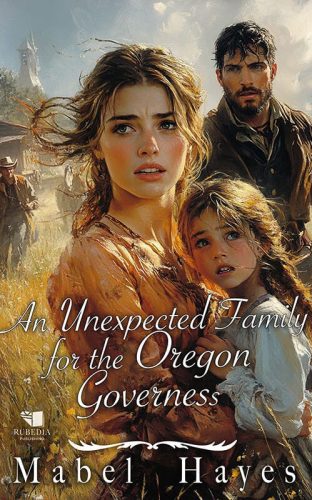
An Unexpected Family for the Oregon Governess
“Don’t mistake my name for my heart, Rose. I’m an ex-convict, not a husband.”
“Then stop acting like a man who would burn this whole town down just to keep me safe.”
Rose Montgomery is a governess bound by a promise. Haunted by a past accident and a debt of guilt she can never repay, she has dedicated her life to the two orphaned children in her care. But as the iron-fisted Father Elias tightens his grip on Pine Hollow, Rose’s status as a single woman leaves her powerless to protect them. She needs a miracle, or a name, to shield the children from a life of exploitation in the logging camps. Even if that name belongs to a stranger.
Nathan Briggs returned to Oregon seeking nothing but silence and the familiar dirt of his ranch. A man forged by three years in prison and a lifetime of hard choices, he didn’t expect to find his best friend dead and a defiant, beautiful governess standing guard over the ruins. To save the kids, he must do the one thing he swore he’d never do: let someone in.
As their “fake” family begins to feel dangerously real, danger follows the two children they swore to protect. When the shadows of the past collide with the dangers of the present, can a marriage born of necessity survive the truth of their hearts?


4.6/5 (333 ratings)
Prologue
Pine Hollow, Oregon
Spring 1868
The wood looked too heavy for the boy.
Sam noticed it from halfway across the yard, long before anyone else bothered to pay him any mind. The stack wavered in the boy’s arms, unevenly piled, the top pieces shifting with every careful move. It was the kind of load that demanded balance and strength both, and the boy had only one of those, if that.
Still, he wouldn’t stop.
He carried it with a kind of quiet resolve, shoulders drawn tight with effort. His jaw set as if bracing against something far greater than the weight of the wood. He didn’t look around for help or approval. Only forward movement. Only the task.
Sam adjusted the bundle in his own arms and kept walking, though his attention lingered.
The yard pulsed with its usual rhythm. Axes split timber in sharp, echoing strikes. Men called out to one another, their voices roughened by dust and long hours. Wagon wheels creaked under heavy loads, readying for the road into town. It was a place built through hard work and endurance. There was no time for anything that didn’t prove useful.
Boys like the one he watched, quiet, slight, easily overlooked, rarely lasted long without learning how to fight for their place.
This one hadn’t learned that yet.
He kept to the edges, near the far fence where the work thinned out just enough to leave him exposed in a different way. He wasn’t trusted with anything important, but still expected to keep up. There was something in the way he held himself that spoke of carefulness rather than ease, as if every movement had been considered before it was made.
Sam had seen him before.
He was always alone. Always watching with a guarded quietness.
Sam slowed his pace without meaning to.
It was then he noticed the others.
A group of older boys drifted toward the fence, their presence marked less by where they stood and more by the space they claimed around them. Their laughter cut through the yard’s noise with a sharp edge, careless and confident, the kind that came from knowing exactly how much they could get away with.
Sam’s grip tightened around his bundle.
He didn’t need to hear what they were saying.
The first shove came quickly, almost lazily, as though it required no effort at all.
The smaller boy staggered, his foot catching against uneven ground. The wood slipped from his arms, crashing to the ground in a rough scatter, pieces rolling in different directions.
For a brief moment, the world seemed to hold its breath.
Then the laughter rose, louder this time.
The boy dropped to his knees without hesitation.
He reached for the nearest log, his movements steady despite the fall, as if the interruption meant nothing more than extra work. One piece, then another. He gathered them with quiet focus, rebuilding what had been knocked down without so much as looking at the boys who stood over him.
As though their presence carried no weight at all.
A boot lashed out, striking the pile.
The wood scattered again.
Sam’s chest grew tight, like a knot being pulled too tight.
Another kick followed, sending a log skidding across the dirt. One of the boys said something under his breath, words that drew more laughter, but Sam didn’t need to hear. He’d known boys like them his whole life. He had known what they found amusing.
The boy kept going with an admirable persistence.
Sam let his own bundle drop.
The sound carried differently than the others, heavier, more deliberate, and it cut through the laughter just enough to draw attention. A few heads turned. Not all of them, but enough.
He crossed the yard with measured steps.
There was no need to rush. He didn’t need to announce himself. Presence, when it was intense enough, did the work on its own.
By the time Sam reached them, their easy confidence had already begun to falter.
Sam stepped forward and placed himself between the boy and the others, his stance easy but firm. He didn’t look down at the boy, and didn’t check if he was all right. That could come later. What mattered now was the space he created.
The laughter faltered.
Up close, the older boys seemed smaller somehow, their confidence thinning under direct attention. One shifted his weight. Another glanced toward the men farther off, as if weighing the risk of being seen. The balance had changed, and they could feel it.
Sam met their eyes one by one.
He said nothing.
Silence, when held long enough, had a way of pressing harder than words ever could.
The moment stretched.
Then one of them scoffed, the sound weaker than before, and stepped back. Another followed, their retreat unfolding in small, reluctant movements until the group broke apart entirely, their muttered remarks fading into the general noise of the yard.
Sam didn’t turn until they were gone.
Behind him, the boy remained on his knees, reaching for a piece of wood just beyond his fingertips. His hands were scraped raw, dirt ground into his skin, but he moved as though he barely noticed.
As though this, too, was expected.
Sam crouched beside him.
For a moment, neither of them spoke.
Then Sam reached for a log and placed it carefully onto the forming pile.
Another followed.
Then another.
The rhythm settled between them, simple and steady, a quiet kind of work that asked for nothing beyond what it was.
The boy hesitated at first.
Sam could feel it without looking. The pause, the uncertainty, the instinct to measure intent before accepting it. Then, slowly, he joined in, adding his own pieces to the stack.
They worked side by side in silence.
It didn’t take long.
When the pile stood solid again, Sam leaned back slightly, brushing the dust from his hands. He studied the boy then, taking in the sharp green of his eyes, the guarded set of his shoulders, the way he seemed ready to disappear the moment the atmosphere shifted again.
Sam offered a small, easy smile. “I’m Sam.”
The boy stilled, as though the words had caught him off guard.
For a moment, it seemed he might keep his name to himself.
Then, quietly…
“Nathan.”
It came out carefully, almost reluctantly, like something that had been protected for a long time.
“Well, Nathan,” Sam said, rising to his feet and extending his hand, “you want to be friends?”
Nathan’s gaze dropped to his hand.
Suspicion flickered there, quick and instinctive. Hesitation followed close behind, along with a look that spoke of lessons learned the hard way.
Time stretched between them, thin but unbroken.
Then, slowly, Nathan reached out.
His hand was smaller than Sam’s, roughened by work and uncertainty, but he didn’t pull away once their fingers met.
And this time, he stayed.
Chapter One
Pine Hollow, Oregon
Spring 1868
By the time Nathan Briggs saw the weathered sign for Pine Hollow, his collar felt too tight.
He reached up and loosened it with two fingers, though the afternoon air was already cool enough to raise a chill along the exposed skin of his neck. The road had narrowed into a ribbon of packed earth bordered by dark pines and damp brush, and the farther he rode, the more the forest seemed to close in around him. It was as if the town had hidden itself from the rest of the world and intended to stay that way.
Six years.
Six years since he’d last come down this road with mud on his boots, blood on his knuckles, and a future that looked no better than the ditch beside him. He’d left in chains, then later by train, after prison had wrung him dry.
San Francisco had taught him how to stand straight, speak properly, and wear a clean coat without looking as though he’d stolen it. He had done all of that. Learned the manners. Learned the business. Learned how to disappear inside a respectable life.
Yet the moment the town sign came into view, none of it seemed to matter.
Pine Hollow still knew exactly who he had been.
His horse shifted beneath him, impatient from the long ride. Nathan patted the animal’s neck once, more to settle himself than the gelding. He kept his gaze forward and urged the horse on.
The first buildings emerged through the trees one by one, rough-hewn and familiar. The blacksmith’s shop. The general store with its porch slanting slightly from age and weather. The church steeple rose above the rooftops like a pointed finger. Smoke curled from chimneys into a sky gone gray with low clouds, and somewhere in the distance a saw bit into timber with a drawn-out groan that took him back so sharply he nearly flinched.
Nothing had changed, and yet, everything had.
A wagon rattled past, and the man driving gave Nathan only a passing glance at first. Then he looked again. His face shifted. Recognition spread slowly, followed by something less easy to name.
Nathan knew that look.
He’d seen versions of it before, in courtrooms, in prison yards, in city streets where a man thought he had outrun his history until someone spoke his name in the wrong tone.
The wagon rolled on.
Nathan kept riding.
By the time he reached the center of town, he could feel the change in the air around him. Conversation didn’t stop entirely, but it bent. Voices lowered. A pair of men outside the mercantile paused long enough to watch him pass, one of them nudging the other with his elbow. A woman gathering parcels from the shopkeeper’s counter glanced up, then quickly away. Two boys on the boardwalk stared openly until an older woman caught them by the shoulders and turned them around.
He did not need to hear the murmurs to know what they were.
Nathan Briggs.
Back again.
The one who ran with the Carter Gang.
The one who went to prison.
The one who brought trouble wherever he went.
His jaw clenched.
He’d told himself the ride here was for Sam. For the ranch. For unfinished business and land that still carried both their names, if not on paper, then somewhere deeper. He’d told himself that he would come, see matters settled, and decide what was left to do.
He hadn’t thought too long about the children.
Sam’s children.
He’d barely let himself think about Sam at all, because every time he did, he saw the same thing: a folded letter in a foreman’s rough hand, words too blunt to soften the blow, and the sickening knowledge that he’d stayed away too long.
Sam and Sarah are dead.
For three days after receiving the letter in San Francisco, Nathan had gone through the motions of his work as if his body could move separately from the rest of him. He’d stood behind a polished counter, spoken politely to customers, counted invoices, written figures in a careful hand, and all the while he had felt the old life dragging him westward with a force stronger than reason. On the fourth day, he’d quit. On the fifth, he’d packed. By the sixth, he’d been on the road.
Too late, all the same.
He guided the horse past the church. Its white paint had peeled more than he had remembered. A handful of townsfolk stood near the steps, and though no one addressed him, he felt their eyes settle heavily between his shoulders.
A cold wind moved down the street, carrying the scent of wet earth and pine sap. Nathan glanced toward the western ridge, where a bank of darker clouds gathered in a long, bruised line above the trees. Storm weather. The kind that started with a hush and ended with broken branches and roof leaks if a man failed to prepare for it in time.
He pulled his gaze away and continued on.
Once he left the center of town, the road widened, and the sounds of other people began to fade. That should have eased him. It didn’t. If anything, the quiet gave his thoughts too much room.
He passed the old Miller place first, then the sloping pasture that had belonged to the Bentons for as long as he could remember. Finally, the land opened into something achingly familiar: stretches of rough grass, split rail fences, the outline of the barn against the horizon, and the house beyond it.
Their house.
Sam’s laugh hit him so suddenly in memory that Nathan drew breath through his teeth.
He saw the place as it had been when they first bought the land, half wild and wholly impractical, nothing but possibility and bad fencing. Two fools with more grit than money, standing in ankle-deep mud and swearing they would make something of it. Sam had grinned like a man holding the world in his hands. Nathan had believed him, because Sam had always been the kind of man who made belief feel simple.
Now, there was no one standing in the yard waiting for him. No broad wave from the porch. No familiar voice calling his name. Only the wind in the grass and a gate hanging crooked on one hinge.
Nathan slowed his horse.
He took in the house with a hard, careful look. The porch steps needed work. One shutter banged lightly in the wind. A thin tendril of smoke rose from the chimney. The yard held signs of use but little order, an overturned bucket near the pump, kindling scattered beside the woodpile, a child’s rag doll lying face down in the dirt not ten feet from the porch.
He felt a little sick.
He dismounted, tied the horse near the rail, and stood for a long moment with one gloved hand resting on the saddle. The yard felt wrong. Too still in some places, too neglected in others. It was a home held together by effort alone.
He removed his gloves slowly, tucked them into his coat pocket, and climbed the porch steps.
The door was not fully latched. He could hear noise inside before he touched it.
A child shouting.
Something crashing.
A woman’s voice, strained nearly past civility.
Then a dog barked, sharp and excited, followed by another shriek that sounded young enough to make Nathan’s spine stiffen.
He pushed the door open.
Chaos met him at once.
For a second, he simply stood there, framed in the doorway, taking in a scene so far from the stillness outside that it seemed almost unreal.
The front room looked as though a windstorm had gotten indoors. Mud was tracked across the floor in irregular prints. A chair had been knocked half over near the hearth. Sewing lay spilled from a basket. One curtain hung crooked from where it had evidently been tugged by small, impatient hands. A yellow dog, caked to its belly in mud, tore wildly from one side of the room to the other with what looked like a bootlace hanging from its mouth.
Near the table stood a woman Nathan had never seen before. She held herself as though the house should have obeyed her, if only it possessed any sense at all. She was slight, plainly dressed, and clearly at the end of her patience. Loose wisps of brown hair had escaped whatever arrangement they had begun the day in, and her cheeks were flushed with exertion. One hand was outstretched toward a little girl clutching a doll to her chest, while the other seemed poised to grab either the dog, a plate sliding off the table, or the young boy darting furiously around her with enough energy to break the rest of the furniture before supper.
“Daniel, you will stop this instant—”
“I won’t!” the boy shouted, red-faced and wild-eyed. “It’s my horse! He took it!”
The dog barked and skidded into the chair, knocking it the rest of the way over.
The girl began to cry harder.
Nathan’s gaze snapped to the boy.
Eight, perhaps. Maybe a little older. Dark hair. Thin from growth and grief both. Sam’s eyes, though angrier than he had ever seen them in the man himself.
His throat went dry.
Before he could speak, the woman turned.
She saw him and froze.
For one suspended moment, they only stared at each other.
Her eyes widened first in surprise, then sharpened with instant alarm. Whatever she had expected to find on the threshold, it had not been a broad-shouldered stranger. Never mind one in a city coat and polished boots, with the travel dust of two states still clinging to him and half the room’s disorder reflected in his expression.
Nathan felt her take in his height, his stillness, the dark edge of irritation he had not bothered to hide.
Then her chin lifted.
“If you have come about a debt,” she said, breathless but firm, “you will have to turn around and leave. This is neither the time nor the place.”
Nathan blinked.
The girl hiccupped into her doll. The dog, delighted by the presence of someone new, bounded toward him and planted muddy paws directly on his trousers.
He looked down at the animal in disbelief.
The boy seized the distraction to lunge for something under the table, colliding with the woman’s skirts in the process. She caught herself on the table’s edge, glared at Nathan as though he had personally arranged the whole scene to inconvenience her, and added, “I said leave.”
Nathan peeled the dog off him by the scruff and set it aside with more force than gentleness. “You mistake me, ma’am.”
“I don’t believe I do.”
“I am not here to collect anything.”
“Then why are you standing in my doorway?”
There was enough challenge in the question to set his temper on edge.
Nathan had spent the better part of a week on horseback. Now he walked straight back into a town that remembered every rotten thing he had ever done. As he arrived at the ranch he had once built with his own hands, he found himself greeted by total disorder and a woman speaking to him as though he were some traveling swindler.
His patience wore thin all at once.
“Because,” he snapped, “this is my house.”
Chapter Two
The room fell abruptly still.
Even the dog stopped moving.
The woman’s expression changed, not softening, only shifting, as if she had been given a new problem and liked it no better than the last.
The boy stared at him.
The girl’s crying dwindled into damp little breaths.
Nathan let the words settle, though saying them aloud felt stranger than he had expected. My house. After six years away. After prison, after California, after Sam’s death. The claim sounded harsher than it ought to have, and he knew it. Yet he could not take it back.
The woman’s fingers tightened around the edge of the table. “Your house?”
He removed his hat at last, if only because it seemed ridiculous to remain standing there with it on his head. “Nathan Briggs.”
Recognition didn’t come to her at once. She searched his face, found nothing familiar, then looked past him as if expecting someone else to step forward and explain the matter. No one did.
But the boy…
His expression shifted with mere recognition of a name he had heard before and wished not to know in person.
His small face hardened.
Nathan saw it and nearly flinched. He knew that look. Had seen it before, in men who had already decided what he was.
The woman recovered first. “Nathan Briggs,” she repeated, slower now. “You are Nathan Briggs.”
“Yes.”
The boy’s hands curled into fists.
The woman’s gaze flicked over him again, this time not as a stranger but as a story turned to flesh. Nathan knew that look too. She’d apparently heard enough to fit pieces together now. The name, the rumors, the unwanted arrival.
She straightened. “I see.”
He doubted she did.
The dog took that moment to shake itself, sending dried flecks of mud onto the hem of her skirt. She closed her eyes briefly, as if petitioning heaven for patience.
Nathan glanced around the room again and found fresh irritation rising. “What is happening here?”
The woman’s eyes opened at once, and if he had expected embarrassment, he was disappointed. “At present? I’m attempting to keep this household from collapsing while speaking to a man who walked in unannounced and immediately began making demands.”
“I made no demand.”
“You declared ownership from the doorway.”
“Because it happens to be true.”
“And if I had been alone?”
He frowned. “What?”
“If I had been alone in the house,” she said, stepping toward him now despite the disorder at her back, “with no children here to witness it, would you still think it proper to stride in and announce yourself in that tone?”
Nathan stared at her.
She was not tall. If anything, she had to tilt her chin to look him squarely in the eye. But there was steel in her all the same, and some part of him, an unhelpful, unwilling part, registered that before anything else. He had expected someone worn down by circumstance, perhaps meek with it. Instead, this woman stood in the middle of ruin like a commander refusing defeat.
His annoyance sharpened.
“I was told the ranch was in need of me,” he said.
Her brows rose. “How fortunate for the ranch.”
Before he could answer, the boy darted forward and snatched a carved wooden horse from the dog bed near the hearth. The girl cried out as though the world had ended. The dog barked again and chased after the boy in renewed excitement.
“Daniel!” the woman snapped. “Give that back this instant.”
“No!”
“It is Eliza’s.”
“He broke mine!”
Nathan turned fully to the boy. “Enough.”
The single word cracked through the room more sharply than he intended.
Silence dropped so fast it seemed to strike the floor.
Daniel stopped where he stood, breathing hard, the little horse clenched in one fist. Eliza stared at Nathan with round, wet eyes, her doll pressed beneath her chin. Even the dog backed off two steps.
Nathan realized, too late, what his voice must have sounded like to children already frightened and grieving.
The woman’s expression tightened. “There’s no need to shout.”
He looked at her. “They were shouting already.”
“They are children.”
“They are out of control.”
Color rose in her face. “And you have been in the house less than one minute.”
“Long enough.”
Her eyes flashed. “You know nothing about what this house has endured.”
He almost said, Neither do you. The words made it as far as his teeth before he stopped them. Because that, plainly, was untrue. Whatever else she was, she had been here. She’d stood in this room after the accident, after the burial, after the endless small hours when children woke crying for parents who would never answer.
Still, his temper had found its footing now, and it would not easily lie down.
“If this is how matters have been run,” he said, “it is no wonder the place looks ready to fall apart.”
He shouldn’t have said that.
He knew it at once.
The woman went very still.
Behind her, Daniel’s eyes narrowed with a hostility so sudden and fierce it made him look older than he was. Eliza began to cry again, softer this time, frightened by the strain in the room, even if she could not follow the words.
Nathan had faced armed men with less discomfort than he felt in that moment.
The woman drew a measured breath. “I suggest,” she said, each word precise, “that you step back outside until you have remembered your manners.”
He gave a short, humorless laugh. “My manners?”
“Yes. Those. Unless prison and the city stripped you of them entirely.”
Heat flashed through him.
For half a heartbeat, he was no longer standing in Sam’s front room but back in a cell with fists clenched, hearing another man decide what he was and what he would always remain.
He looked at her, really looked, and saw that she regretted the words almost as soon as she said them, but not enough to retract them.
Good, he thought grimly. At least she had the courage to stand by her insults.
“You have a sharp tongue for a governess,” he said.
Her spine stiffened. “And you have a remarkable talent for making a difficult hour worse.”
A laugh burst from Daniel then, but it held no mirth. “You’re awful.”
Nathan’s attention shifted to the boy.
Daniel lifted his chin, defiant and wounded, and so much like Sam, it hit Nathan harder than any insult the woman had thrown. There was dirt on his cuffs, anger in his posture, and pain beneath all of it so naked that Nathan could scarcely bear to see it.
Awful.
Perhaps the boy was right.
Nathan removed his gloves from his pocket and set them on the sideboard with deliberate care. “I did not come here to quarrel.”
“No?” the woman replied. “You might have fooled me.”
He ignored that. “Where is Walter?”
That, at least, caught her off guard. “At the south pasture, I believe. He was meant to return before supper.”
Nathan nodded once. Walter would know what had happened here, what was expected of him, why no one had thought to warn this woman of his arrival.
The dog nudged his hand with a muddy nose. Nathan frowned at it until it retreated under the table.
He forced himself to speak more evenly. “And you are?”
Surprise crossed her face, as if she had not expected the courtesy after all.
“Rose Montgomery,” she said after a moment. “I was governess to the children before… before the accident.”
Her voice changed slightly on the last words. Softer, though not weaker. Nathan heard the care with which she stepped around grief, as one might avoid rotten boards on a porch one had not yet repaired.
Rose Montgomery.
Next chapter ...
You just read the first chapters of "An Unexpected Family for the Oregon Governess"!
Are you ready, for an emotional roller-coaster, filled with drama and excitement?
If yes, just click this button to find how the story ends!