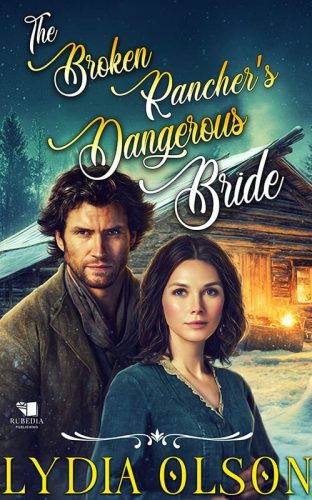
The Broken Rancher's Dangerous Bride
“If I touch you,” he said, low and rough, “I won’t be careful.”
David trusts his land, his rifle, and the distance he keeps from people. Haunted by past bloodshed and betrayal, he believes survival depends on control. A mail-order wife is supposed to bring order to his ranch—not challenge every wall he’s built…
Mabel has survived loss and an orphanage that taught her how to endure without hope. She doesn’t expect love—only safety, stability, and a place to belong…until she meets the man who is supposed to be just her husband in paper…
He leans in, breath hot against her ear. “Tell me to step back.”
Her fingers tighten in his shirt. “Tell yourself.”
But when the past closes in and old rivalries resurface, their fragile marriage becomes a battlefield. Trust may cost them everything… yet without it, they could lose the only family they’ve ever truly known…


Prologue
Deadwood, Dakota Territory
Winter 1875
The scent of coal smoke and wet leather hung thick in the air as Mabel Smith stepped into the courthouse, her boots echoing sharply on the hardwood floor. The morning had brought a sudden frost, turning the horse troughs to ice and dusting the roofs of the town with a pale shimmer. Her fingers, gloveless and pink from the cold, clutched the worn edges of her shawl as if she could hold herself together with nothing but fraying wool.
Deadwood’s modest courthouse was little more than a square building of weathered clapboard and drafty corners, its windows rattling when the wind howled. The pew-like benches were full; shopkeepers, farmers, and townsfolk gathered like they always did when trouble brewed. Everyone knew the Wilson boys.
The judge hadn’t arrived yet. Mabel’s eyes swept the room, landing on George and Peter, flanked by a deputy, their wrists bound with iron cuffs. George stood tall, his jaw clenched in defiance, though the bruising on his cheek from his arrest still showed violet. Peter, slighter and paler, looked as though he might be sick right there on the courtroom floor.
When they saw her, George managed a tired smile. Peter lowered his gaze.
Mabel crossed the aisle and slid into the front row, heart thudding like a war drum in her chest. Her hands, red from the cold, trembled as she folded them in her lap. She could feel every eye on her. The poor orphan girl, standing by the thieves.
Let them stare, she thought.
She didn’t care. She turned her attention back to George and Peter.
These weren’t just friends. No, these boys, no, men now, were her family.
She remembered it like yesterday. The first time she met them. She’d been fourteen, cold and half-starved, standing on the stoop of Saint Agnes Orphanage with a bag of clothes that didn’t belong to her and no name she wanted to claim. Sister Lydia had opened the door, but it was George who’d handed her a crust of bread before she even crossed the threshold.
He was sixteen then, tall and full of mischief. Peter, a year younger, had offered her his blanket that night when the snow blew in through the broken window of the girls’ dormitory. He hadn’t said much, but he didn’t need to. His kindness was steady. Solid.
They weren’t always perfect. None of them were. They fought, they stole, they lied to keep each other safe. But they were loyal. Fiercely loyal. When her nightmares—memories of her father’s fever, the screaming from the foster home that followed—Peter sat beside her until dawn. When a local boy tried to corner her behind the stables, it was George who bloodied his nose.
They were the only ones who knew the truth: that she’d had a father once. That she’d once known love and stories by lamplight. That she wasn’t always an orphan.
But now, now they were shackled. Facing prison. And she was powerless.
A door creaked open, and heavy footsteps thudded across the floor. The sound of boots and the scrape of a chair echoed as Judge Beckett entered. He adjusted his spectacles and surveyed the room with the weariness of a man who had long ago grown tired of seeing boys turn into criminals.
Beckett looked every inch the law. He was stern, graying, with dark brows that cast shadows over his eyes. His black robe was worn and patched at the elbows.
“Court is now in session.”
The murmurs quieted.
The bailiff called the charges.
“George and Peter Wilson, accused of burglary and theft. Breaking and entering of Miss Landry’s bakery on the night of September 28th.”
Miss Landry herself stood to speak, short, plump, with sharp eyes and a kerchief tied under her chin. Her flour-stained hands trembled as she pointed toward the boys.
“I woke that morning to find my back door broken, sack of flour gone, jar of honey, and two loaves I’d set out to cool.” Her voice cracked. “I may be a widow, but I work for every penny I earn. I can’t afford to feed the whole orphanage.”
A few murmurs of agreement rose from the crowd.
Mabel bit her lip so hard she tasted blood.
Deputy Randall stepped forward. “Caught ’em red-handed with the flour still in a satchel. George tried to talk his way out of it. Peter just hung his head.”
The judge looked to the boys.
“You have anything to say for yourselves?” he asked, voice like gravel.
George raised his chin. “We were hungry,” he said. “Not just us. The kids at the orphanage. There ain’t been meat in weeks. Sister Lydia’s tried everything, but donations stopped coming, and the winter’s coming on fast.”
Peter spoke softly. “We weren’t trying to hurt nobody.”
Beckett exhaled long and slow. “You boys have been in this courtroom before. Petty theft. Vandalism. Trespassing. Now burglary. I warned you last time. The town’s patience has worn thin.”
“But Your Honor—” Mabel stood before she realized it, her voice clear and breaking. “They didn’t steal for themselves. They stole for the children.”
Gasps rippled through the courtroom. The judge looked up, annoyed but curious.
“You are?”
“Mabel Smith, sir. From Saint Agnes.”
“You’re not on the docket to speak.”
“No, sir. But someone ought to.”
Beckett studied her. “This isn’t about intentions, Miss Smith. This is about law.”
His gavel struck.
“One year. Territorial prison at Yankton.”
“No,” Mabel whispered.
Peter swayed. George steadied him, chains rattling as he moved.
“You can’t—” She stepped forward. The deputy held up a hand, barring her with a shake of his head.
Her throat closed. She couldn’t breathe. It was happening. They were being taken.
The courtroom erupted in murmurs. Someone in the back muttered about “orphan trash.” Mabel heard it, sharp and mean. She forced herself not to look back. Instead, she rose to her feet and crossed the aisle before anyone could stop her.
The deputy stepped aside, and Mabel threw her arms around George first, burying her face in his shoulder.
“What am I going to do without you?” she whispered fiercely.
George exhaled slowly. “You’re stronger than you think, Mabs. You always were.”
When she pulled back, Peter was crying.
“I’m sorry,” he choked. “We thought maybe—just maybe—we could fix things.”
“You’re still my brothers,” Mabel said, gripping his hands. “That doesn’t change. Not now. Not ever.”
The deputy touched her arm gently, a signal. The prisoners had to be taken away.
Mabel stepped back, watching the boys disappear through the courthouse doors like they were being swallowed whole.
She stood in the same spot as the courthouse emptied. It was only when the cleaner arrived with a mop that she turned and left the building, her heart in her throat.
Outside, the sky had turned steel gray. A few snowflakes drifted lazily through the crisp air, melting the moment they touched the dirt-packed street.
She walked slowly, the weight of the day pressing into her shoulders, her mind a whir of grief and panic. Every step took her farther from that courtroom and closer to a future she could no longer picture.
At eighteen, she was almost aged out of the orphanage. If they couldn’t keep her on to help with the cleaning and caring of the children, she would be cast out. No prospects. No money. No family left, save for Sister Lydia and the fading scent of her father’s pipe smoke in memory. She’d thought she still had time to figure things out. But now…
Now the silence of adulthood yawned open before her like a canyon.
And she had no bridge to cross it.
The orphanage came into view as Mabel trudged up the sloped trail. A clapboard house with fading blue shutters and a roof that still leaked despite Nick Irwin’s best patchwork job last spring. Smoke puffed steadily from the chimney, a comfort in the cold, but inside, she knew, the hearth was burning low. Wood was being rationed, just like everything else.
The old wooden gate creaked as she opened it, and before she even reached the porch, the door burst open.
“Did they hang ’em?” came a shout from the littlest voice.
“Henry!” scolded another.
Mabel blinked as a small flurry of children gathered around her.
“No, they didn’t hang them,” she said gently, exhaustion catching in her voice.
Eight-year-old Henry squinted up at her, brown hair sticking out in every direction. “But are they in jail?”
“Yes.” She nodded, crouching down. “A year in prison. They’re going to be okay. But they won’t be home for a while.”
The group went quiet, and then ten-year-old Lily, freckles dusted across her nose like cinnamon, reached out and took Mabel’s hand.
“Will they get cold?” she whispered.
“They’ll be fine,” Mabel said, unsure if she was lying or just hoping. “Prisons aren’t kind places, but George and Peter are tough. You all know that.”
“They stole for us,” muttered Theo, who’d turned twelve last month and still slept with a knife under his pillow, just in case.
“They did,” Mabel agreed. “They made a mistake, but they were trying to help.”
Behind them, the screen door creaked open, and a warm voice cut through the chill.
“All right, let Mabel breathe. Back inside, everyone.”
Sister Lydia Brown stood in the doorway, arms crossed over her apron, her graying hair pulled back in a tight bun beneath her wool cap. Her eyes, stern but never unkind, met Mabel’s across the yard. The older children stepped back, guiding the younger ones inside with a mix of solemn silence and shuffling feet.
Mabel rose and followed.
The inside of the orphanage smelled of cabbage, wood smoke, and soap. It was clean but worn. The floorboards had grooves from years of boots, and the hallway wallpaper peeled at the edges like curled bark. A single oil lamp burned low in the parlor, casting soft yellow light on the settee with the stuffing peeking out of one arm.
Lydia poured tea into a chipped mug and handed it to her without a word. Mabel took it with both hands and sipped. Bitter, no sugar—there hadn’t been any for weeks.
“They didn’t fight the charges,” Mabel said finally. “George tried to explain. Peter looked sick.”
“I’m sorry,” Lydia said, folding her hands on the table.
Mabel nodded, blinking back tears. “They’re gone, and there’s nothing I can do.”
The older woman let the silence stretch between them.
Mabel studied the lines around Lydia’s eyes, the tightness in her mouth. Her usual composure looked more like effort today.
“They’re good boys, even if the world won’t see it,” Lydia said.
“It’s so unfair,” Mabel said, her voice cracking.
After a moment, Lydia exhaled slowly, then moved to sit across from her.
“Mabel,” she said, voice gentler now. “We need to talk about something else.”
“What is it?”
“You’re turning nineteen in March.”
“I know.”
“Well, I’d hoped the funding would stretch… that we’d find a new donor before winter set in. But it hasn’t. And it’s getting worse.”
Mabel set the cup down.
“You’re saying I have to leave.”
“I’m saying…” Lydia’s voice caught. She cleared her throat and continued, “I’d like to keep you. I would, truly. You’ve done more for the younger ones than most grown women would’ve. But the doors might not stay open another month.”
Mabel blinked hard, forcing back the sting in her eyes. “So you can’t keep me.”
“No,” Lydia said. “I can’t keep another mouth to feed.”
Her voice was thick with regret. “And I don’t want to see you get swallowed by this place when there’s no longer anything here for you. You’re not one of the little ones anymore. You’ve given them enough of your youth.”
Mabel’s gaze drifted to the fire, burning low behind the iron grate.
“I thought I might be able to stay,” she admitted.
“So did I,” Lydia said.
Then the older woman reached out to squeeze Mabel’s hand, and she did her best to smile. But the truth was that this had been her last hope, and now it was gone as quickly as a breath on a flame.
***
Later that night, Mabel lay in her narrow bed beneath the eaves, the roof groaning with every gust of wind. Her quilt, patched and threadbare, barely kept the chill at bay. The little ones were asleep in the room next door, and the house had quieted to the sound of creaking wood and her own breath.
She stared at the shadows on the ceiling.
Life for an orphan didn’t stretch very far.
Most girls left at eighteen and never came back.
Some said they found husbands. More often, the truth was harder. A girl might marry a man twice her age, someone with work-worn hands and a dead wife already buried behind the church. Sometimes it worked out. Sometimes it didn’t. Mabel had seen one of the older girls come back bruised and quiet, only to vanish again the next day.
The “lucky” ones found work as laundresses or scrubbed floors at the saloons for pennies a day. The scent of sweat and whiskey clung to them, and their fingers stayed raw through winter. A few went to the brothels. Painted women who danced for gold dust and traded their names for something softer, something easier to forget.
No one ever talked about those girls in church.
And still, there weren’t enough jobs for all the mouths trying to feed themselves.
Deadwood wasn’t a place for dreaming. Not anymore.
Once, during the height of the Black Hills Gold Rush, it had promised opportunity. Men flooded in with pickaxes and wagons full of hope. But that had been years ago. The veins were drying up. Fortunes had been squandered, claims abandoned. The Civil War had ended ten years back, but its ghost still clung to the West. It was there, in the faces of broken men, in the amputees begging outside saloons, in the desperate way some folks clung to their land as if it were all they had left.
The railroads hadn’t reached this far yet. Freight came in by wagon or pack mule, and prices rose with every mile. Flour, sugar, nails, cloth, all cost more than they used to. The winters were harsher. The cattle thinner. The charity that once supported the orphanage had dried up when donors in the east stopped writing back. Maybe they’d found new causes. Or maybe they’d simply forgotten the wild towns out West, where the frontier lived off hope and hard liquor.
And there were more mouths to feed now. Not just at Saint Agnes, but everywhere. Widows with children. Veterans with no land. Orphans left behind by illness, by war, by poverty.
Every job in town was already filled. Miss Landry barely made enough to keep her bakery open, and she wasn’t likely to hire someone tied to the boys who’d just stolen her flour. The boarding house took only girls with references and calloused hands. The schoolhouse was run by the reverend’s cousin.
And Mabel?
She had no dowry. No trade. No land. Nothing but her stories and the fading scent of pipe tobacco that reminded her of the father she’d once had.
That wasn’t enough to build a future on.
She was a girl grown into a woman, standing at the edge of something vast and cold and uncertain.
Her options were slipping through her fingers like snowmelt.
And tomorrow, she’d wake up still here, with fewer choices than she’d had yesterday.
Chapter One
Johnson Ranch — Black Hills, Dakota Territory
Spring 1876
The wind coming off the Black Hills carried the scent of pine, thawing earth, and manure. They were all welcome signs that winter was loosening its grip. David Johnson pulled his coat tighter as he crested the last hill overlooking the homestead.
The ranch spread wide beneath him like a painting done in shades of brown and gold—snow patches still clinging to the shadowed side of the hills, the rest slowly turning to mud under the steady march of spring. The bunkhouse chimney smoked lazy curls. Corrals stretched like ribs from the main barn. And past them all, the house stood as it always had—quiet, square, and waiting.
Home.
Two months on the trail, and all he wanted was ten minutes alone with his horse and a cup of black coffee that didn’t taste like burned grounds and creek water. But even as he inhaled the sharp scent of pine and hay, a familiar weight settled back on his shoulders, the weight of land, of responsibility, of ghosts.
“Well,” came a voice from beside him, “we didn’t lose a single steer.”
David turned. Nick Irwin, his foreman, sat tall in the saddle, his weathered face splitting into a grin beneath his gray-streaked mustache. His hat was tilted back just enough to catch the sun in his eyes, but he didn’t seem to mind.
“Darn miracle,” Nick added. “Last year, we lost eight to the river, two to snakes, and five to that busted fence. This time? Nothin’.”
David nodded. “We had good men.”
Nick chuckled. “You mean we had you ridin’ their backs like the devil himself. Thought young Tom was gonna cry that third day out.”
“He needed to learn,” David said, shrugging.
“Sure,” Nick replied. “But even the Lord rested on the seventh day.”
David didn’t answer. He nudged his horse forward, boots tapping the stirrups, and the two men rode down toward the yard.
Below, the ranch hands had already spotted them and come out to meet the returning crew. There were hoots and hollers, rough claps on the back, the loud creak of saddle leather as men dismounted. A few of them made a beeline for the well to wash the dust off before heading to town, no doubt thinking about whiskey, women, or both.
“You’re not going with ’em?” Nick asked as he swung down from his gelding.
David stayed mounted. His gaze swept the yard, watching Pete from the bunkhouse hurry to throw open the barn doors, and seeing someone already leading horses to water.
“No,” David said. “There is work to be done.”
Nick studied him for a moment, the way he always did when David avoided company.
“Heck, you know, son,” he said, pulling his gloves off one finger at a time, “you ever think about takin’ a day off? Just once? You been drivin’ that herd since January.”
“We had a thousand head of longhorns, three hundred miles, and four swollen rivers between here and Laramie,” David said. “And you saw the men. You think I could’ve taken a day off?”
Nick snorted. “That’s not what I’m sayin’, and you know it.”
David swung down finally, his boots hitting the earth with a dull thud. He took the reins and began walking his horse toward the barn.
“I’ll celebrate when the spring calves survive the thaw,” he muttered.
Nick called after him. “You keep waitin’ for life to get easier, you’ll be six feet under before it does.”
David didn’t respond. He ducked into the barn, letting the shadows and the smell of horses welcome him like an old friend.
The air inside was warm, musty with sweat and hay. Dust motes danced in the slanted sunlight pouring through the high window slats. He led his horse to the first empty stall and began stripping the tack—his fingers moving out of habit. Reins. Bit. Saddle.
Every movement grounded him.
The barn had always been his refuge. As a boy, he’d hidden in these rafters when he fought with Chris. As a young man, he’d rebuilt the west wall after a spring storm flattened it. After the war… after he came home alone… it was in this barn he first felt something like peace.
He ran a hand down his horse’s neck. The gelding snorted, shifting its weight.
David stared at the stall wall for a long moment.
You’re working the land like it’ll forgive you, his mother once said.
But the land didn’t forgive, and it didn’t forget either. It just took what you gave and gave back what it could: hay, calves, blizzards, and dust.
Outside, laughter rose from the yard, men teasing one another, boots stomping, someone shouting about a card game. But David didn’t join them.
He went to the feed room, checked the grain levels, then made his way to the house.
Inside, the ranch house was cool and still. The parlor sat untouched, its hearth swept clean. The dining room table was bare. He’d built that table with his father, oak from the valley, heavy as sin. It had seated six once. His mother. His father. Chris. Themselves.
Now, just him.
David walked into the kitchen and lit the stove. The kettle was still hanging on the hook above it, dry. He filled it from the pitcher and set it to boil.
He hadn’t been home more than ten minutes, and already the stillness was pressing against his ribs.
He poured coffee grounds into the pot, the bitter scent rising immediately. Stared out the window.
A hawk soared over the pasture.
The herd was safe, the barn was standing. The men had earned their drink and their dice.
But none of it felt like enough.
None of it filled the cold place inside.
Just then, Nick knocked once on the back door and let himself in.
“Thought I’d find you brooding in here,” he said.
David looked over his shoulder. “I’m not brooding.”
Nick sat down at the kitchen table, rubbing his knee as he did. “That trail ride took ten years off my joints.”
“You rode less than I did.”
“I’m forty-two, not twenty-six,” Nick muttered. “And besides, I’ve got no reason to ride like I’m runnin’ from somethin’.”
David said nothing. He poured two cups of coffee and handed one to Nick.
Nick sipped. “Hot dang, that’s stronger than church guilt.”
David leaned against the counter, arms crossed. “You came in for a reason?”
Nick reached into his coat and dropped a thick bundle of envelopes onto the table with a dull thud.
David looked down at the letters. There were dozens of them.
All tied up with twine, the corners weathered from travel, some in fancy handwriting, others smudged and rushed. A few bore Eastern postmarks. One had pressed flowers between the pages. Another had red wax at the seal.
“What’s this?” David asked, though he already knew.
“Replies to your advertisement,” Nick said, grinning. “Looks like it got more attention than you expected.”
David scowled. He had almost forgotten about the mail-order advertisement Nick had convinced him to place.
He leaned forward in the chair, elbows on his knees, hands clasped.
Why the heck did I do this?
He already knew the answer.
It hadn’t been a sudden decision. It had taken shape over months. Conversations that started as jokes and turned, slowly, into suggestions. Nick was good at that, planting seeds and letting them grow where they couldn’t be ignored.
“You need help, David,” he’d said one evening over stew and silence. “Not just with the house. With your life.”
David had scoffed. “I don’t need a woman to feel complete.”
Nick had just looked at him the way only a man in his forties could look at a man in his twenties, like he’d already lived through the lies David was still telling himself.
“It ain’t about feelin’ complete. It’s about not tryin’ to carry the weight of a life all by yourself.”
And that was the truth of it.
He didn’t want companionship. He didn’t want softness. He didn’t even want love—not really. He didn’t trust it. Not after watching his father bury his grief beside his wife and younger son, then waste away in silence. Not after seeing the way women in town looked at him like he was something to fix or tame. Not after four years of trying to stitch together a life from what the war had left behind.
But the ranch needed a woman.
Someone who could manage the inside while he managed the outside. Someone who wouldn’t mind the cold or the quiet. Someone practical. Capable. Steady.
That was why, one bitter morning last October, he’d ridden into town and tacked the ad to the post office bulletin board while no one was watching.
He hadn’t even told Nick until two weeks later, when the foreman found a letter addressed to “Mr. David Johnson” in the supply basket and nearly choked on his coffee.
“You actually went through with it?” Nick had said, laughing. “I thought you were just bluffing.”
“I don’t bluff,” David muttered.
Nick hadn’t pushed after that—not much. Just raised a brow every so often and muttered about how a woman might at least convince David to buy new curtains that didn’t smell like smoke and saddle oil.
David had tried to forget about the ad after that. It was easier to let it fade.
But now, looking at the stack of letters, here they were.
“They came while we were drivin’ cattle,” Nick said. “Brought in by the supply wagon from town last week.”
David stared at the letters, silent.
He didn’t reach for them.
Nick sat down across from him, stretched his legs out, and poured the last of the coffee from the pot into his tin cup.
“Lotta women out there looking to come West. Most don’t have land, or family, or any kind of future where they are. A man with a roof and a ranch? That’s security.”
David grunted.
“It’s the way it is now,” Nick said. “Most of those women can’t afford to wait for flowers and poetry. They want a warm stove, a name to take, and a chance to not die poor. Same as you—just the other side of the deal.”
Still, David said nothing. He untied the bundle slowly but didn’t open any of the letters. Just thumbed through them like cards in a deck. They smelled like paper and perfume and something he couldn’t name. Possibility, maybe. Or desperation.
He didn’t like either.
One envelope was written in delicate script with a return address in St. Louis. Another had a child’s shaky drawing on the back—maybe a widow with young ones.
He set the stack down again and leaned back in the chair, arms crossed.
“It just seems strange,” he muttered.
“What does?”
Next chapter ...
You just read the first chapters of "The Broken Rancher's Dangerous Bride"!
Are you ready, for an emotional roller-coaster, filled with drama and excitement?
If yes, just click this button to find how the story ends!
Can’t wait to read Chapter 2 Lydia, I really enjoyed Chapter 1.
I look forward to read it !!!
Great preview.