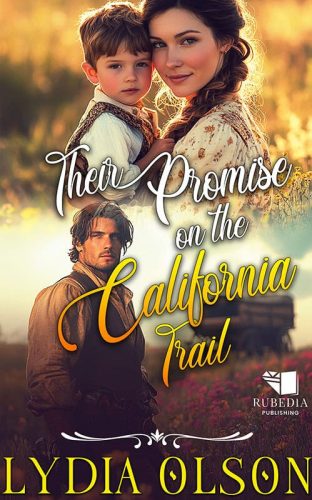
Their Promise on the California Trail
“You’re too proud for begging,” he said.
“I’m not begging,” she replied. “I’m bargaining.”
He stepped in close. “Then be careful what you offer.”
Loss taught Michael that standing still means getting swallowed whole. So he keeps moving—driving cattle, breaking horses, outrunning memories, and becoming a known trail master. But when a stubborn widow with fire in her eyes joins his wagon train, he feels the past catching up…
Rose has buried a husband and nearly buried herself trying to survive. With her young son in tow, she’s heading west for a new beginning—one that doesn’t rely on any man. Especially not a guarded trail boss that she can’t seem to get out of her mind…
“You’re not responsible for me,” she tells him.
“You think that’ll stop me?” he says.
But the trail is tough, and danger rides closer every day. As Michael and Rose draw together under wide western skies, they must decide if love is worth the risk or if some hearts are too bruised to trust again…


Prologue
Just outside of Iowa City, Early Spring 1859
“Go left!” Michael Talbot barked, boots pounding across the muddy alley.
James Cormac, Michael’s best friend and his deputy, veered sharply, flanking the back exit. Their coordination was a well-known routine, these hunts done a hundred times before. The suspect, Gilroy, a wiry man with blood on his shirt and panic in his eyes, shoved a crate into Michael’s path as he lunged into the stables.
Michael vaulted the crate easily. “He’s headed for the horses!”
Together, they pursued Gilroy into the stables, kicking up hay and dust as he tore through the rows of stalls. The frightened whinny of a mare echoed further down the aisle. Michael yanked his revolver from its holster, slowed down his pace, and pressed forward.
The scent in the stable hung thick with manure, sweat, and blood. Dust floated in the narrow beams of sunlight slanting through the cracked roof. Somewhere nearby, a horse stamped nervously, the wood creaking under the strain.
Michael raised his Colt.
He could see Gilroy cornered at the far end of the stables, half-hidden behind a sagging feed barrel. His face was bloodied from the scuffle outside, one eye nearly swollen shut, but he still gripped his pistol in white-knuckled desperation. He was boxed in; the only way out was past Michael and James.
“End of the line, Gilroy!” he called out, voice hard as iron. “You run any further, I shoot.”
A beat of silence answered him, and then a sudden crack of gunfire split the air.
The shot was wild, high.
It tore into the wooden beam above Michael’s head, sending splinters raining down. In their stalls, the horses shrieked and kicked.
Michael flinched instinctively, ducking low behind a support post, the scent of fresh gunpowder in his throat.
“You’re a terrible shot,” James drawled, looking on from where he’d posted himself behind a beam across from Michael. “Must be the shaking hands.”
“Don’t need to be good to get lucky,” Gilroy spat.
Michael moved closer, careful, calculating. “You killed a man over five dollars and a bottle of whiskey. Was it worth this?”
“You don’t know nothin’ about it!” Gilroy bellowed, the words ripping out of him as hard as his gunshot.
He half-lurched from behind the feed barrel, lowered pistol shaking in his grip, teeth bared in a snarl.
Michael stayed still, the weight of the gun steady in his hand, watching the man unravel. Gilroy was a cornered animal, bloodied and blind with rage, and too far gone to see reason.
“I know your wife left you, you got fired from the mill, and you’ve been running scared ever since,” Michael said coldly. “You’re not the first man with problems.”
“You think you’re better?” Gilroy shouted, and suddenly his gun was thrown up, aimed right at Michael. But Michael didn’t give him a chance. He fired once. The shot cracked like thunder.
Gilroy dropped to the ground, unmoving as the dust settled slowly, drifting down over the blood that quickly pooled on the straw.
James lowered his rifle, slowly approaching Gilroy’s body. “Heck of a way to start the morning.”
Michael exhaled, low and tired. “You can say that again.”
For a moment, neither of them spoke. The stable grew eerily quiet, and only the shuffle of uneasy hooves and the distant crackle of wind outside broke the silence.
James holstered his pistol as he nudged Gilroy’s boot with the tip of his own.
“Well,” James said dryly, “that’s one less wanted man troubling the good people of Kansas.”
Michael said nothing. He crouched, checking Gilroy’s pulse out of habit. The blood confirmed enough, but he always checked. He’d learned that hard lesson years ago, caught off-guard by a suspect he thought to be fallen.
“Come on,” Michael said after a moment, straightening up. “Let’s load him up.”
James found an old wooden plank in one of the stalls while Michael took control of a horse and wagon from the alley outside. Grim-faced, they hauled the body onto the plank to carry out to the wagon. With a grunt and a shove, they heaved a cold Gilroy into the back.
Michael wiped his hands on his trousers, sparing a glance toward the town sprawled ahead of them, half-built, half-forgotten. No sheriff’s star shined here. Just the flicker of lamplight in windows and the occasional sharp look from men who preferred the law to stay far, far away.
He tugged his hat lower over his brow.
“Let’s take him to Marshal Crane,” Michael said. “He’s the one who hired us, and he’ll want proof Gilroy’s not breathin’ anymore.”
James gave a low grunt of agreement, climbing up onto the wagon bench.
Michael took the reins, snapping them once. The wagon jolted forward, wheels creaking under their weight.
Behind them, the stable door swung open and banged closed again in the rising wind.
Michael guided the wagon down the main strip of town, a muddy, uneven excuse for a road lined with weather-beaten storefronts and crooked signs. Most of the buildings looked slapped together in a hurry: saloons, a blacksmith’s shed, a dry goods store, and a scattering of houses farther back.
Folks watched them from doorways and windows, their eyes sharp and silent.
Nothing like a dead man to stir up curiosity.
The marshal’s office sat at the far end of the town, a squat brick building with a battered tin star nailed above the door. The paint was peeling. The boardwalk creaked under the weight of the wagon as Michael pulled up out front.
James jumped down first, landing with a grunt. He pushed open the office door without knocking, greeted by the scent of old leather, pipe smoke, and dust.
Marshal Crane sat behind a desk, chewing on the stub of a pencil. His coat was off, his shirtsleeves rolled up, with his badge pinned crookedly to his vest. His face was lined, his hair going thin at the temples, and he had the look of a man who had seen enough of the world to know better than to expect much from it.
He looked up when the door opened, his eyes narrowing, looking behind Michael to find no suspect. He cocked his head. “You bring me somethin’, Talbot?” Michael stepped further inside, jerking a thumb toward the wagon. “Gilroy.”
Marshal Crane rose, moving to the doorway. He squinted at the tarp-draped form in the back of the wagon, then gave a low grunt of satisfaction.
“Dead?”
“Dead,” Michael confirmed.
The marshal walked down the steps, lifting the tarp briefly. He gave a long, hard look before dropping the cloth back in place before anybody else could accidentally—or noisily—peek their way.
“That’s proof enough for me,” Crane said. He turned back, pulling a battered ledger from a shelf just inside the doorway. “Payment’s posted at a hundred and twenty dollars. Full bounty, seeing as he didn’t come in peacefully.”
Michael followed him back inside. Crane counted out the money from a battered strongbox, the bills worn thin and silver coins clinking dully onto the desk. Michael took the payment without comment, tucking it into the inner pocket of his coat.
“You’ll want to be careful on your way outta town,” Crane said, his tone casual but his eyes sharp. “Gilroy had friends. Some of ’em ain’t too particular about revenge.”
Michael nodded once. He hadn’t expected thanks or protection. That wasn’t the way things worked out here. He turned to leave, but Crane’s voice stopped him at the door.
“You did right,” the marshal said. “Might not feel like it some days, but you did.”
Michael didn’t answer. He just tipped his hat and stepped back out into the bright, pitiless sun.
James was already climbing back on his horse that they’d tied to the marshal’s office, whistling low under his breath.
“On to the next fool who needs justice comin’ down on them like a hard fist?” he asked.
Michael grunted and swung up onto his horse beside him.
“No,” he said, flicking the reins. “Time to go home.”
“Sounds like a plan to me,” James agreed.
Michael turned his horse towards home, and James followed.
As they made their way across the Kansas prairie, Michael loosely held the reins of his dapple-gray gelding, Boone. His posture in the saddle was easy, but always alert. A man who never quite let his guard down. The black brim of his hat shaded his face, and the trail dust clung to his dark coat and trousers like a second skin. Beneath his open duster, a worn leather gunbelt slung around his hips, the Colt holstered at his side, polished from constant use.
His eyes were ice-blue, sharp as glass, often narrowed from a habit of scanning the horizon even when there was nothing there. When he chased danger for a living, he had learned that danger always lurked in the corners nobody thought to look.
“Whatcha lookin’ for over there?” James asked, smirking in amusement. “Sure, Gilroy was enough for you today?”
“I’m sure,” he answered. “I ain’t lookin’ for nothin’.”
“It ain’t never nothin’ with you. Those keen eyes…” James shook his head. “They’ll always be tellin’ a lie a mile off, or seein’ a raindrop before it falls.”
James rode slightly behind on a sorrel mare named Betsy, humming an old tune and letting the reins sit lazily in one hand. He was looser in the saddle than Michael, more inclined to banter than brood, but sharp in his own right. The two had trained together under the same crusty old sheriff in Illinois, had been bloodied in the same shootouts, and buried more than one friend side-by-side.
They crested the last ridge just after noon. Council Bluffs lay below, dust rising from wagon wheels and chimneys smoking like sentinels watching the Missouri’s slow churn in the distance. Michael could already make out the steeple of the church and the slanted roof of the blacksmith’s shop catching the early spring sunlight.
But something was wrong.
People were running, not walking, toward the edge of town. Women in aprons, skirts hitched up to their knees, men abandoning wagons mid-load, yelling names, waving arms. They all fled towards the same road.
James pulled his horse up short. “What in—?”
Michael didn’t answer. His stomach dropped, a sudden cold creeping through his chest like snowmelt running through his veins.
That’s the road to my ranch, he thought to himself.
He dug his heels, urging Boone forward, the horse’s hooves tearing up the path. James shouted after him, but Michael didn’t look back. The sound of Boone’s gallop thundered in his ears, louder than the shouts, louder than his thoughts.
As he rounded the last bend, he saw smoke. It was not the thin, pale gray wisps curling above the treeline, but plumes of dark grey rising, blocking out the sunlight.
The front gate was open, and a crowd had gathered outside his house. “Sheriff Talbot!” He barely heard whoever called for him. He reined in sharply at the edge of the path, nearly running into Mr. Carter, his neighbor and friend from the adjacent homestead.
Carter stepped in front of Boone, arms wide. “Michael, don’t. You don’t want to—”
Michael swung down off his horse before Carter finished the sentence.
“Son.” Carter’s voice broke. “It’s bad. Just… don’t go in alone.”
But Michael was already pushing past him.
The porch steps were stained. He didn’t let his mind register what with. Not yet.
His sister-in-law, Ellen Summers, sat on the top step, her apron streaked with ash and blood. She was rocking slightly, hands clutched over her mouth. Her eyes met his, and then she broke like a windowpane hit with a stone.
“Michael,” she whispered. “Oh, Michael.”
Behind her, the door hung crooked on its hinges. His boots thudded across the floorboards as he stormed into the house, following a coppery smell he had spent too long in his job not to know the meaning of. Michael’s breaths grew shallower as he ran into the parlor. One of the chairs was overturned, the corner of a blanket peeking from beneath it.
His heart outright stopped when he saw Mr. Burns, the town’s doctor. He was trembling, kneeling beside two still forms on the parlor rug.
Mr. Burns looked up, eyes filled with pity.
“No,” Michael said. “No… no.”
The doctor stood slowly and went to reach for him, but Michael jerked away, his eyes never leaving that corner of the blanket. The blanket he had wrapped his baby girl in only the night before when he put her down to sleep. The blanket his wife had knitted, her smile pretty and soft, as they cooed over their growing family. “You don’t want to see them like this.”
Them.
Michael lunged forward, but strong arms gripped him. He barely registered James shouting his name, trying to get him to stop struggling, but all Michael could do was fight, trying to get to her, to his wife, to his child. No, no, no, no. Please. Please, God. James dug his fingers into Michael as another pair of hands clamped around him, holding him back.
“Let me go!” he screamed, struggling. “Let me see her! Let me see my girls!”
“You can’t, Michael,” James choked. “You can’t.”
But Michael wrenched hard, staggering forward. He keeled over the chair, winded, as he stared down at the horror.
His wife’s hair spilled out from under the edge of the blanket, pale fingers just visible. And beside her, too small, too still.
“No.” The sound tore from him, raw and animal. His knees hit the floor with a sickening thud. His hand clawed at the wood, nails scraping. “No, no, no…”
The world blurred, voices muffled. James, apologizing, another man crying, and Mr. Burns saying something about bandits… robbery gone wrong…
Michael’s hands shook as he pressed the heels of his palms into his eyes, as if he could blot out the world, erase what he’d seen.
He couldn’t. He’d never be able to.
The silence in the room was unbearable, heavier than any bullet wound. He didn’t feel James’s hand on his shoulder, didn’t hear the low murmurs from the doctor or the others in the room.
“Michael…” Mr. Carter’s voice was the only thing that broke his stupor. “I…I was the first one here. I saw the smoke from my field and came runnin’. The front door was open, the place ransacked.”
Michael didn’t move. His forehead rested against the floorboards, his breath shallow and ragged. Had he kissed his wife before leaving that morning? Had he held his baby another minute longer? He couldn’t remember. What had been the last thing he’d said to his wife?
It shouldn’t matter, not really, but it did. It did.
“They took some of the silver from the hutch and broke into the trunk upstairs. But… they didn’t come for things, I don’t think. Not with the way they… the way they hurt her. I think that she must’ve tried to go for your rifle, but…”
His voice trailed off, and Michael let out a broken sound. Not quite a sob. Not quite a scream. His stomach clenched, and he thought he might vomit.
“She was protecting the baby. She—”
“Stop.” Michael’s voice was hoarse, unrecognizable.
Carter froze. “I-I’m sorry, son, I just thought you should—”
“I heard you.” He pulled his hands down, stared at them like he didn’t recognize them. Blood beneath his nails. Dirt in the creases. His own or someone else’s, he didn’t know. He didn’t care.
The walls seemed to bend inward, the ceiling tilting, darkening. The stench of iron and ash filled his nose, thick and metallic.
Blood.
It clung to everything.
He tried to suck in air, but it caught in his throat. His chest rose and fell too fast, like a horse spooked into lather.
“I can’t,” he gasped, voice cracking. “I can’t breathe.”
James leaned forward. “Michael. Look at me.”
But he couldn’t. His vision swam. He shoved himself up, stumbling over the rug and lurching toward the door. He had to get out. The walls were closing in. The blood was in his lungs.
He burst onto the porch, boots thudding on the wood. He bent forward, hands on his knees, dragging air into his chest in sharp, painful gulps.
The cold wind hit his face like a slap, but it didn’t help. Nothing would.
He looked up, eyes burning, and saw Ellen still sitting on the top step, her knuckles white where she clutched her apron. She met his eyes again but said nothing.
Behind him, the door creaked softly in the breeze. Inside lay everything he loved, yet nothing he could save.
Michael straightened slowly, face hardening as he stared out across the prairie. The wind tugged at his coat. The river glinted far off like a blade.
And slowly, something inside him died, giving way to something colder that took its place.
Chapter One
Council Bluffs, Iowa, January 1860
“Now remember, Leo, keep those little hands to yourself. No touchin’, just lookin’, alright?”
“Yes, Mama,” Leo answered, his voice full of curiosity and mischief. “No touchin’, just lookin’.” She didn’t believe him for a moment.
Rose Wright adjusted her grip on her son’s hand as they stepped into the general store owned by the Willows. The bell above the door gave a rusty jingle, announcing their arrival. Inside, the scent of flour dust, tobacco, and kerosene hung thick in the air, mingling with the sweet, syrupy smell of penny candy behind the counter.
Wooden floorboards creaked beneath their steps, and shelves groaned under sacks of grain, jars of pickled vegetables, and tins of coffee and lye soap. Bundles of calico fabric were stacked near the window display, faded from the morning sun that slanted through the dusty panes.
At four years old, Leo’s big brown eyes, so much like hers, darted from the crates of apples to the bright bolts of fabric to the row of tin toys lined up along a lower shelf. He lifted one foot as if to step closer.
“Uh-uh,” Rose said gently, squeezing his hand. “I meant what I said.”
He looked up at her, sheepish, and nodded. The pinkish scar that curved along his right cheekbone caught the light. People still stared when they noticed it. Rose was used to it by now. She never explained.
Let them wonder. Let them whisper.
She guided him toward the back corner where the dry goods were kept. A few other townsfolk milled about, two older women whispering over quilt thread, a farmhand stacking crates of molasses jugs near the stove, and young Mrs. Ainsley from the boarding house, her arms full of flour sacks.
“Morning, Mrs. Wright,” called Benny Willow as he came through the back door, carrying a sack of grain over one shoulder like it weighed no more than a sack of feathers.
Rose smiled at him. At sixteen, Benny was tall and lean, with a mop of sandy hair that never seemed to stay put, no matter how often his mother fussed over it. He was the Willows’ only son, and he followed in his father’s footsteps, having taken on a full-time job now that he had finished school.
“Hello, Benny,” Rose greeted.
“Got a new batch of sugar in, if you’re lookin’.”
“I’d be lookin’ harder if it weren’t so expensive,” Rose replied with a polite smile. “Just here for the basics today. Coffee, salt, dried beans if you have any left.”
Benny smiled. “You’re in luck. Mule train came through two days ago.”
She gathered what she needed quickly, her list already memorized, her budget precise to the cent. Money was tight. It always had been, but now it was only her hands that kept a roof over their heads and Leo’s belly full. She paid no mind to the women glancing her way, to the way their chatter softened when she passed. She could feel their judgment brushing against her like winter wind, both cold and unwelcome.
Leo tugged her sleeve. “Mama?”
“Yes, baby?”
“Can we have peppermint candy?”
Rose glanced toward the jar. It was three copper pennies for a twist of striped sweetness.
She hesitated, then sighed softly. “Just one.”
His grin broke across his face like sunshine.
“Come on,” Rose said. “Let’s settle up and get home.”
As Rose set the last sack on the counter, Mr. Willow, Benny’s father, stepped out from the back room, wiping his hands on his apron. He was a stout man with a kind face, lined and weathered, but always clean-shaven. He tipped his head toward her as he approached, but his expression shifted at the goods in her hands. It was polite but hesitant.
“Mrs. Wright,” he said gently, keeping his voice low so as not to draw attention from the other customers, “I was wondering… about your account.”
She felt her stomach tighten. Her fingers stilled on the hem of Leo’s coat.
Mr. Willow cleared his throat. “You know I’ve never minded runnin’ a bit of credit, especially for folks like you, workin’ hard, raisin’ a little one. But your tab’s grown… considerably. I was hoping you could pay some of it today.”
She straightened her shoulders, willing her voice to stay calm, thinking of how her husband had left their home in a good mood only that morning. “John came into town this morning. I gave him the money from my last sewing orders and told him to stop by here first. He promised he’d settle at least part of the debt.”
Mr. Willow’s face shifted, and there it was, a flicker of discomfort in his eyes. “I’m sorry, but I haven’t seen him today. He never came by.”
Her heart sank. A slow, bitter heat crept up her chest. She looked past Mr. Willow toward the direction of the tavern, invisible from here but never far from her mind.
Of course. Of course. The coin she had stayed up late earning, sewing by lamplight until her fingers ached, had likely bought John whiskey and dice.
She swallowed the fury building in her throat and nodded tightly. “Then I’ll come back for the items another time.”
Before Mr. Willow could reply, Leo tugged on her skirt, arms lifted. “Mama… up.”
She knelt and scooped him into her arms, but the motion tugged her sleeve upward. A bruise bloomed across her forearm. It was deep purple and rimmed with green at the edges, the mark of a hard grip and harder throw. She remembered the moment as clear as day: John shouting, her back hitting the wall, the corner of the table catching her ribs, her arm bouncing off a sharp doorway.
Mr. Willow’s gaze dropped to the bruise. One of many, but he wouldn’t know that, and Rose was grateful for it. His expression shifted again, this time to something darker. Compassion. Anger. Pity.
She yanked her sleeve down quickly, heart hammering.
He didn’t say anything, didn’t ask. Thank Goodness. But he turned and began packing her items into a canvas sack anyway. The flour, beans, salt, and sugar she hadn’t asked for.
“Mr. Willow,” she started.
“No,” he said gently, holding up a hand. “Take it. For the boy.”
Rose hesitated, pride warring with necessity. She didn’t take handouts. Not since she’d left home at seventeen, but Leo needed food, and she was tired. So tired.
She lowered her eyes. “Thank you.”
He offered her the bag. “How about you come see me yourself next week? We’ll work something out.”
She nodded, shifting Leo on her hip and wrapping her arm tightly around the supplies. “You’re a good man, Mr. Willow.”
He offered a sad smile. “You let me know if there’s ever anything you need, Rose. Anything at all.”
She met his eyes then, just for a second. She knew what he meant.
But she also knew the law didn’t protect women like her. Not from their husbands. Not even if they ran.
Next chapter ...
You just read the first chapters of "Their Promise on the California Trail"!
Are you ready, for an emotional roller-coaster, filled with drama and excitement?
If yes, just click this button to find how the story ends!
I enjoyed the preview.
Thank you for being so kind, Karen🤗
I’m hooked!
That’s music to my writer’s ears, Rheta!🎶
It’s a great beginning and I am looking forward to reading the story very soon.
Wishing you a cozy, heartfelt read all the way through, Karen💗
So far so good Lydia, interesting and looking forward to reading the rest of the book.
That’s so encouraging to hear, Mo—thank you! I loved writing this one💙
I look forward to reading this book!
So glad to hear that, Kathy! I truly hope the story sweeps you away💗