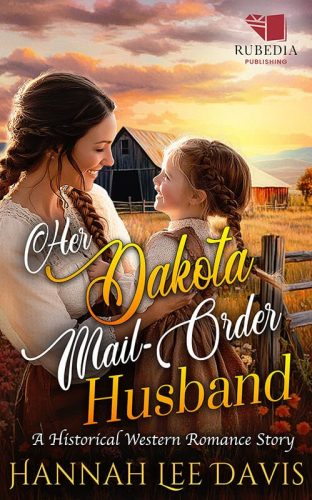
Her Dakota Mail-Order Husband
“This land could get us both killed,” Nora said, breathless.
Weston stepped closer. “Then we fight for it—together. And if we fall, we fall side by side.”
In the lawless hills of South Dakota, Nora Quinn is a rancher with too much to lose and no one left to lean on. Orphaned and drowning in debt, Nora’s greatest fight now is to keep her sister—and her land—out of a ruthless man’s hands. Out of options, Nora places a desperate ad for a mail-order husband, hoping for a partner who can help her hold the line—even if there’s no love involved.
Weston Crane arrives with nothing but a battered past. Once a proud rancher himself, he’s seeking a second chance, not romance. Their marriage is one of convenience—practical, distant, and fragile.
“I didn’t ask for your past,” Nora snaps. “Just your help.”
Weston’s reply is cold steel. “And I didn’t come here to be wanted. I came to disappear.”
As survival demands unity, their walls begin to crack under the weight of shared burdens and stolen glances. But when Weston discovers a secret that could cost them everything, he pushes her away.
“You want someone whole,” he says.
“I’m what’s left after the fire.”
Now Nora must decide if she’s strong enough to fight not just for the ranch—but for the broken man she never meant to love.


Chapter One
Deadwood, South Dakota
1880
Nora Quinn sat between her parents, holding her baby sister close as the sun dipped low behind the Black Hills. Two-year-old Mary Jane was curled in her lap, half-asleep, letting Nora’s arm brush her soft curls.
“You’re safe, little bug. Just rest.” Nora leaned down and left a soft kiss on Mary Jane’s temple, the way Mother always used to do to her when she was younger. “Dream of cotton clouds and warm milk.”
The toddler’s tiny fingers clutched the edge of Nora’s shawl, and every so often she stirred, mumbling nonsense and blinking up with big, trusting eyes before drifting off again.
“You’ll wake up at home before you know it,” Nora went on. “I’ll carry you in if you’re still asleep. Like always.”
Nora couldn’t remember the last time they’d all ridden together like a family. It was just the four of them; no hands, no errands pressing them home. It felt like something borrowed from a happier time, when life was simpler.
“You know, Nora,” Father broke the silence, letting his elbow rest lazily on his knee. “Sheriff Maddox seemed really taken with you today.”
She groaned good-naturedly. “Oh, don’t start, Father.”
“He’s a good man,” Father insisted, as the carriage wheels creaked along the rocky trail. “He’s got good manners, a steady mind. Not to mention a good job. I’d wager a month’s beef that he’s thinking of building himself a home.”
Nora laughed, moving a stray wisp of hair from her face. “Cade’s a friend. A really good one. You know that.”
“Friend now,” he said with a wink. “But that can change.”
She smiled, but her gaze drifted toward the hills. At twenty-one, she didn’t want to settle for something small and safe, even if Father meant well. Not with her heart still holding out for something true. Yet, she said nothing. Dreams were easier to cradle in silence.
She looked at Mother, who also smiled, though her eyes were fixed on the road. Nora knew Mother liked Sheriff Maddox too, probably more than she’d ever admit. But to Nora, Cade was someone who helped her down from a saddle or taught her to shoot straighter. Not someone she pictured at the altar.
Her thoughts were interrupted by a sudden move. The carriage jostled, one wheel dipping into a rut. Father’s smile faded..
“Truth is,” he said, very low, “we might need more than laughter to get through this year.”
Nora felt a wisp of unease. “What do you mean?”
He glanced at Mother, then back to Nora. “Cattle prices are falling. Timber contracts haven’t come through. I’m not saying we’re out of money, but we’re not far from it. If something were to happen—”
“I can help,” she said quickly. “We can sell off the dry pasture, or maybe take in boarders again, or—”
“I know you would.” Father tried to speak more lightly, but his deep sigh of concern showed quite the opposite. “You’ve always had more grit than most men I know. But a partner wouldn’t be the worst thing, Nora. Not now.”
She’d barely opened her mouth to argue when the carriage jolted again, . the movement so abrupt and sharp she had no time to process it. She was thrown clear, still clutching Mary Jane to her chest. The baby was crying, the horses were screaming, and she couldn’t do anything about it. Pain flared through Nora’s side. Her ears rang. For a moment, she couldn’t breathe. Then, she pulled herself upward a bit, to hands and knees.
“Mother?” Nora crawled with one hand, as her knees tore against stone and dirt. “Father!”
The carriage was on its side, crushed inward. Nora saw Mother’s hand reach through a broken panel, her fingers slick with blood. She grabbed hold, pulling, praying, whispering God’s name. But the wood gave way with a hollow crack. And then, to her horror, the structure collapsed further, swallowing her parents inside.
“No, no…Please!” Nora screamed her voice broken, but no one answered. Mary Jane’s cries were the only ones cutting through the silence.
“I’ve got you,” Nora went on numbly. Her own hands were trembling, bloodied at the knuckles, but she held Mary Jane tight against her chest. “Shhh, you’re all right, little bug. I’ve got you.”
The baby’s cries softened, then faded to quiet whimpers as she nestled into Nora’s shoulder. When Nora pulled back slightly, Mary Jane blinked up at her with wide, tearful eyes. Her lip was still trembling, but she didn’t cry again. For one fragile moment, the world stilled, and somehow, even at two, Mary Jane seemed to know that Nora was all she had.
“I won’t leave you,” Nora whispered fiercely, buried her face in Mary Jane’s curls, and breathed in the living warmth of her. “Not now, not ever. I swear.”
Chapter Two
Deadwood, South Dakota
Three years later
The morning sun cast long, golden fingers across the dry plains, and Nora squinted against its glare as she tightened the last nail into the fencepost, but even then, the post barely held. She sat back on her heels, wiping sweat from her brow with the back of her glove. The fencing hammer hung heavier than it used to, or maybe she was just more tired than she let on.
Somehow, it had been three years since the accident took her parents. Three years of holding the ranch together with threadbare rope and stubborn grit. Some days she seemed to make progress. Other days, like today, she felt like someone patching holes in a sinking ship.
A puff of wind kicked up dust and sent it swirling across the pasture. In the distance, the cattle stood idle and disinterested, their silhouettes framed against the low hills. The fence was temporary, a crude patch over a winter-ruined stretch, but it would hold for now.
The ranch had aged in strange ways. Some corners seemed frozen in time, like the porch swing that still creaked with no one in it; others wore thin from overuse. Paint peeled faster than Nora could keep up, hinges groaned louder, and the barn doors never quite shut the way they should. It was still home, yes, but it carried a tiredness now, the kind that settled into wood and soil and bone.
Everything just feels like it’s holding its breath. Same as me.
Nora stood and rolled her shoulders. From here, she could just make out the house, a squat shape of white clapboard and red roof, still standing tall against the years. Inside, she knew, Mary Jane was probably underfoot in the kitchen, asking June endless questions about flour or frogs or where the sun went at night. Nora smiled to herself.
June Dawson had worked as a cook at her family’s ranch for decades; the woman had practically raised her. And now, she was doing the same for Mary Jane. She had a sweet way about her, gentleness and warmth, but underneath that softness was steel. More than one ranch hand had learned the hard way not to cross June when it came to “her girls.”
Nora slung the hammer into the canvas tool bag and turned her back to the house, dust trailing her boots. She tried not to think too far ahead. The ranch books still didn’t balance, and the pasture needed reseeding. But Mary Jane would be having her sweets. And June would have coffee on.
The rest can wait.
She had just hoisted the tool bag into the back of the wagon when the distant thud of hooves broke the quiet, and Nora froze. Her spine stiffened before she even turned.
“Good mornin’.”
There he was. Nash Colter, coming up the ridge like he already owned the land beneath his horse’s hooves. He sat tall in the saddle, broad-shouldered and square-jawed, with that arrogant stillness that only men born into power seemed to possess. His dark blond hair was slicked back beneath a wide-brimmed hat, not a strand out of place. His pale blue eyes scanned the horizon with the calm detachment of someone who believed everything in sight was his for the taking.
Even from here, Nora could see that unpleasant smirk tugging at the corners of his mouth. He always wore it like it was part of his uniform, right along with his polished boots, spotless black coat, and silver spurs that gleamed even in the dust. A man playing dress-up as a gentleman, masking coldness underneath.
Nora set her jaw and stepped forward, hands on her hips, boots planted in the dust. “What do you want, Nash?”
He slowed his horse to a stop just a few yards away, his eyes sweeping over her like he was assessing the price of something. “You already know,” he said. His voice was smooth, like honey laced with poison.
She didn’t blink. “Not interested.”
His smile twitched. It wasn’t gone. However, it was tighter now. “Nora, I’ve made you a generous offer. One any sensible woman would take.”
“You mean the one where you pay off my debts and I spend the rest of my life shackled to a man I despise?” She folded her arms. “Really generous of you.”
For a moment, he just stared at her. The silence stretched; it was heavy and slow, like the moment before a rattler strikes.
Then he tilted his head a little. “You might want to reconsider,” he said quietly, “before something happens to this place. Hard winter. Maybe a fire. Or another… accident. You never know out here.”
Nora’s blood ran hot, but she didn’t give him the satisfaction of seeing it. Taking a step forward, she forced herself to keep her voice cold and steady. “You’re threatening me, Colter?”
He raised his hands in mock innocence. “Of course not. Just concerned. Would be a shame, after all your hard work.”
She stepped close enough now to see the cruelty behind those eyes, the flicker of frustration when charm didn’t work on her.
“You listen to me,” she said, low and sharp. “I’d rather lose every acre of this land than tie myself to a man like you.”
Nash’s expression darkened. “Stubbornness can be dangerous out here, Nora. Especially for a woman alone.”
“I’m not alone.”
Nash held her gaze a beat longer, then tugged the reins and turned his horse. “Think it over,” he called over his shoulder. “I’d hate to have to ask again.”
Nora didn’t say another word. She just watched him ride off, as dust curled behind him like smoke.
He’ll be back. No doubt about that. But so will I. And I’ll still be saying no.
***
Nora slammed the door behind her harder than she meant to. The loud crack echoed through the old house like a gunshot.
Flour dusted the air in the kitchen, glowing in the sunlight that filtered through the curtains. Mary Jane stood on a stool by the counter. She had her small hands deep in a lump of dough, face smudged with white. “Nora, look! When I grow up, I’ll be a cook, just like June!”
June was beside her with her sleeves rolled up, and her silver-streaked hair tied back in a kerchief. She was tall, broad-shouldered, with a quiet steadiness about her, her strong hands shaping the dough as if the rhythm steadied her. Now, the cook’s sharp eyes caught the storm on Nora’s face in a single glance.
“What happened?”
Nora let out a breath and yanked off her gloves, tossing them on the table. “He was here again.”
June’s mouth drew into a thin, hard line. “What did that snake want this time?”
“The same old thing,” Nora muttered, rubbing the back of her neck. “Tried to make it sound like he’s doing me a favor. Then hinted that my ranch might ‘accidentally’ burn down if I don’t say yes.”
June set down the wooden spoon she’d been using and crossed her arms. “I swear, one of these days I’m going to chase that man off with a skillet.”
Mary Jane, oblivious, giggled and said, “A skillet to the butt!”
Nora tried to laugh, but it came out tight and tired. She walked over and kissed the top of her little sister’s head. “Don’t let June hear you say that too loud, sweetheart,” she murmured. “She might actually do it.”
“No!” Mary Jane grinned wider, her hands deep in dough.
“Yes!” Nora gave another kiss to Mary Jane and leaned against the wall. Her gaze turned to the rise and fall of the bread beneath June’s practiced hands, breathing in the smell of flour and warmth and yeast. For a moment, the kitchen wrapped around her like a soft blanket.
Suddenly, the front door burst open without a knock, and a familiar voice rang out. “Anybody home, or did I just hear a man ride off with Nora’s last nerve?”
Nora smiled before she could stop herself. Sadie Maddox, the Sheriff’s younger sister, strode into the room with her right hand resting against the pistol on her hip. Her wild, dark hair swept back like she’d just outrun a dust storm. She grinned when she saw Nora, but her eyes were already scanning Nora’s face as if reading a map.
“Don’t start,” Nora warned.
Sadie ignored her. “Let me guess…him again?”
Nora just nodded.
Sadie pulled out a chair, plopped down, and snatched a piece of dough from the edge of the bowl, ignoring June’s swat. “You know what your problem is? You keep trying to run a ranch, raise a kid, and hold the world together with nothing but spite and fence wire. You need a man around here.”
Nora raised a brow. “Is this your subtle way of suggesting I marry Nash Colter?”
“Hell, no.” Sadie snorted. “I’m saying maybe it’s time to look into one of those mail-order grooms. Pick one with good intentions and strong shoulders.”
Mary Jane perked up. “Does he come in a box? Like peaches?”
Nora groaned, covering her face. “Please stop.”
But Sadie was grinning. “I’m serious. You don’t have to do it all on your own. And don’t give me that look—I’m not saying you need saving. I’m saying maybe you deserve some help.”
Nora opened her mouth to argue, but nothing came out. Just a pause. A flicker.
She didn’t want to admit it, but the thought had been creeping in lately. Not marriage. Not love. Just…relief. Someone to help carry the weight. Someone to stand on the other side of the fence line and say, I’ve got it today. Now, however, she shoved the thought down.
“No mail-order grooms. Not now. Maybe not ever.”
Sadie shrugged, clearly not buying it. “Suit yourself. But when you come around, I’ll help you pick one. You can’t trust June, she’ll just choose someone who might sound polite and have a nice smile.”
“I’d pick someone who doesn’t make her life harder,” June protested. “Although that rules out most men.”
Nora turned back toward the counter, rolling up her sleeves to help her favorite girls prepare a meal. The smell of bread, the sound of Mary Jane humming, Sadie’s laughter, everything helped dull the sharpness that Nash had left behind. But the seed was there now. Buried deep, planted. And like most things out here, it wouldn’t take much sun or pressure to make it grow.
***
That night, the house was quiet, save for the faint crackle of the fire and the soft creak of the rafters settling in the wind. Nora eased the bedroom door shut behind her. The faint scent of lavender was still hanging in the air from the sachet June had tucked under Mary Jane’s pillow. Her little sister was asleep, curled like a kitten beneath the quilt. One hand clutched the worn hem of her blanket; the other one still bore a faint dusting of flour.
Nora lingered there for a breath, then turned away.
She made her way to the parlor, where the fire was burning low and the stack of bills waited on the side table like a snake coiled in the dark. She didn’t sit right away. She just stood there, staring down at them. The ink seemed darker tonight, the numbers larger.
Finally, she sank into the armchair and pulled the pile into her lap. The paper crackled like dry leaves in her hands. She flipped through them slowly: feed, lumber, doctoring, repairs. The roof on the south side of the barn was buckling. And the last two cattle sales hadn’t brought in near what they should have.
Her thumb rested on the corner of a brittle ledger page, but her mind had drifted elsewhere.
You don’t have to do it all on your own, Sadie had said.
Nora leaned her head back. Her eyes closed briefly. Again, it wasn’t that she wanted a man. She didn’t want anyone to come in thinking they could run the place, or make decisions for her, or tell her what a woman ought to be doing.
But what if…what if there was someone out there who’d help, for real?
Someone who could mend fence lines without trying to take the reins? Someone Mary Jane could look up to? Someone who wouldn’t flinch when things got hard?
Her eyes opened again. The fire was down to embers now, but she didn’t move to stoke it. She didn’t want to give up anything—not her freedom, not her home, not her pride. But if she didn’t make a choice soon, she might lose all three anyway.
It really is high time I did something…
Nora let out a long breath, one hand resting on the top of the bills, the other pressed to her chest as if she could hold the weight in place for just a little longer.
Maybe…maybe there’s another way.
And though she wouldn’t admit it out loud, she found herself wondering what it might be like to open a letter and find hope written in a stranger’s hand.
Chapter Three
Three weeks later
That day, the town of Deadwood stank of horse sweat, sawdust, and suspicion.
Weston Crane stepped off the wagon road and onto the packed dirt of the main street, his boots leaving faint scuffs in the dust with each step. He straightened his spine, though every bone in his body ached from weeks on foot. The soles of his boots were worn thin, his coat stained from rain and trail grit, and his jaw lined with days of unshaven stubble, he could feel it under his hand. At thirty-two, he felt like what he was: tired, broke, and not from around here.
And the townsfolk saw that, as well. Eyes followed him from porches and storefronts. A woman ushered her child away with a quick hand. Two men on a bench stopped talking mid-sentence to mutter something under their breath. Weston didn’t hear the words, but he knew the tone. He’d heard it before in Missouri, in Wyoming, in every nowhere town he’d passed through since the fall.
He knew he didn’t look like the man he used to be. Back then, before everything fell apart, he’d worn clean shirts and polished boots, owned his own spread and a good horse. Folks had called him dependable. Honest. They’d shaken his hand, looked him in the eye.
But that was before he’d lost everything. People didn’t know the man he once was. He’d been head of his family’s ranch, riding tall beside his father. He’d been trusted by neighbors, and respected for his quiet strength. They didn’t see the years he’d spent trying to keep it all together after his father’s heart gave out, after consumption took hold of his mother and left her coughing up blood, after it came for his sister next and carried her off just as quietly.
They didn’t see the man who stayed up late trying to save the land while the sky stayed dry and the bank came knocking. They just saw what was left. Dust on his boots. A coat worn thin. A face lined by grief and bad sleep. And they judged, the way folks always did.
But Weston had stopped caring about that. Judgments didn’t break a man; they just reminded him he was already broken.
Let them look. Let them talk. He wasn’t here to prove himself to strangers. He was just looking for a place to land before the ground gave out under him again.
He kept walking. He was too hungry to care. The general store sat in the middle of town, painted white with red trim. The sign above the door stood steadily above. Weston stepped inside and paused, blinking in the dim light. The scent of tobacco, flour, and stale coffee hit him all at once.
A man stood behind the counter with his arms crossed. He was stocky, with a thick beard and doubtful eyes that narrowed the moment Weston stepped through the door. Weston had seen that look too many times to be surprised. He already knew this man would greet him like he wasn’t worth the dirt on his boots, like his very presence dragged down the value of the shelves.
Weston nodded once. “Just need a loaf of bread,” he said, reaching into his coat and pulling out the last few coins he had left, clinking them into his callused palm.
The storekeeper didn’t move. He looked Weston up and down like he was a stray dog. “We don’t serve beggars,” he said flatly.
Weston’s jaw tightened. “Didn’t ask for charity.”
“Same difference,” the man replied. “Try the saloon. Maybe they’ll toss you a biscuit if you bark loud enough.”
Heat rose in Weston’s chest, but he didn’t answer. He pocketed the coins slowly, turned on his heel, and walked out without another word. Pride was a thin blanket when a man was cold and hungry, but he’d rather shiver than beg.
***
Weston stepped back out into the afternoon glare. The wind kicked up a little, carrying the scent of manure and smoke, and something acrid beneath it all. It was resentment and bitterness, or just the stink of people who’d decided they were better than the man beside them.
He walked on.
The blacksmith was the first. A thick-armed man with soot on his face and a hammer in his grip, wiping sweat from his brow with the back of his hand. Weston stood at the edge of the forge’s open mouth, with his hands in plain sight.
“Are you hiring?” he asked.
The blacksmith didn’t even look up. “Not for you, I ain’t.”
Weston nodded once, took the rejection like a nail to the boot, and moved on.
Next was the livery. A boy, barely old enough to shave, ran it with his father, or so Weston guessed from the way the older man barked orders. Weston offered to muck stalls, shoe horses, even clean tack. Hard work didn’t scare him; it never had.
But the old man squinted at him like he was dog rot. “Don’t need no trouble. And you look like you bring plenty.”
“I’m asking for one chance,” Weston said, trying to sound as convincing as possible, even if he, too wasn’t sure anymore he deserved one. “And you’ll see that I have the right skills.”
“Then you best look somewhere else.”
Somewhere else. Always somewhere else. Weston tipped his hat out of habit, though his throat was dry with shame, and kept walking. He asked again at the carpenter’s yard. The feed store. Even the undertaker.
Same looks. Same answers. One man asked if Weston had a criminal past, just because of the way he looked. Another told him he smelled like crime itself. One woman went so far as to cross the street when he turned toward her shop, as if hard luck were contagious.
Weston tipped his hat and called after her, “Don’t worry, ma’am. I only bite when I’m fed.”
She didn’t laugh. Didn’t look back either.
Tough crowd.
He should’ve been used to it by now. But it still scraped deep inside him. As he wandered back toward the edge of town, past a church with peeling paint and a crooked cross, a memory surfaced, sharp and uninvited. He saw his sister Lottie, maybe fifteen, sitting by the window of the old ranch house. Her dress was threadbare at the cuffs, but her hair was brushed and braided. She’d been reading out loud to their mother, whose breath came in shallow, wheezing gasps. He remembered the way Lottie’s voice faltered when their mother stopped responding.
Weston blinked hard, shook his head.
Not now.
He didn’t have time for memories. He sat on the edge of a dry creek bed just beyond town. The sun was starting to dip behind the pines, and the air had cooled enough that he could see his breath when he exhaled. His stomach knotted, not just from hunger now but from despair.
He used to have hands that fed a family, mended fences, calmed spooked colts. Now they just begged for scraps.
He rubbed the back of his neck, wincing at the grit caked there. He hadn’t seen a real bed in weeks. Not since that one rancher outside of Casper let him sleep in the hayloft after mending a busted gate. A single night. Then back to the road again.
People used to wave when they saw him coming. Kids used to call him “Mister Crane” and run to hold the gate open. Now he couldn’t even get someone to look him in the eye.
How many more steps before I’m not even a man anymore?
The wind shifted. More smoke was in the air. His gut twisted again. Still, he stood. There was always one more step to take. One more patch of cold ground to sleep on. One more town that might not shut its door in his face.
He headed for the tree line. Night would come fast, and he’d need to find a place to camp before it did.
Next chapter ...
You just read the first chapters of "Her Dakota Mail-Order Husband"!
Are you ready, for an emotional roller-coaster, filled with drama and excitement?
If yes, just click this button to find how the story ends!
I loved the intro to this book. I am looking forward to reading it.
Thank you, Kathy, warms my heart! Did you enjoy it?💗