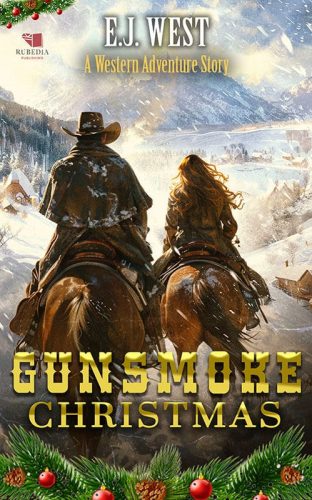
Gunsmoke Christmas
The Montana winter is unforgiving. So is Marshall Kane…
Marshall Kane returns from War to find his home burned, his family butchered, and the life he fought to protect buried in ashes. With nothing left but his ranch, his rifle, and a heart frozen hard as December ground, he swears one thing: no trust, no love, no weakness ever again.
Then he finds her.
Sylvia Morton—widow of an outlaw—stumbles out of a blizzard with her young son, right before Christmas, hunted and hurt. Kane doesn’t believe in coincidence…nor in charity. But leaving them to die isn’t in his blood.
When the gang responsible for destroying both their lives returns to finish the job, will Kane risk reopening old wounds to protect a woman he barely trusts and a child who reminds him of everything he’s lost?


Prologue
Ruby, Montana, December 1877
His weight crushed her chest, each ragged breath scraped thin between his ribs and hers. His face bent close, sweat and sour-whiskey breath rolling off him, the ruined flesh of his cheek as stiff as leather. His scar glimmered in the lamplight, twisted skin pulled into a terrible grimace. His hands seemed everywhere, pinning her arms, knees wedged cruelly against her thighs.
Sylvia kicked, but his bulk held her, pressing her down into the hard-planked floor. Somewhere in the corner, Max’s wail rose. The boy was crying, high and broken, his little hands clutching the ragged blanket. She tried to turn toward him, but the man’s jaw scraped against hers, and he forced her chin sideways until all she could see was the crooked sprig of mistletoe lying in the dirt. It was almost Christmas.
Clay had nailed it above the door, said a house with a tree and mistletoe could pass for a home again. Now the sprig was snapped, hanging limp from one nail like it had been executed. The small Christmas tree they’d dragged in two weeks early still stood in the corner, lopsided, with the ribbon Max had begged her to tie around its branches. Max loved it. He had clapped when the candlelight glimmered on the needles.
Now Clay lay stretched on the floor, a widening pool beneath him dark as tar. His eyes were wide, the gunshot a black blossom in his chest. Max’s cries broke against the silence of his father’s body.
“Don’t look, baby!” she tried to shout, but all that came out was a breathless whisper.
Boots clattered, laughter sharp as spurs. The other men rifled through Clay’s trunk, tossing blankets, cursing at how little there was, then howling when one pulled out gold bars, one by one. The shine of it caught the lamplight, and the men roared.
“Quiet, kid!” screamed the youngest of the bunch. With a swift sweep of his hand, he struck Max across the cheek.
“No!”
Sylvia jerked against the man pinning her, but the scarred brute only ground his hips down harder, and her cry stuck raw in her throat.
Something snapped in her, then.
The scream ripped out of her chest. She lunged her head upward, teeth catching flesh. His nose tore under her bite. He roared like a bull, blood spraying, his grip faltering.
“She bit me!”
Sylvia thrashed, clawing with hands freed, nails catching his cheek, his jaw. He struck her once across the face, but she did not stop. She rammed her knee upward, catching him low in the pelvis. The brute folded, gasping.
She kicked again, hard, then wriggled loose beneath him, rolling fast, scraping her shoulder on the planks. Her hand found the nearest thing, Clay’s jacket, lying beside his body, and she snatched it up. Max was in the corner, eyes wide. She scooped him with one arm, his body small but heavy with fear, and wrapped the jacket tight around his frame.
“Hold on,” she gasped, though her breath tore at her throat.
The men were shouting now, curses cracking. One lunged for her, but she slipped under his arm, bare feet striking the frozen earth as she burst out the door. She was out.
The night struck her like a wall. Bitter wind sliced through the thin fabric of her nightdress. The snow was already thick, flakes driving hard sideways, covering her in seconds. She stumbled but kept running, Max clinging to her neck, sobbing into Clay’s jacket.
Behind her, the men bellowed. One fired a shot into the dark, the ball sparking off stone. She did not stop. Her feet screamed with pain as they struck ice and gravel, but the fear gave her strength. She ran down the black street, past shuttered houses that would not open, past lamps blown out by the storm. The only light was the moon, blurred behind clouds, and the faint fire-glow from the house she had fled.
Max whimpered against her. “Mama… Cold…”
“I know, baby. Hush now, hush.” She ran harder, each breath scorching her lungs.
The snow thickened, swallowing sound, muffling everything except the thunder of her heart. The men’s voices behind her grew faint, consumed by the storm. She dared not look back.
Her legs began to ache, the skin of her feet raw and split, but she clutched Max tighter. His breath was shallow and quick against her shoulder. She shifted Clay’s jacket higher, wrapping his small hands inside, tucking his head under the collar. Her own arms stung with cold, her nightdress already stiff with frozen sweat.
She thought of Clay. His last shout, the way he had stood before them with his gun drawn, firing until they overwhelmed him. His body had been a shield until it was pierced through. And she had been too slow, too weak to stop it. Now his son sobbed into her shoulder, and she was all that was left.
A lantern flared suddenly ahead, swinging in the storm. Her heart slammed. Another man coming to cut her off? She darted down an alley, nearly slipping on the ice, the shadows swallowing her. Max whimpered louder, muffled by the collar she held over his face. She pressed her lips to his forehead, her breath steaming.
“Quiet now. We’ll find a way.”
The alley ended in a low fence. She climbed, scraping her thigh, hauling Max over, landing in a drift that swallowed her ankles. She pushed on.
The storm was winning. Her body screamed for rest, but stopping meant death. And death was behind her, laughing in the dark with Clay’s blood still fresh on its hands.
So she kept running. Bare feet through the frozen streets of Montana, night pressing down, snow cutting her skin. Just a mother and her boy in a world that wanted them both gone.
The storm did not ease. It thickened, a curtain of white that blinded her eyes and filled her mouth when she opened it to breathe. The streets of Virginia City lay silent beneath the weight of snow, cabins shuttered, chimneys dark. No lamp in any window, no door opened to her pounding. She tried one, beating her fist against it until her knuckles bled. No one came. Fear of the gang kept every bolt locked.
Max whimpered in her arms. “Mama…cold.”
His words broke her. He was too young to feel this kind of cold. His little fingers had stiffened around her neck. She shoved them deeper into the fold of Clay’s jacket, wrapped the collar tight around his head. His curls were wet with snow, and she brushed them back with a hand already stiff as wood.
“I know,” she whispered, lips numb. “I know, baby.”
She staggered on, her bare feet no longer stinging; they had gone past that into a dull, frightening nothing. The boards and gravel that cut her soles had been forgotten. Now there was only whiteness beneath, her toes swallowed, her steps leaving shallow holes that filled as soon as they were made.
She did not know how long she had run. Time was lost in the storm. The only measure was her son’s weakening weight and the fire that had gone from her chest. Every breath tasted of blood.
At last, she stumbled from the road into a patch of trees. The pines bent low under the snow, their boughs creaking in the wind. Here it was darker, the wind less cruel. She pressed deeper, her body quaking, searching with wild eyes for any hollow, any shelter.
Max stirred, his voice slurred, “My fingers… can’t feel ’em.”
Panic clawed her throat. She dropped to her knees in the snow, set him against her chest, and rubbed his hands between hers. They were stiff and pale. She blew hot breath onto them, cursed her own weakness. Tears froze on her cheeks.
“You hold on, Max. You hear me? You hold on for Mama.”
He whimpered again, then sagged against her shoulder. She pressed her lips to his temple, rocking him back and forth, though her own strength was spent. Her nightdress was stiff with frost, thin fabric clinging to her thighs, her chest. She would have torn it off for him if it meant warmth.
And then she saw it: a fallen giant, a tree trunk thick as a wagon, its base hollowed by rot and some fire long ago. The opening yawned black in the snow, big enough for her and the boy both.
She crawled toward it, half-dragging and half-carrying her son. Inside the hollow, it was dark, the smell of sap and ash. The wind eased at once, and she sagged into the stillness. Snow piled at the entrance, but did not reach inside.
She wrapped Max tighter in Clay’s jacket, then tugged her nightdress over her knees, tearing the hem with her teeth until a strip came loose. With fingers numb as stone, she wound it around Max’s head and neck, tucking it close beneath his chin. He whimpered, but his body shook less with the cloth pulled close.
“There, love. That’s better,” she murmured, though she could hardly form the words.
Her own body shook violently now, exhaustion creeping up like a tide. She pressed Max against her, chest to chest, letting what little warmth she had flow into him. His small heart thumped against hers. She clutched him like she could force her life into his.
The hollow was dark, and in that dark her thoughts turned. Clay’s face, hard with fear, but steady as he leveled his gun. The way his body jerked with each shot until he fell. He had fought for them. Died for them. And she had run.
Guilt burned hotter than the cold. She should have died with him. She should have drawn her pistol and fought beside him. Instead, she had fled like a thief. Is that what Max will remember? His mother, wild-eyed, dragging him through the snow while his father bled out?
Her jaw clenched. No. She had saved him. Clay would have wanted that, wanted their boy spared. She could not die here.
But the scarred man’s face rose before her again. His ruined cheek, the grin pulled wide by the scar. She had never seen him before. Not one of Clay’s men. Clay had known dozens, boys he’d led like a father. But that brute, with his eyes like coals, was new.
Sylvia pulled Max tighter, teeth chattering. The boy stirred faintly and sighed. She rocked him again.
“I’ll keep you safe,” she whispered into his hair. “Ain’t nobody gonna take you, Max. Ain’t nobody.”
But her arms were losing strength. Her legs had gone dead from the knees down. She could not feel her toes, her fingers, or even her lips. The darkness pressed heavier.
It was cold here. Clay had promised California, where the sun was warm and the gangs far behind. This thought usually filled her chest with hope, but now it gave her nothing but grief. He had wanted a new life. For them. Now he was gone.
She pressed her face into Max’s curls, smelled the faintest trace of smoke and pine.
“If I die,” she thought, “let him live.”
Her eyelids fluttered. Her breathing slowed. She felt herself slipping, not caring if the snow buried them both. Just so long as the boy slept warm.
But before the dark swallowed her, she forced her arms to lock tighter around Max. She pulled him wholly against her chest, skin to skin beneath the jacket, the only heat left in her body. She pressed her chin to the crown of his head and whispered again, though her lips barely moved:
“Hold on, Max. Hold on.”
The snow hissed outside, wind wailing in the trees. The world shrank to the hollow, to the faint thrum of her son’s heartbeat.
And then… nothing.
Chapter One
Virginia City, Montana
Marshall had not slept well. The dream came like it always did, slow at first, then tearing into him with a suddenness that left no breath. Weston’s face was there in the smoke. The cheekbone split wide by the gunshot, his green eyes like Marshall’s own, rolling white until half his head was gone. He tried to hold him, but the fire was already upon them. A coach burned, its iron wheels already melted—glass popping, the wood curling black. He could hear his family inside, their voices calling his name, and he was a boy again, hands too small to pull the door, too weak to break the glass. The flames rose higher, swallowing his kin whole.
He woke gasping.
He thought of Weston then, clean as if the boy had stepped around the corner. His brother laughed quietly—the way he laughed—like a creek under ice. Weston stared up at him the day he’d signed his name with a shaking hand and gone off anyway. Weston running messages like he was made of wind, and the one run that came back all blood and pinned telegraph paper. Marshall had put his hand over that wound and felt the last heat leave his brother and had told them all it was the surgeon’s fault, the colonel’s order, the Confederates’ shell, God’s neglect. He had told himself none of it was him.
He told himself fewer of those stories now.
The room was dark but for a strip of moonlight. Marshall’s chest was slick with sweat. He lay listening, the thump of his heart louder than any sound in the night. Then, a soft whine.
Shep.
The collie’s shape moved at the window, ears forward, body stiff. She scratched once at the sill, then let out a low growl that rattled through her throat.
Marshall sat up, swinging his legs down. The floor was cold under his bare feet. “What is it, girl?” he muttered.
Shep answered by snapping her head toward the door and barking sharply.
His hand found the rifle propped against the wall. He rose, broad shoulders filling the shadows, and tugged on his boots. He had slept with his shirt half undone, and he left it that way now.
The gang wars had made him cautious. Burke’s men had been seen on the outskirts, and the Blackwoods weren’t much better. No man slept easily in Virginia City.
He opened the door and stepped out.
Shep bounded down the steps, nose low, then froze, ears twitching. The wind carried a faint smell, woodsmoke, maybe; it was hard to tell.
Behind him, another door creaked open. Dawson Hart, hair ruffled from sleep, came out rubbing his eyes, pistol in hand, steady as ever.
“What’s got her up?” Dawson asked.
“Don’t know yet,” Marshall said.
Shep barked again, sharp and insistent. She bolted across the yard toward the line of pines at the edge of the pasture. Marshall followed, his rifle held low but ready. Dawson fell in step, cocking his pistol.
The snow crunched under their boots. The night was silent but for the dog’s barks and their breath steaming in the cold.
They reached the pines. Shep paused, nose pressed to the ground, then darted deeper into the stand. Marshall swore under his breath. He had known her long enough to trust her nose.
“Stay sharp,” he muttered.
They pushed through the trees. The branches were heavy with snow, the air thick with resin. Shep stopped before a fallen trunk, thick and hollow, its mouth dark as a cave. She whined, pawing at the rim, then thrust her nose inside and licked.
Marshall lifted his rifle, scanning the dark. “Back, Shep,” he snapped
Dawson’s pistol rose too, his eyes on the black hollow.
Another sound, “Help…Mommy.”
Marshall stiffened. The voice was small, a child’s.
He crouched, rifle still aimed, and peered inside. At first, it was only darkness. Then the shapes resolved. A boy curled against a woman’s chest beneath a great tree. She lay motionless, her hair solid with frost, her lips pale. The boy’s eyes were open, glazed with cold.
Marshall’s throat tightened.
He shoved the rifle onto his shoulder and stripped off his coat in one movement. He eased into the hollow, the bark biting his shoulders, and wrapped the coat around the woman. Her skin was ice-cold, breath shallow but still there.
The boy whimpered again, clutching Clay’s jacket tighter.
“You’re all right, son,” Marshall muttered, tugging off his own shirt despite the bite of the wind. He wrapped it around the boy, knotting it clumsily but tightly. The child’s small chest rose against the cloth, and he sagged into Dawson’s waiting arms.
“I got him,” Dawson said. He cradled the boy against his chest, warming him with his own coat.
Marshall bent, slid his arms beneath the woman, and lifted her. She was light, far too light. Her head lolled against his shoulder, hair brushing his beard. He shifted her easily, broad frame swallowing her weight, and rose.
“Let’s get them home,” he said.
Shep yipped and turned, leading the way back through the trees.
Marshall followed, boots crunching, the woman limp in his arms. Dawson walked close beside him, the boy’s small hand clutching his foreman’s collar. The night seemed less empty now, though the danger of it had not passed.
The ranch lights glimmered faintly through the dark, fire-smoke curling from the chimney. Marshall tightened his hold on the woman, his jaw set.
The house was dark but for the embers in the hearth. Dawson shoved the door wide with his boot, stepping through first, the boy clinging to his chest like a pup. Marshall ducked, the woman limp in his arms.
The warmth inside was faint, the kind that came from a fire dying too soon. He grunted and turned toward the table, lowering her carefully onto the bench, but Dawson shook his head.
“Best to keep her off the floor,” Dawson said, shifting the boy against his chest. “Cold will hold too long in the wood.”
“Then where?” Marshall growled.
Before Dawson could answer, a shuffle of feet sounded down the hall. Sterling appeared, hunched, his silver hair wild from sleep. His cane tapped once against the boards, though his other hand braced against the wall. His eyes, though clouded with age, fixed sharply on the scene: the boy half-buried in Dawson’s coat, the woman pale as death in Marshall’s arms.
“God’s teeth,” Sterling whispered. His voice trembled with both weakness and anger. “You bring ’em in like frozen calves, but you don’t think to heat water? Or light a fire proper?”
Marshall stiffened. “Just pulled ’em from a tree hollow. They’re near frozen through. Ain’t been time yet for us to make a fire.”
“There’s always time for a fire,” Sterling snapped, slapping the wall with his cane. The sound echoed. “And hot water. You boys got no sense.”
Dawson lowered his head like a scolded child, though his hands never left the boy’s back. “I’ll see to it, sir.” He crossed to the hearth and crouched, feeding split logs to the coals until flames caught again, crackling sharply.
Sterling turned his gaze back to Marshall. “And get the woman into bed. Strip her of that ice-rag and put her in dry things before the cold takes her lungs.”
Marshall hesitated. His jaw worked. “You can do that.”
Sterling barked a laugh, rough as gravel. “Look at these hands, boy.” He lifted them. They shook with tremors, fingers gnarled from years of rope and rein. “Couldn’t untie a child’s shoes if I tried. You’ll do it.”
Marshall’s throat closed. He shifted the woman higher in his arms. “She’s a stranger.”
“She’s a soul. That’s all that matters.”
Shep padded in then, paws wet, nose twitching as she sniffed the hem of the woman’s nightdress. Marshall tightened his grip and gave a low whistle. The dog backed off, but her eyes stayed fixed on the bundle.
“Upstairs,” Sterling ordered. “Use your room. Mine’s too damp for the child.”
Dawson glanced over his shoulder, sweat on his brow from coaxing flame. “I’ll fetch Elias as soon as the fire’s steady. Caleb can sweep the ridge for tracks.”
Marshall nodded curtly. He ducked his head and carried the woman down the hall, his boots loud on the boards. Each doorway pressed close. He had to bend his neck to clear them, his shoulders hunching with the size of his frame. The boy stirred in Dawson’s arms behind him, whimpered once, then went quiet.
In his room, the air was colder still. Marshall laid the woman across his bed, the feather tick sagging beneath her slight weight. Her lips were blue, her lashes clumped with frost.
He hesitated again, with his rifle-calloused hands hanging above her. He could not remember the last time he had touched a woman not already bound to him by blood. His mother, years dead. His grandmother, gone to violence. Only Sterling, his grandfather, remained.
Marshall reached to the chest at the foot of the bed, lifted its heavy lid. Inside were relics of another time, his mother’s dresses, folded neatly though faded, the smell of cedar rising. He pulled one dress free, woolen and heavy, meant for winters long gone.
He set it beside her, then leaned down and worked at the ties of her nightdress. His fingers were clumsy, stiff, almost resentful. The cloth was torn at the breast, ragged at the hem. When he slid it free, he caught sight of her skin, pale but streaked with bruises along her collarbone. His eyes narrowed.
Blood darkened her fingernails, thick beneath them as though she had clawed something, or someone. His jaw tightened further.
He pushed the thought aside and tugged the wool dress over her, careful not to jostle her limp frame. When she was covered, he drew the blanket up to her throat, then pulled the quilt down from the peg, and laid it over the top.
Behind him, Dawson entered with the boy. Max’s eyes were heavy, his lids swollen from crying, but he reached his little hands toward Marshall.
“Help… Mommy.” Once again.
The sound of it struck like a hammer.
Marshall cleared his throat, turned, and took the boy. He was light as a sack of grain, his body chilled but not beyond saving. Marshall set him on the bed beside his mother and opened the chest again. At the bottom lay Weston’s childhood clothes: a small flannel shirt, trousers patched at the knees. He had kept them, though there hadn’t been any use for them. It was his brother’s after all, had to mean something.
He dressed the boy quickly, the flannel hanging loose but warm. The trousers he cinched with a strip of leather. Then he wrapped him in the quilt’s corner, tucking him close to his mother’s side.
The boy sighed, pressing his face into the wool.
Marshall stood back, arms folding across his chest. His breath came slowly. The room smelled of cedar and damp wool, smoke from the fire below drifting through the floorboards.
Dawson’s voice came soft behind him. “They’ll need the doctor soon. Elias can ride fast.”
“Do it,” Marshall said.
Dawson nodded and slipped out.
For a long moment, Marshall did not move. He studied the woman’s face. Freckles dusted across her cheeks, the bruise on her jaw, the tear at her dress where his mother’s wool now covered it. Her hands lay limp on the quilt, nails stained red.
He told himself again that it could be a trick. Burke wanted his ranch, had offered him more than once to sell out and leave. Marshall had refused every time. Now a woman and child lay in his bed, near dead, and he could not shake the thought that Burke might have sent them.
But then the boy stirred once more, soft voice thick with sleep, “Mama.”
The sound unmoored him.
He turned away, his jaw set, and left the room, ducking once more through the low doorway. Shep followed at his heel, her tail low. The dog looked up at him, her eyes shining in the dark, as though she, too, knew the house had shifted, and nothing would be the same come morning.
Next chapter ...
You just read the first chapters of "Gunsmoke Christmas"!
Are you ready, for an emotional roller-coaster, filled with drama and excitement?
If yes, just click this button to find how the story ends!
Good so far, when released?
Very soon, Gregory! Keep an eye on this page or your emails if you’re subscribed. If not, you can subscribe here: EJ West Mailing List