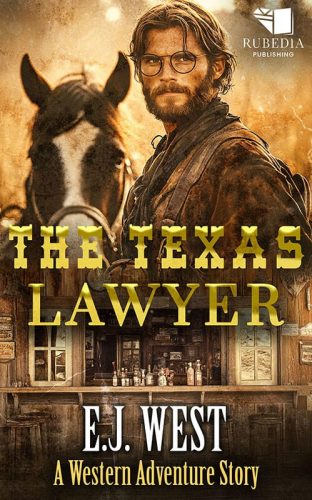
The Texas Lawyer
He came to Austin to bury his brother—he stayed to fight a gang war…
When lawyer Morgan Graves rides into Austin to settle his estranged brother’s affairs, he finds more than dusty paperwork and unopened whiskey bottles. His brother was murdered. His saloon is now ground zero in a brutal turf war led by Callum Ramsey, a cunning saloon baron with hired guns and half the town in his pocket. But Morgan isn’t the only one standing in Callum’s way.
Clara Thatcher, a widowed rancher and mother, has her own battle—fending off Callum’s men from seizing her land. Outnumbered and outgunned, Clara turns to Morgan for help, and they become unlikely allies in a fight neither of them can afford to lose. As bullets fly and loyalties shift, Morgan must trade his courtroom ethics for frontier justice.
The law can’t stop Callum—but a gun just might…


Prologue
Fort Worth, Texas, 1875
“… and well, everything looks pretty clear from where I’m standing, Mr. Peralta.”
Morgan Graves shuffled the last of his papers before dropping them in a loud thump on his table, right in front of the small man in the very expensive gray silk suit. This was Cristo Peralta, the owner of C & P Bank, who seemed to make it his personal business to terrorize the good folks of Fort Worth, as far as Morgan could see.
Good folks like the Sawyers, Morgan thought. The Sawyer family was poor tenant farmers who had come begging to him for help.
Because this bank man has decided to take them for everything they have and more… Morgan squinted at the man. Just because he can.
Morgan knew he was a tall man, taller than Cristo was, with short dark hair and a tidy dark beard. He used that height difference to his advantage as he leaned down to place his fists on his own table, looming over the smaller man.
This really wasn’t how things like this were supposed to be done. Morgan slowly raised one hand to adjust the spectacles on his nose, and glared down at Cristo over them.
But Morgan had to admit that it was fun, scaring parasites like Cristo Peralta. Threatening greedy bankers and slumlords with the law was one of the most enjoyable parts of his profession as a lawyer, he had to admit.
Well, that… and seeing the faces of the people that he’d defended, as relief washed over them.
Harsh, dusty sunlight glared in through the window from the day outside. The muted sounds of shouts and the clatter of hoof beats rose to their ears. Somewhere, someone was arguing about a gambling debt, and someone else was threatening to beat ten kinds of hell out of someone.
This was the Wild West. And some days, Morgan could believe that the only justice that his clients ever saw was either with a gun in their hand—or through him.
And in truth, I’m not sure which one is better some days, either… Morgan fixed the banker with a hard stare, and saw Peralta’s outrage collapse into desperation.
“Counter sue, you say? I mean… but the Sawyers don’t have that kind of money!” The bank manager looked at the giant stack of papers, and swallowed nervously.
“I’m working for the Sawyers free of charge. I figure that the amount we’re going to make when we sue you for clearly breaking the National Banking Act of 1863 and 1864—well, it’s going to more than pay my fees.” Morgan straightened back up, this time crossing his arms over his chest and beaming down at the man as if everything was settled.
The look on the bank manager’s face said it wasn’t—but Morgan knew when he had a man beat. Especially a low-life like Peralta, who falsified debts and claims and made up bogus laws like ‘Urgent Land Reevaluation Notices’ that he would send to tenant farmers to scare them into selling their properties.
Tenant farmers like the Sawyers, Morgan thought grimly.
“I, uh… I’ll take a look at the Sawyer account myself. I’m sure there’s something we can do about it,” Peralta muttered, jumping to his feet and grabbing his hat (it was a stovepipe one, which Morgan reckoned the man had probably bought to make himself appear taller).
“I’m sure there is, Mr. Peralta,” Morgan smiled, and tapped the desk. “Don’t forget the legal notices and code of banking. I’m sure they will prove very enlightening reading for you.”
The bank manager scowled at that, stopping hurriedly to snatch the stack of a hundred sheets of paper, bound with legal red thread. With a barely muttered, “Good day to you, sir!” he was out of Morgan’s second-floor office—just in time.
“Mr. and Mrs. Sawyer? Please do come in!” Morgan boomed in a loud voice over the shoulders of Cristo Peralta, as the bank manager skidded to a stop in the doorway, seeing the very farmers that Peralta had hoped to scare off their property.
Mr. Sawyer was a thin man with light blond whiskers—the sort of fellow who looked as though he skipped as many meals as he ate. But his and his wife’s clothes were clean and tidy, despite their simplicity.
Peralta garbled something that could have been a greeting or a groan—rushing past the Sawyers where they stood in the hallway outside Morgan’s office—and took to the stairs with dedicated speed.
“Mr. Graves, sir?” the man, John Sawyer, turned to look at him with a face that was half hopeful, and half a mask of anxiety. Morgan gave him a reassuring nod.
“He won’t be bothering you for a while, Mr. and Mrs. Sawyer. I am pretty certain you will get some pompous letter in the next few days suggesting that there was some terrible mistake, and you don’t owe them any money,” Morgan smiled, stepping out of the way and gesturing for them to enter.
“Oh no, we can’t come in, sir. Straight after this we have to pick up our little Maisy from the doctor’s, and we want to get her back home just about as soon as we can, if you don’t mind,” the man said, wringing his cloth cap in his hands in worry.
“Of course,” Morgan said at once.
Glory be! For some folks it never rains but it pours, don’t it?
Morgan felt his heart ache. He knew that he was one of the lucky ones, while families like the Sawyers were definitely the unlucky ones. His parents—although both were long gone now—had a chance that few people these days had. His father had inherited enough money from his father to train as a lawyer, and had set up this very practice in Fort Worth, for Morgan to inherit once his father had passed away.
And I hope I did as good a job at it as he did, Morgan thought.
“Go to her. Here.” Morgan fished inside his breast pocket, pulling out a billfold with a few notes secured in a clip. He took the first two crisp notes, and handed them to the man.
“For the doctor’s fee. It should cover some groceries for a few days, as well,” Morgan insisted. Mr. Sawyer tried to resist, but a man in his position really didn’t have the choice to say no, and he knew it.
“But I still owe you your fees, Mr. Graves. We can’t—” the man started to say.
“Forget about that. I’m happy to take schlubs like Peralta down a peg or two for free. You aren’t the only family C & P Bank has tried to rinse some money out of, and now that he knows that Graves Solicitors are on his case, I am sure he will toe the line—at least for a little while.” Morgan said.
He saw the Sawyers’ faces flush red, and then a look of disbelief crossed their faces. “You’re not going to charge us?”
“Not if he drops those ridiculous bills. Now go. Get to your daughter!” Morgan laughed at their surprise. In truth, it was almost payment enough to see the look on their faces when they realized that perhaps things did sometimes turn out for the best.
We have to be there for each other in this life, Morgan remembered his father’s favorite quote. It was the entire reason his father had become a lawyer in the first place. We have to do right by each other—because that is all we got.
“But I would still advise moving out, Mr. Sawyer, if you can manage it,” Morgan called out to them as the family took the stairs. “Take your time about it, and look for a decent contract—but you don’t want anything to do with guys like Peralta.”
“Yes, sir! Been thinking about it, sir!” Mr. Sawyer said, still giddy with celebration as his and his wife’s tired boots clattered down the stairs, leaving Morgan Graves in his doorway, with another case closed.
“Did I do right by you, Pops?” Morgan whispered softly, closing the door after them and turning to see the small picture he kept of the great man on the wall over his desk. The name of Jeremiah Graves still went some ways in this town, and every day when Morgan put on his waistcoat and settled into work, he tried to uphold that great name.
But it wasn’t just his father that Morgan found his eyes turning towards. They sought out the smaller photograph, held in a bronze frame on the desk, next to his inkwell.
Mary.
In her picture, Mary Graves had no touch of crow’s feet that her widow’s face now wore. She had no silver threads beginning to twine through her hair as Morgan, at thirty-seven, now did. Morgan reached down and turned it just so that it caught the light a little more, and imagined how that light would have fallen on her strawberry-blonde hair.
She had been a beautiful woman, and there was no denying it. Taken too young in childbirth. Not even their baby daughter survived.
Morgan guessed he would never have a little girl like the Sawyers had Maisy. Not now. When he was truthful with himself, that was why he had decided to take on their case in the first place. No child should have to go through that. A child deserved a stable home—the sort of home that he would have provided, had his wife and their girl lived.
“Ah,” Morgan sighed, sliding his spectacles off and pinching his nose as a wave of emotion threatened to roll through him.
What was there left for him, really, apart from this work?
The sounds of Fort Worth outside swirled in under the slightly open window, along with the harsh Texan heat. Someone was chopping wood. There was a different argument going on now, about barrels—and there was the whistle of work teams or Texas Rangers as they marched past.
Life went on. The South rebuilt itself after the war. Mary and his parents both were a long time gone. He hoped that he was a good man and that he honored their memory…
But was this all there was?
“Mr. Graves, sir!”
Morgan was startled by a sudden hammering on his office door. He recognized that voice anywhere. It was Eustace Stubbs, his farm hand.
“Eustace?” Morgan called, turning as the door opened to a beanstalk of a boy, tall like his four brothers were, with hair so red that it made Morgan feel sunburned just looking at it.
But Eustace was a good lad. At nineteen years of age, he looked after Morgan’s smallholding, including the hens and the small head of sheep he had, in return for a portion of the profit.
“Urgent message, sir. Messenger rode straight to your front door all the way from Austin, Boss,” Eustace said, holding out a large, folded envelope.
Austin? Morgan blinked. His mouth went suddenly dry. There was only one reason for anything to be coming to him from Austin, Texas—and that reason would be Garrett Graves, his older brother.
Morgan accepted the parchment silently, as Eustace bobbed his head. The younger man cast a look around the chamber before sauntering over to the large water cylinder and helping himself to a long draft. That was the farm hand all over. He didn’t wait on formalities for anything—and that is exactly what Morgan liked about him.
“The sheriff sent the messenger, you say?” Morgan asked, turning the envelope over and, uncharacteristically, pausing as he dreaded just what he was going to find inside.
What have you gone and done now, Garrett?
Morgan pursed his lips as he picked up the small bronze letter opener from his desk and tried to imagine good news. It was impossible. Town sheriffs weren’t exactly known for spreading cheer wherever they went.
Worse still, was the fact that there were plenty of reasons why his older brother might be the subject of a sheriff’s letter.
Garrett hadn’t exactly fallen into the family business. Truth be told, he had fallen about as far from it as was humanly possible. Morgan remembered him as the fun and exciting older brother who was always doing something exciting, and always wanted to do more. He would be the one who knew which of the flooded quarries would be safe to swim in. Garrett Graves would know where there was a bear den, or which of the old mine cottages were being used by moonshiners.
Garrett Graves was, in essence, someone who had his nose screwed on for trouble from the moment he was born, as Morgan remembered their departed mother saying.
Which would have been fine, if that had been all the trouble he had got into, Morgan grimaced, and slid the letter opener up the gummed edge of the envelope.
After that, unwise swimming expeditions and hunting and bottles of hooch had become bar fights, and even rumored petty theft. Garrett had fallen in with a bad crowd, and Morgan remembered things in that last year getting worse and worse between Garrett and their pops.
Until you kicked him out, and he moved to Austin, Morgan silently shot a look at the picture of ‘Pops’ Jeremiah Graves on the wall. Morgan still didn’t know if that had been the right thing to do or not.
“Let’s see now,” Morgan opened out the letter, and read the contents silently. He remained silent for a long time after, too.
“Boss?” Eustace looked from where he had sauntered to the window to look down on the Fort Worth high street.
Morgan wasn’t quite sure what to say. What was there to say at a time like this?
“Eustace… you’ll be good at the farm for a few days—maybe a couple weeks at most, won’t you?” Morgan said lightly, as he felt his chest turn over and over.
“Sure. If you need me. I basically live there, right?” Eustace shrugged, and then suddenly frowned. “Why? What is it, Boss?”
Morgan looked at the letter for another long minute. “I’m leaving town for a bit. Going to Austin to deal with my brother’s effects. My older brother is dead.”
Chapter One
Morgan, Austin, Texas
Harsh sunlight struggled to cut through the haze of wagon-and-cattle dust as Morgan Graves eased his horse to a gentle walk by the side of the road.
The fact that Austin had a road and not a trail was telling at once. Morgan could see that the town ahead of him was booming, with a heavy mix of traffic. Wagons, riders, and a herd of steers were being driven across the road to the cattle yards to the east of the town.
Busy. Too much noise, too many people, Austin thought at once, keeping his kerchief up over his nose and mouth until the dust started to settle.
The air was filled with shouts and the jostles of animals of everyone and their aunt seemed to be going about the business of making money—or looking to spend it.
“You need a hand, sir? Need a lodging house? Need a job? Game of chance? You need some female cheer for the night?” a voice called up to him out of the murk, and Morgan turned to see a lad of no more than Eustace’s age—nineteen summers, or thereabouts—in drab, dust-laden clothes but with a tattered, fancy jacket coat over his shoulders.
There was no way that a youth of that age could have afforded that jacket, Morgan thought. That meant it was probably either stolen or a dead man’s goods. He was probably employed by one of the saloon managers to bring in trade. As Morgan looked down at the youth, he could hear other hawkers moving up a line of wagons, rapping on wooden boards and offering every service from woodwork to dancing girls.
“Nah, I’m good thanks,” Morgan shook his head, his kerchief hiding his grimace of disgust.
So, this was the sort of town his brother had chosen to settle in, was it? It had the feel of a place that was getting too big, and too quickly. In places like that there were always those who came to make an easy dime.
“But you can tell me where Graves’ Saloon is. And the sheriff’s station,” he said.
“Why, that’s a pretty combination,” the youth laughed, displaying black gaps where at least three of his teeth should have been. “What’s it worth?”
Not getting a box around the ear? Morgan resisted saying. He was aware that, even though he was wearing his traveling kit—a light poncho of heavier shirt and trews for the two weeks he had taken to get here—it was still finer and better made than many could afford around here.
“Here,” He fished into his pocket, pulled out some small change and threw it at the lad, who laughed, snatching one spinning coin out of the sky a moment before his foot stamped on the one that had hit the ground.
“Straight down and turn right. You can’t miss it. It’s the place with the broken door and the deputy standing outside of it,” the youth shouted up.
“And the sheriff’s station?” Morgan demanded. What, is there only one place in all of Austin with a broken door?
The youth shrugged. “This amount of coin only gets you one answer, mister!” The youth laughed, and sprang away before Morgan could decide that the exchange had been mostly one-sided… not that Morgan had expected much else, if he was honest.
Morgan let the youth go, and ambled into the town of Austin as discreetly as he could. He wanted to get an eye on the place where his brother had set up shop.
You were only a couple weeks away, Garrett. You could have come back, at any point, Morgan said silently to the shade of his brother. Although it was a lie, and the lawyer knew it.
Pops was harsh on you, wasn’t he? Morgan thought, and wondered how he felt about that. Garrett was the older brother. He was the one who would naturally clash with his father the most—but even Garrett had pushed it too far. Their father had disowned him as soon as he heard from his lawman contacts about the sort of people with whom his eldest son was hanging around.
“Heaven only knew how you could afford a saloon,” Morgan whispered to the unseen shadow of his older brother. Garrett Graves—as far as Morgan remembered him anyway—had never been one to hold onto money.
But it was clear Austin was a place where money flowed. Most of the businesses were houses constructed in stone with wooden porches. The town itself was filled with wide, grid streets, and with hard-eyed men who stood on street corners. There were shops galore, with everything from druggists to bookstores down the main avenue, as well as general stores, trappers, chemists, and of course—saloons.
Even this early in the afternoon, Morgan heard the tinkle of keys from a piano coming out of swing doors, and the chorus of laughter and harsh voices. Morgan wasn’t immune to a shot of rye himself, but he knew his limits. He wanted to be a lawyer who people turned to, not the lawyer that people avoided.
He tipped his hat to some of the folks who cared to stop and stare at him—Morgan got the sense that staring at the newcomers was a bit of a local sport around here—and turned the indicated corner.
His brother’s saloon was on another wide street, sitting next to a pharmacy and a general store, while on the other side of the street there was a slightly larger, better-kept saloon known as The Stokes Star Inn.
Morgan turned his attention to his brother’s great project to find that the building was large enough, but its porch was sagging and the large sign above it was hanging on three pins. Faded and flaked paint read Graves’ Saloon, although most of the letters were illegible.
Maybe you didn’t have that much money in the end, Morgan thought, turning his horse—a bay called Champion—towards it to see that the young miscreant had been right.
Outside the front door, leaning against the railing, was a man with a cowboy hat, a kerchief around his neck, and a deputy star on his breast. The man was big and freckled, and looked up as Morgan approached, but said nothing.
“Sheriff Kane?” Morgan said, pulling his kerchief down and reaching for the letter from his saddlebags.
Immediately, the deputy straightened up, one hand moving to the six shooter on his belt.
“Easy there,” Morgan showed the man his hands. So it’s THAT kind of town, is it? Morgan was getting less and less surprised his brother had chosen to settle here with every passing minute.
“I got a letter. From Sheriff Kane,” Morgan said, slowly reaching down to fish it out of his bag.
“Wallace! What’s that? Who’s that you got there?” a voice shouted from the shadows past the saloon doors, as a young man marched out, and glared imperiously at Morgan.
The man wore a ten-gallon hat and the same uniform of tidy shirt and trousers, plus a kerchief around the neck. The star on his sleeveless jerkin was a little larger, however.
“Sheriff Kane?” Morgan had been around enough lawmen in his years to notice the difference in badges.
The man was younger than he was, Morgan saw, and he kept his appearance smart and clean-shaven. But Morgan did notice that he had a pistol on each hip, which was unusual. It was usually bravos who wore two guns… or people who were really good.
“That’s me. Who’s asking?” Kane fixed Morgan with a heavy glare. It seemed that the man was used to being hard first and then asking questions about it afterwards.
Morgan flashed him a wry smile. “You asked me. Here. To my brother’s saloon.” He waved the letter in the air between them, and saw Sheriff Kane’s face suddenly drop.
“Ah. You’re the brother. Morgan Graves.” The sheriff didn’t entirely relax, and Morgan could see the man’s eyes measuring him, sizing the sort of man he was.
“I am the brother. Lawyer. Graves and Sons, Fort Worth,” Morgan swung himself from Champion’s back, patting her flank and offering her some of the dried chips of apple before leading her to the bar.
“I’m sorry for your loss, Mr. Graves—” the sheriff began.
“Are you?” Morgan asked quickly, unable to stop himself. Maybe it was the long ride. Maybe it was the fact he was here to bury his brother. But Morgan realized in that moment he had no idea who killed his brother—or why.
“Every death in this town is my business,” the sheriff said a little more stiffly.
Next chapter ...
You just read the first chapters of "The Texas Lawyer"!
Are you ready, for an emotional roller-coaster, filled with drama and excitement?
If yes, just click this button to find how the story ends!