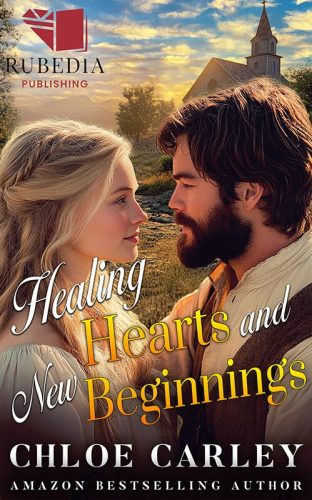
Healing Hearts and New Beginnings
I left everything behind to find a new purpose, not to be drawn to the man who’s testing my patience…
Disowned by her family after vicious rumors ruin her reputation, Amber is lost and searching for purpose. When a divine vision calls her to a ranch in Montana, she believes God is leading her to travel west. She is determined to become the wife of a rancher trying to adopt a traumatized little girl. But her faith is tested when she clashes with the gruff, skeptical Landon…
Landon’s heart turned cold years ago, scarred by betrayal and heartbreak. Once deeply faithful, he now focuses only on keeping his ranch afloat and protecting the little girl he’s trying to adopt. Amber’s inexperience and pampered upbringing irritate him, but her quiet resolve begins to challenge the walls he’s built…
As old enemies and new threats close in, they must learn to trust in God—and each other—before everything falls apart…
Do not conform to the pattern of this world, but be transformed by the renewing of your mind.
Then you will be able to test and approve what God’s will is—his good, pleasing and perfect will.
Romans 12:2


Chapter One
En route to Frazer, Montana
Late June 1867
Amber Wilson regretted having prevailed upon an obliging hotel maid to help fasten her stays before she’d boarded the stagecoach for the last leg of her journey across the continent. The closer she was to reaching her destination, the harder it was to catch her breath.
The galloping horses continued across the wild and unsettled landscape that was so different from what she’d known in Boston. It had all seemed exciting and adventurous when she’d gotten on the train in Boston. It had continued to feel that way until she had entered that alien part of the United States which claimed no cities, no industry, and certainly no railroad tracks.
“Frazer is the next stop, my dear,” said the garrulous woman who’d traveled with her through a sufficient number of US Territories to discuss, at some length, her plans to join her sister in Oregon. It was now a state, Essie Hofbrauten had informed her with pride, and she was going there to help her sister whose husband had died of cholera, leaving the widow with five children.
Amber tried to smile and inhale at the same time, but for some reason, the tightness of her corset stays seemed to prevent even her lips from moving.
“You must be so excited at the prospect of meeting your intended,” Essie declared, squeezing Amber’s gloved hand with her own.
Amber swallowed and nodded. Of course she was excited to finally meet the man she was going to marry. Wasn’t she excited? Of course she was. She had taken special pains to arrange her honey-gold hair in an artfully stylish manner so that her husband would find her attractive. She had chosen to travel in a beige traveling suit so that her brown eyes would appear to their best advantage.
If only she had considered that excitement, combined with the narrowed circumference of her waist, would imperil her ability to breathe comfortably, she would not have asked the maid to pull the stays so tight. She wanted to make a good impression on her future husband, and for a young woman of fashion and breeding, the width of one’s waist was of paramount importance. Especially a woman of twenty-four years, who by the customary dictates of society, ought to have been a wife and mother by this time.
“Now, you have my sister’s address,” Essie went on, “you must write and tell me all about Montana. I’m sure it will become a state at some point.” The older woman’s pitying manner indicated that Montana could only aspire to whatever grandeur Oregon had achieved.
Amber nodded. As she did so, a wayward lock of hair escaped the confines of her bonnet with its lovely tan plumes and fell against her cheek. Amber grabbed the rebellious hair and impatiently tucked it behind her ear.
“Never mind, dear,” Essie said. “You’re so very pretty that your young man will be dazzled by the sight of you.”
Landon wasn’t exactly young. He was thirty years old, but Father Norris was of the opinion that her husband-to-be’s maturity was a benefit. He would be settled, the priest assured her. Established. Not the sort to go off to the gold fields which had attracted numerous adventurers from all over the globe. Landon Brown’s character had been vouched for, via letter, by an acquaintance of Father Norris who was well acquainted with the rancher.
Mr. Brown needed a wife, and he had a child who needed a mother. Amber needed a husband and a home.
Amber sighed, or at least exhaled within the limitations imposed upon her by her corset. While she was still in Boston, having taken sanctuary with the priest and his sister, she had been imbued with optimism that a most unusual dream she’d had, combined with Mr. Brown’s plight, were signs from God that there was no reason to fear—God’s plan was proceeding as ordained. Only now, thousands of miles away from home, did she quail at what she’d done.
She had not told Essie the circumstances in Boston which had driven Amber into a mail-order marriage. Essie was not a Bostonian and saw nothing off-putting about a mail-order bride journeying across the continent to marry a man she had never met.
“Dear, are you unwell?” Essie took out her handkerchief and began dabbing at Amber’s cheeks. “You are flushed.”
“I—it’s very hot,” Amber said, taking her ivory fan in hand. “I wonder if it’s always so very hot here.”
“I believe Oregon has a more moderate climate,” Essie said.
Amber fanned herself furiously. Too furiously, for yet another lock of hair sought release from the pin holding it in place and trailed down the other cheek.
“No doubt,” Amber said. “I am sure that Oregon has much to boast of.”
Essie was impervious to Boston sarcasm. “Why, yes,” she agreed. “My sister tells me so often in her letters, and soon I shall see for myself.”
The stagecoach came to a stop. Amber’s brown eyes widened. She was about to lose the only person she knew in this frighteningly raw place called Montana.
Essie hugged her. “It will be well,” she assured her. “You will meet your rancher, and you will be married. That’s why you’ve come this far.”
“Yes,” Amber affirmed. That was indeed why she had come so far. Not that she had had any other options.
Because she was the only passenger disembarking from the vehicle and because the stagecoach was on schedule to pick up more passengers at Fort Benton, there was no opportunity for Essie to get out to stretch her legs after the journey. Amber swallowed hard to keep tears from forming.
“I shall pray for you, my dear,” Essie assured her.
“Please do,” Amber pleaded, suddenly stricken by the thought that she was a stranger in this place.
“And you shall pray for me and my sister and her five little ones,” Essie nodded. “God will be with us, no matter the miles in between.”
The stagecoach door opened. The driver, a burly man with skin the color and texture of the boots on his feet, stood there, his hand out to help her down. Amber gathered as much air as her lungs allowed and stepped down.
The street upon which she now stood was packed dirt. On one side was a saloon, a general store, a land agent’s office, and a hardware store. Each building attested to its purpose by way of painted signs of varying size and length, but all looking as weathered as the structures below. On the other side of the street, Amber saw an edifice whose sign declared it to be a hotel.
Amber, accustomed to the hotels in Boston, wondered whether there was room within its walls to house guests; it seemed so small. There was a barber shop next to the hotel. A sign overhead informed potential customers that the price of a bath was fifty cents for fresh water or twenty-five cents for used water, except on Saturday nights, when the cost rose to seventy-five cents.
Amber turned her head. Suddenly the dandies of Boston, with the scented pomade in their hair and their waxed mustaches, did not seem like such figures of fun.
The driver pointed to the side of the dirt street. “There’s your plunder,” he said, referring to the two trunks, three valises, two carpetbags, and a like number of hatboxes stacked like a teetering pyramid upon the wooden planks that served as a porch for the general store. “Ma’am, you must have more duds than any other woman in town. Maybe in all of Montana Territory.”
“I—could not be sure of what attire I might need in this unfamiliar climate,” Amber said with dignity. “It is very hot.”
“Hot?” the driver hooted. “You call this hot? Why, ma’am, I’ve known Montana to get up to one hundred degrees in the depths of summer.”
“That—that must be quite sweltering,” she returned, fanning herself as if the temperature had soared upon the driver’s words.
“You got someone comin’ to fetch you?” he asked. “I gotta make Fort Benton before—”
“Yes, thank you, Mr. Leroy,” Amber said, holding out her hand and watching as her white-gloved fingers disappeared in the driver’s leathery paw. “My fiancé will be arriving.”
“I hope he brings a wagon,” the driver intoned darkly. “Never seen so many bags for one person in all my born days.”
Apparently, the amount of her luggage was not merely a matter of speculation for the driver. After the stagecoach pulled away, Amber was aware of other eyes gazing at her, at the stacked luggage beside her, and then back to her once more. She stood stiffly, meeting no one’s eyes, maintaining a dignity that she was far from feeling. Her elaborate bonnet, with its dyed plumes and silk sash, no longer seemed like the sort of millinery that would command the approving attention of the Montana rancher she was to marry. Her fashionable button-up boots, which had been purchased at Boston’s most elegant shop, were now coated with a thin patina of brown dust.
More eyes looked upon her. Everyone passing by looked upon her. She was just about certain that even the horses trotting down the street paused to look at her when she saw a man striding toward her. He was coming from the direction of the barber shop.
He was tall, moving with a brisk gait that allowed for no wasted movement. His wore one of those Western hats she’d noticed other men wearing, with a brim that shadowed his forehead and eyes. His trousers had no crease. The sleeves of his white shirt were rolled up to his elbows, revealing broad forearms and wrists.
He stopped in front of her. “Miss Wilson?” he inquired in a deep voice. When he removed his hat, Amber saw that his hair was a rich shade of brown, the color of coffee before cream was added, and curly.
“Mr. Brown?” she queried, transfixed by his rugged good looks and at the same time, hoping that if he’d gone to the barber shop for a bath, he had paid the fifty cents demanded for fresh water.
He nodded. “This all yours?” he asked, paying scant attention to her exquisite bonnet and traveling costume. Instead he focused upon the trunk, valises, carpetbags, and hatboxes which occupied the space beside her and reached to her waist in height. Amber was a tall woman; she supposed that made the altitude of her luggage even greater.
Landon Brown did not appear to be enthusiastic at the prospect of a bride who came with such an abundance of luggage.
“Yes, I—is it customarily this hot?” She fanned herself again, the ivory handle of the fan slick from perspiration.
She couldn’t breathe. Her lungs wouldn’t work. She felt a trickle of sweat begin to slink down from her temple. Her throat was dry. “I wonder if I might have—”
She leaned forward. She saw Landon Brown put out his hand as if she were about to fall, which was nonsense of course, because she had no reason to fall. No reason at all, except that the sun was making her see a series of black dots in front of her eyes and she couldn’t decide whether it was better if she leaned forward or backward just a bit to compensate for the dizziness she felt.
She fell to the dirt in a swirl of plumes and petticoats, chagrined even as her consciousness fled that her fashionable attire was now displayed for the fascinated attention of her new neighbors in Frazer, Montana.
Chapter Two
Something was brushing against her nostrils, tickling her nose. Opening her eyes, Amber was greeted by a glacial pair of pale blue eyes that contrasted vividly against the tanned skin of the man she was going to marry.
“What—what—that’s my bonnet!” she yelped, scrambling to her feet as Landon Brown swished one of the plumes beneath her nose.
“I don’t carry smelling salts,” he offered laconically.
“I have some in my bag,” she told him.
One long, measuring appraisal of the mound of luggage told Amber just what Mr. Brown thought of her assortment of bags. “This was quicker than plowing through all of that,” he said. “My apologies for not breaking open your luggage to find your smelling salts.”
He might be a rough-edged frontier rancher, but Landon Brown understood the nuances of sarcasm as Essie had not.
“I understand,” Amber submitted, knowing when she was bested. “But I don’t understand what happened.”
Landon Brown, who was bent at the knee and leaning on his haunches with no indication of discomfort, gave the plume one final twitch against her nose, almost playfully. “You fainted,” he said, standing up and holding out his hand to help her rise. “I reckon Frazer hasn’t had this much excitement from a stagecoach passenger since Luke Coleman stepped out, took one look at the town, and shot the driver.”
Amber’s mouth opened wide with dismay. “He shot the driver?”
“Didn’t kill him, just shot him,” Landon explained. “They made up over a few drinks yonder at the Devil’s Ransom Saloon.” He gestured with his free hand, the one that still held hers although she now stood on her own.
“The Devil’s Ransom—Saloon?”
“Yeah, I guess the sign could use a coat of paint,” Landon decided as he glanced at the saloon, his hand poised over his forehead to screen his eyes from the sun’s glare.
“Why is it called that?”
Landon had taken up two of her valises. “Folks say that when Lucifer Hades arrived in Frazer—he goes by Lucifer, you can guess why, but his given name is Lucius—and saw that there wasn’t a saloon, he said he’d build one himself and it would take a ransom from the devil to stop him.”
There might have been a glint of amusement in Landon’s light blue eyes, but then again, it might have been the sun. Amber wasn’t sure. “No one stopped him.”
“I see,” Amber replied, noticing that although it was only mid-day, she had already observed several men pass through the swinging doors of the saloon.
“You well enough so we get a move on?” Landon asked. He pointed to a wagon across the street, where a horse of the most unusual color Amber had ever seen was hitched in front of the barber shop.
“Yes, thank you.” Amber picked up one of her hatboxes. “Is that horse blue?”
“Blue roan,” Landon answered and there was no mistaking the pride in his voice.
“I’ve never seen such a beast before,” Amber breathed.
“Well, give me time and the day will come when I’ll be breeding blue roans to sell all the way to Boston.”
They approached the wagon. Amber put the hatbox in the back, which was occupied by several bales of hay. Landon had already gone back to bring more of her luggage to the wagon. She hoped there would be enough room for her belongings.
Before she went back for the second hatbox, Amber couldn’t resist the temptation to meet the blue roan.
“You’re a beauty, you are,” she said, unconsciously mimicking the Irish accent of Donal Flaherty, one of the residents of the Boston neighborhood known as Little Ireland. She had often accompanied Father Norris on his pastoral visits to the inhabitants, many of whom suffered from lung complaints from their labors in the textile mills.
Donal’s lungs weren’t impaired, but he’d lost both his legs in the fighting at Antietam when he’d served as a soldier. With no means of employment and a family to care for, Donal depended upon the generosity of the parish.
Most of the time when they called upon him with a sack of groceries and provisions, Donal talked of the horses he’d trained when he was a lad in Ireland. His words and his accent returned to Amber now.
The mare turned her head at the unfamiliar hand stroking her neck. The horse’s face, mane, and tail were black, but her coat was undeniably blue. Blue-gray, Amber corrected herself, for the color was not as blue as the sky, nor was it as frosty as the light blue of Landon’s eyes. But the blue was there.
The thud of another valise landing in the wagon alerted her that Landon had returned with more of her luggage.
“You like horses?” he asked diffidently, as if her answer didn’t really matter to him one way or the other. But the icy cast of his pale blue eyes seemed to thaw a bit.
“Oh, yes,” Amber exclaimed. “My nanny would have a fit of temper whenever she couldn’t find me because she knew I’d be down at the stables with the grooms, begging them to let me ride.”
“Nanny?” Landon repeated. The eyes were regaining their frosty stare.
“Yes,” Amber answered. “Mummy is British, and when she married Papa and sailed across the Atlantic, she brought her nanny with her.”
“A nanny raised you?”
It seemed an odd question. “She was part of our household. My sisters and I grew up in the nursery. We spent most of our time with her until Miss Simpson—she was our governess—came. Then when we were old enough, we went to finishing school, of course.”
“Of course,” Landon said flatly. He turned on his heels and crossed the street to retrieve the last of Amber’s luggage.
Amber pressed her nose against the mare’s warm neck. She took comfort from the animal’s patience and absence of judgment. If her husband-to-be was already displeased with her because of her luggage, he was unlikely to approve of her at all. The decision to come to Montana now seemed ill-judged, and Amber felt uneasy about the future.
“I seem to have said something amiss, my beauty,” she whispered, once again aping Donal’s Irish accent. “I wish I knew what to say and what not to say. It’s very hard when we think we speak the same language as someone else, only to find out that our words mean entirely different things.”
In order to wedge the last of her baggage into the wagon, Landon needed to remove her hatboxes and place them on top. Amber eyed them. They seemed to be rather precariously positioned.
Landon followed the line of her gaze. “What’s the matter?” he demanded. “With all the bags you brought, those hats need to be on top.”
“I’m fearful that they might fall off,” she told him.
Landon’s lips curved downward. “I know how to drive a wagon,” he said as if by her remark she had maligned his ability to master his horse.
“I’m sure you do,” Amber said, conscious once more that her stays were too tight. She needed to inhale before she continued to speak.
Landon put his hand out. “I need to get back to the ranch,” he said. “I’ve got building to do.”
Tentatively, Amber placed her white gloved hand in his palm. Even through the kidskin, she could feel the heat and strength of his hand. She couldn’t help but recall Rasmus’s slender, white hands when they danced. Her sister Garnet, three years Amber’s senior, complained that Boston men had the hands of a flailing codfish.
Garnet was married to an officer in the Union Army and was disparaging of the men in their social circle who had opted out of fighting in the recent war against the Confederacy, as Rasmus had done, by paying a proxy five hundred dollars to do their fighting for them. Donal Flaherty had been one of those proxies. Amber wondered if her former suitor ever felt guilty to think that he was unscathed because he could afford to send someone else to fight in his place.
It was not a suitable subject for ladies, Amber had often been reminded. But then, many of Amber’s interests, such as accompanying Father Norris on his rounds to the impoverished members of his parish, were not suitable for young Boston ladies. Which was one of the reasons why Amber had not divulged this pastime to her family.
Accepting his help, Amber stepped into the wagon and sat primly on the wooden seat, which was a far cry from the cushioned upholstery of the Wilson family carriage back in Boston. She folded her hands in her lap.
Landon tugged on the reins, and the horse stepped into the street.
“How far are we from your ranch?” Amber asked after the silence lengthened. Raised in the tradition that it was a well-bred young woman’s duty to maintain conversation, she felt obliged to speak.
“Twenty minutes, maybe more, on a good day,” he replied. “First, I need to stop by the Jarrett spread and drop off this hay.”
“Who are the Jarretts?” Amber asked, interested in the prospect of meeting people who would become known to her as she acclimated to her new life. That they were people who would not know of the rumors that had ruined her reputation and caused her parents to disown her made Amber even more eager to develop a new circle of friends.
“Just folks.”
Amber waited a moment. “What sort of folks?” she inquired with studied patience. Landon had seemed to be distant since she mentioned that she’d grown up with a nanny. That was unfair, but she was willing to disregard his reaction. Still, it seemed as though he should be glad that she was displaying an interest in the population of Frazer, Montana.
“Church folks,” he said, spitting out the words like they were morsels of food not suited to his palate.
Again, Amber waited a moment before speaking. “Are not most folks church folks?” she inquired.
“I’m not.”
Amber was so taken aback by this candid admission that she gasped. Landon’s head turned.
“You don’t approve?”
She didn’t know what to say. She shifted in the seat so that she could breathe more freely despite the constriction of her corset. She hadn’t had anything to drink for hours, and she felt a trifle dizzy. “I’ve never heard anyone say that,” she replied.
“Now you have,” he said, turning his attention back to the road that had been carved out of the earth not by engineers or surveyors, but by the hooves of horses over time. On either side of the makeshift road were long stretches of trees with what seemed like spindly trunks to Amber, although they made up in stately height for what they lacked in width below their foliage.
“I trust you won’t object if I wish to attend worship services.” Amber spoke in slightly frigid tones. She had assumed, from the correspondence between Father Norris and his acquaintance in Montana, that Landon Brown was a faithful Christian.
“You can do as you like, as long as the chores are done and Hannah and Aunt Barbara are looked after.”
Father Norris had mentioned that Landon Brown had family in Frazer, but nothing in his information had indicated that Amber was to be responsible for them. Presumably Hannah was the motherless child; Father Norris didn’t know whether Landon was a widower, but it seemed likely. Amber was sure that Father Norris would never have sanctioned her decision to be a mail-order bride if he had suspected that her faithfulness as a Christian was at risk.
“Aunt Barbara is my aunt,” Landon supplied. “She lives with me. She’s…older and a mite forgetful in her years.” The lack of detail in his description made Amber wonder if his aunt’s age meant that she was more than “a mite forgetful.”
“Tell me about Hannah?”
“Look, Miss Wilson…” Landon again turned to her, the reins slack in his hand as if he trusted his horse to know the way without direction. Which, Amber thought bitterly, the horse probably did, for in the time that had passed since they’d left Frazer, she had not seen a single house, person, or even another horse. “I don’t know if this is gonna work.”
“Work?”
“You and me,” he said brusquely. “Getting married. You with your Boston ways and your fancy hats. And your nanny.”
Amber was stricken with panic. She opened her mouth to protest, but once again, the stays rendered her short of air. “You cannot mean that!” she gasped. “I have come all this way to marry you, and I will do all in my power, with the help of Almighty God, to be a good wife to you!”
Landon took hold of the reins with a firm hand, his grip as tight as the unyielding line of his jaw. “I don’t know what kind of life you had in Boston, but Montana is nothing like what you’re used to back East. We work from sunup to sundown here, and everything we have comes from what we do ourselves. We don’t have anyone to depend on but ourselves.
“If you’re going to be a good wife to me,” he said, looking away from her because of the shocked expression on her face, “you’d better have more to count on than Almighty God, that’s all I have to say. He hasn’t sent any miracles my way, so don’t expect any from him here.”
Next chapter ...
You just read the first chapters of "Healing Hearts and New Beginnings"!
Are you ready, for an emotional roller-coaster, filled with drama and excitement?
If yes, just click this button to find how the story ends!