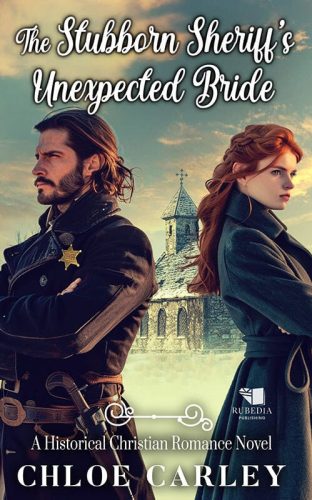
The Stubborn Sheriff's Unexpected Bride
She was always beautiful, but in this moment, lit up from within by righteous indignation, she was breathtaking.
I can’t stay here, Layla Love thought. Every hour is a miserable reminder of everything I’ve lost.
That night, she dreamed of Abraham. Could God be calling her to leave home for a new life—just as He had called others before her?
She would go west on the Bride Train.
What she didn’t expect when she arrived in Franklin, Idaho, was to be chosen by a cruel man. Yet God never left her side. The sheriff’s eyes widened when he saw her—he knew something was very wrong. Without hesitation, he stepped between her and the terrible man… and claimed her as his own.
Noah Rivers had taken responsibility for her on a whim, but a wife was never what he wanted…
What am I doing?

Prologue
Sebring, Florida — Early-Spring, 1866
The scream tore through the night like a wounded animal, raw and primal. Penelope pressed the damp cloth against Lucy’s forehead, her hands trembling. The air hung thick with the metallic tang of blood and sweat-soaked linens. A single oil lamp flickered on the nightstand, casting shadows across Lucy’s pale face.
“It hurts,” Lucy gasped, her fingers digging into Penelope’s arm, turning the warm, suntanned skin pale beneath her grip. “Penelope, I can’t—”
“Yes, you can,” Penelope interrupted, forcing conviction into her voice even as fear clawed at her chest. “Remember when you faced down that drunk at the inn? You didn’t flinch then.”
Lucy managed a weak smile through her pain. “That was different. I had you beside me.”
“And I’m beside you now,” Penelope whispered, tucking a loose strand of her dark hair behind her ear as she leaned closer. “I’m not going anywhere.”
Another contraction seized Lucy’s body. Her cry pierced the air, and Penelope felt her own heart constrict. Through the thin walls, she could hear other tenants’ footsteps, quick and deliberate, as if they could outrun the specter of death hovering in the room.
“Tell me again,” Lucy panted when the pain subsided. “About the apple pie we stole.”
Penelope’s lips curved into a bittersweet smile. “You convinced me that Mrs. Henderson had baked it specifically for us hardworking kitchen girls.”
“It was true,” Lucy insisted, her attempt at indignation marred by another grimace. “She just didn’t know it yet.”
The memory hung between them, precious and fragile, a reminder of simpler times before war had stolen fathers and brothers, before Lucy’s circumstances had become so desperate.
“Mary,” Lucy said suddenly, her gray-blue eyes focusing with startling clarity despite the exhaustion carved into every line of her face. Damp blonde curls clung to her forehead, darkened by sweat. “If it’s a girl, I want to name her Mary. After my mother.”
“Mary,” Penelope repeated. “It’s perfect, Lucy.”
Lucy’s hand found Penelope’s. “Promise me something. If anything happens to me, you’ll take care of her.”
“Nothing is going to happen,” Penelope said firmly, even as dread pooled in her stomach.
But Lucy wasn’t listening. With fumbling fingers, she reached for the thin leather cord around her neck, pulling until the small wooden cross came free. It had been her mother’s, a humble family heirloom smoothed by years of prayer.
“Take it,” Lucy pressed the cross into Penelope’s palm. “For Mary. So she’ll know that God is always with her, even when I can’t be.”
“Lucy, no—”
“Please,” Lucy whispered, and Penelope saw acceptance in her friend’s eyes.
The small bedroom was stifling despite the open window. A single oil lamp flickered on the washstand, casting dancing shadows across Lucy’s pale face. The midwife, a wiry woman with silver-streaked hair pulled back in a severe bun and hands that moved with practiced efficiency, bent over Lucy, her weathered face tight with concentration. Penelope hovered near the door, wringing a cloth in her hands, her dark eyes wide with worry.
Lucy’s scream tore through the room as her body tensed. The midwife barked orders. There was more blood than seemed possible, soaking through the carefully prepared sheets.
Then came a new sound; a thin, wavering cry that grew stronger. Her.
The midwife placed the infant in Lucy’s arms. Lucy gazed down at her daughter, her features softening with a look of profound love. “Hello, little Mary,” she murmured, kissing the baby’s forehead. “She’s perfect.”
“She is,” Penelope agreed through tears.
Lucy’s arms began to tremble, and Penelope quickly took the baby, cradling the warm weight against her chest.
“Take care of her,” Lucy whispered, her eyes already glazing. “Love her for me.”
“Lucy, please,” Penelope choked out. “Stay with me.”
But Lucy’s grip was weakening, her breathing shallow. “Tell her she was loved. Tell her she was wanted.”
“Lucy, don’t—”
“Promise me, Penelope.”
“I-I will,” Penelope replied. “I swear it, Lucy.”
Lucy’s hand went slack. Her chest rose once more, then fell, then was still.
The midwife moved forward to close Lucy’s eyes, her expression grim but unsurprised. Penelope sat frozen, the baby warm against her chest, her friend’s body growing cold, the wooden cross clutched so tightly it left an imprint on her palm.
The baby began to cry again, hungry and insistent. Penelope looked down at Mary’s scrunched face and felt panic rise in her throat.
She was a twenty-two-year-old orphan with no money, no home, and no family to turn to; nothing but the clothes on her back, a dead friend growing cold beside her, and a newborn baby who would starve within days if Penelope couldn’t find a way to feed her.
She moved to the window. Outside, dawn was breaking over Sebring, painting the sky in shades of pink and gold. Out there, people were waking to ordinary lives, unaware that Lucy Monroe had just left the world.
Penelope pressed her lips to Mary’s forehead and felt the wooden cross pressing against her palm like a prayer.
“I don’t know how,” she whispered to the sleeping infant, to God, to Lucy’s spirit. “But I’ll find a way.”
“The Lord is nigh unto them that are of a broken heart; and saveth such as be of a contrite spirit.”
She wasn’t sure if she was praying it, remembering it, or clinging to it like breath—but the words were all she had left.
The baby nestled closer, seeking warmth in the only arms that would hold her.
Penelope closed her eyes and prayed with desperate fervor. “Lord, please. Show me what to do.”
But the dawn offered no answers, and the road ahead stretched dark and uncertain before them both.
Chapter One
Sebring, Florida — Six weeks later
The autumn sun beat down mercilessly on Penelope’s back as she trudged along the dusty main street of Sebring, her arms aching from the weight of the baby she’d been carrying for hours.
Her petite frame felt even smaller beneath the weight of her exhaustion. Long dark hair, once neatly braided, now escaped in disheveled strands around her tanned face. Her traveling dress, threadbare and patched in places, clung to her with dust and sweat. Deep brown eyes, expressive by nature, held shadows that spoke of grief too fresh and burdens too heavy for someone barely twenty-two. The wooden cross at her throat caught the sunlight as she shifted Mary’s weight, the only piece of beauty left to her now.
Mary had been crying on and off all morning, her tiny face scrunched and red, her gray-blue eyes, so like Lucy’s, squeezed shut as her wails echoed off the wooden storefronts and drawing disapproving stares from passersby. Penelope’s dress clung to her skin, damp with sweat and sour milk, and her feet throbbed in boots that had worn through at the soles two months ago.
She hadn’t eaten since yesterday morning. The last of Lucy’s saved coins had gone to the midwife and the undertaker, leaving Penelope with nothing.
The boarding house landlord had given her until sundown to vacate the room, his expression hard and unyielding when she’d begged for just one more day. The inn where she and Lucy had worked in the kitchen had turned her away that same afternoon, the owner’s wife taking one look at the baby and shaking her head with finality.
“Can’t have an infant in the kitchen,” the woman had said, not unkindly but firmly. “Health concerns, you understand. Besides, you’d need someone to watch her while you work, and we can’t afford extra wages for childcare.”
Penelope had understood perfectly. She nodded, thanked the woman for her time, and walked away with Mary pressed against her shoulder and despair settling like lead in her chest.
Now, as the sun climbed higher and Mary’s cries grew more desperate, Penelope found herself standing outside the Sebring Orphanage, a squat brick building with narrow windows and a wooden sign that hung crooked on its post. She stared at the door for a long moment, her throat tight and her eyes burning with unshed tears.
This wasn’t what she wanted, and she knew Lucy would have hated the thought of her daughter being handed over to strangers. But what choice did Penelope have? She had no means to feed the baby, no roof to offer her, and no way to provide the life she deserved.
The wooden cross hung heavy around her neck, tucked beneath her dress where it rested against her skin. She touched it through the fabric, drawing comfort from its familiar weight as she silently begged God for guidance and forgiveness.
“Forgive me, Lucy,” she whispered, then climbed the three stone steps and knocked on the door.
A severe-looking woman in a steel-gray dress answered, her iron-colored hair pulled back so tightly it seemed to stretch her sharp features into permanent disapproval. Cold brown eyes swept over Penelope with obvious disdain, lingering on the baby in her arms before returning to her face with unmistakable judgment.
“Yes?” the woman asked, her tone clipped.
“I—” Penelope’s voice cracked, and she cleared her throat, trying again. “I have a baby, an orphan. I was hoping you might have space for her.”
The woman’s expression didn’t even soften. “How old?”
“Six weeks.”
“We don’t take infants.” The woman began to close the door. “Too much care required. Try the church.”
“Please,” Penelope stepped forward, her free hand shooting out to stop the door. “I have nowhere else to go. She’s a good baby, quiet mostly, and she doesn’t eat much—”
“The church,” the woman repeated firmly, and this time she did close the door, the sound of the latch clicking into place echoing with awful finality.
Mary had gone quiet in her arms, her small body tense. Penelope looked down at the infant, at the blonde hair so like Lucy’s, and felt something fierce and protective surge through her chest.
“I won’t give up,” she told the baby softly. “I promised your mother I’d take care of you, and I will. Somehow.”
The church offered no better hope. The priest was kind but helpless, his weathered face creased with genuine sympathy as he pressed a few meager coins into her palm and insisted she take a meal in the parish kitchen—simple bread and cheese, but warm. He even found a clean cotton shawl for Mary, tucking it carefully around the baby’s tiny form with gentle hands before promising to lift them both in prayer. But prayers wouldn’t shelter them tonight, and kindness wouldn’t fill their bellies come tomorrow.
Penelope thanked him and left, her mind racing. The sun was past its peak now. She had perhaps three hours before the landlord would throw what few possessions she had left into the street.
Wealthy families, she thought suddenly. Estates dotted the countryside beyond town, their owners having survived the war with fortunes intact. Perhaps one of them would want a child. Perhaps someone would look at Mary’s perfect little face and feel compelled to offer her a home and a future.
It was a slim hope, but it was all she had.
Penelope turned toward the edge of town, where the main road led to the larger estates scattered across the Florida countryside. Her legs protested with each step, and her empty stomach cramped painfully, but she forced herself forward for Mary and Lucy.
The first estate had a grand iron gate and servants who sent her away without hearing her request. The second belonged to a silk-clad lady with three children of her own who shook her head apologetically. The third estate’s housekeeper took one look at Penelope’s bedraggled appearance and closed the door in her face.
Each rejection was a fresh wound. The sun sank lower, and the light turned the horizon a dull orange as Penelope’s steps became unsteady, her vision swimming with exhaustion and hunger.
She didn’t know how long she’d been walking when she stumbled upon the next estate. The sign at the entrance was weathered but still legible: Mercy Estate. The name felt almost too fitting.
The property stretched out before her, clearly once grand but now showing signs of neglect. The main house was large and imposing, built in the Colonial style with tall windows and a wide veranda, but the paint was peeling, and several shutters hung crooked. The gardens were overgrown, and the fountain in the circular courtyard sat dry and cracked.
What caught Penelope’s attention was the group of men gathered near the front entrance.
Confederate soldiers, or former soldiers, judging by the remnants of gray uniforms they still wore. There were perhaps a dozen of them, their voices carrying across the quiet evening air, their postures aggressive and proprietary.
Penelope’s heart began to pound. This was dangerous, but Mary chose that moment to begin crying again, her wails loud, and several of the men turned to look in their direction.
There was no retreat now. Penelope straightened her spine, lifted her chin, and walked toward them with as much confidence as she could muster.
“Hold there,” one of the soldiers called out, stepping forward to block her path. He was young, with a patchy beard and suspicious, pale blue eyes. “What’s your business here?”
Penelope’s mind raced. She looked at the house, at the soldiers clearly preparing to raid it, at the desperation of her situation, and made a choice that terrified and exhilarated her in equal measure.
“My business?” she repeated, injecting as much indignation into her voice as she could manage. “This is my home. I am the lady of this house, and I’d like to know what you’re doing on my property.”
The words rose in Penelope’s throat, bitter as bile. Every Sunday of her life, she sat in the pews and listened to her mother’s steady voice reciting the commandments. Thou shalt not bear false witness. The weight of that teaching pressed down on her now, heavy as stone. The cross beneath her dress, Lucy’s cross—now hers—seemed to burn against her skin, a brand of guilt she could not escape.
But Mary whimpered against her chest, a fragile sound that cut through everything else. Lucy’s voice whispered through her memory, raw with desperation, “Promise me something. If anything happens to me, you’ll take care of her.”
The lie fell from her lips with surprising ease. The soldiers exchanged glances, uncertainty rippling through their ranks.
“Your home?” the young soldier repeated, his bravado faltering. “But we heard the owner died in the war. Captain Lockheart fell at—”
“My husband gave his life for the South,” Penelope said, hoping the rumor she’d once overheard was close enough to the truth. “He left me with a child to care for and a home to maintain, and unless you want to explain to your commanding officer why you harassed a war widow, I suggest you leave. Now.”
An older man with sergeant’s stripes pushed forward, his expression more cautious than hostile. He removed his hat respectfully.
“Ma’am, we meant no disrespect. We’d heard the property was abandoned. Some of the boys were hoping to find supplies, maybe a place to rest before heading home. If you’re truly the widow, then we’ll leave you in peace.”
Penelope’s knees weakened with relief, but she kept her expression stern. “I appreciate your service to the Confederacy, Sergeant, but as you can see, this property is very much occupied. I’m sure you understand that a woman alone with a child needs what little we have to survive.”
The sergeant nodded slowly, then gestured to his men. “You heard the lady. Pack it up. We’ll find somewhere else.”
As the soldiers dispersed, grumbling but compliant, Penelope felt the full weight of what she’d just done crash over her. She’d lied, claimed to be someone’s widow, invoked a dead man’s name for her own survival.
“Lord, forgive me,” she prayed silently, her fingers finding the cross beneath her dress. “I had no choice. Please understand, I had no choice.”
The front door opened, and a young woman appeared, her dark hair pulled back in a simple bun. She stared at Penelope with wide eyes, taking in the scene with obvious confusion.
“Ma’am?” the woman called hesitantly. “Is everything all right?”
Penelope had to commit now. She walked toward the house with as much dignity as she could muster, Mary still fussing in her arms.
“Everything is fine. The soldiers were just leaving. You must be one of the household staff?”
The young woman nodded slowly. “Yes, ma’am. I’m Naomi Thompson. I’ve been maintaining the house since Master Lockheart passed and the young master went off to war.” Her eyes dropped to Mary. “Is that—is the baby—”
“Could we perhaps discuss this inside?” Penelope interrupted gently. “It’s been a very long day, and my daughter needs feeding.”
Naomi hesitated only a moment before stepping aside. The entrance hall stretched before them, dim despite the afternoon sun struggling through closed curtains. Dust motes hung suspended in the stale air. High ceilings crowned walls papered in faded damask, and the furniture sat draped in ivory muslin, its true condition hidden beneath the covers.
Naomi led Penelope to a sitting room, quickly removing the dust cover from a sofa to reveal cushions upholstered in forest-green brocade, the fabric worn smooth in places by years of use.
“I’ll fetch some water and food,” Naomi said.
When Naomi left, Penelope collapsed onto the sofa, exhaustion overwhelming her. Mary had quieted somewhat, rooting against her chest. Penelope rocked her gently, humming a song Lucy used to sing, and fought back tears.
She’d done it. She’d lied her way into a stranger’s home. But Mary was safe. For now, that was enough.
Naomi returned with a tray bearing water, bread, and cheese. She set it down and sat across from Penelope, her expression carefully neutral.
Penelope tore off a small piece of bread with shaking hands and ate quickly, the simple food easing the ache in her stomach. She took a few more bites before Mary fussed again, pulling her attention back.
“Ma’am,” she began carefully, “I don’t mean to speak out of turn, but I’ve been managing this household for a while. I’ve gone through Master Jack’s papers, organized his correspondence, and maintained his records. There was never any mention of young Master Cassian having married before he went to war.”
Penelope’s heart sank. She looked at Naomi, saw the intelligence in her eyes, and made another desperate choice—to tell the truth.
“You’re right,” Penelope said quietly. “I’m not Mrs. Lockheart. My name is Penelope Sutton, and this baby isn’t Captain Lockheart’s daughter. Her mother was my best friend, and she died six weeks ago in labor. I’ve been trying to find somewhere safe for her, but every door has been closed to us.”
She met Naomi’s eyes directly. “When I saw those soldiers preparing to raid this place, I thought if I could just get inside, have one night of safety and a little food, I could figure out what to do next. I’m sorry for lying. If you want me to leave, I’ll go.”
The silence that followed was deafening. Penelope braced herself for anger, for accusations.
Instead, Naomi’s expression softened. “Those soldiers would have taken everything. They would have left me with nothing, and I’d have had nowhere to go. My position here is the only thing standing between me and the poorhouse.” She looked at Mary, then back at Penelope. “You saved this estate, Miss Sutton. You saved my livelihood, even if you didn’t know you were doing it.”
Tears streamed down Penelope’s cheeks, her composure finally cracking. “I don’t know what to do. I have nothing. But I swore I’d keep her safe, and I don’t know how.”
Naomi moved to sit beside Penelope on the sofa. She reached out and gently touched Mary’s soft hair.
“Stay,” Naomi said simply. “At least for tonight. We’ll figure out the rest in the morning.”
“I can’t. It’s not right. When Captain Lockheart’s family discovers what I’ve done—”
“There is no family,” Naomi interrupted gently, reaching out to clasp Penelope’s free hand in both of hers, her touch warm and grounding. “Master Jack died six months ago, and everyone believes young Master Cassian fell at Appomattox. As far as the county is concerned, this estate has no heir. At least this way, we both have a roof over our heads for a little while longer.”
Mary let out a pitiful wail, and all Penelope’s resistance crumbled. She reached for the bread with shaking hands.
“There’s a nursery upstairs,” Naomi said, standing. “Let me show you.”
Penelope followed Naomi up the grand staircase, her legs trembling. The nursery was small but tidy, with a sturdy crib, a simple rocking chair, and soft curtains that warmed the fading light. A folded blanket waited at the foot of the crib, and a faint scent of lavender lingered in the air; clean, safe, nothing like the room Penelope had been forced to sleep in these past weeks. For the first time since Lucy’s death, she felt a flicker of relief. Naomi helped her settle Mary in the crib, then brought up a basin of warm water.
“I’ll bring you something to wear,” Naomi said. “Mrs. Emily’s clothes are still in storage.”
When Naomi left, Penelope sank into the rocking chair and pulled out Lucy’s cross from beneath her dress. She held it in both hands and bowed her head.
“Father in Heaven,” she whispered. “I know I’ve sinned today. I’ve lied and deceived. But I had to save her. I had to keep my word to Lucy. Please don’t punish this innocent child for my transgressions. Let her be safe here, even if only for a little while. Show me what to do next. I’m so lost, Lord. I need Your guidance.”
She pressed the cross to her lips, then tucked it back beneath her dress, feeling it rest against her heart.
Penelope looked down at Mary, now sleeping peacefully in the crib. Despite everything—the lies, the fear, the uncertainty—she felt a small spark of something she hadn’t felt in days.
Hope.
Perhaps God had led her here, to this place called Mercy, for a reason she didn’t yet understand.
The sound of horses in the drive below jerked her from the edge of sleep. Penelope’s eyes flew open, her heart racing. Through the window, she could see a carriage pulling up to the house, and two figures—a woman and a man—descending from it.
Naomi’s footsteps sounded rapid on the stairs, and then she burst into the nursery, her face pale.
“Miss Sutton, there’s someone here. Miss Hawkins from the neighboring estate, and she’s brought—” Naomi’s voice dropped to a horrified whisper. “She says he’s Captain Lockheart, that he’s come home alive.”
The world seemed to tilt beneath Penelope’s feet. The blood drained from her face, and her hands gripped the arms of the rocking chair so tightly her knuckles turned white.
The dead man had come home. And she had just claimed to be his wife.
Next chapter ...
You just read the first chapters of "The Stubborn Sheriff's Unexpected Bride"!
Are you ready, for an emotional roller-coaster, filled with drama and excitement?