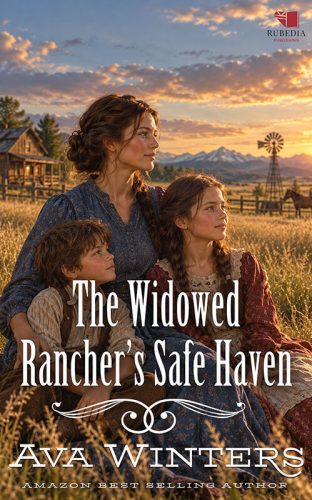
The Widowed Rancher's Safe Haven
“For the love of God,” Lucas muttered. “She’s my new bride.”
He called me his bride. Lord, help me.
Rebecca Shaw has spent years running from a controlling fiancé. After her mother’s death leaves her completely alone, she answers a mail-order bride advertisement, hoping marriage will finally give her the safety she’s never had.
Instead, she discovers the advertisement was written by two lonely children desperate for a mother. And not their father.
Lucas Grant never planned to remarry. Still grieving the loss of his wife, the widowed rancher reluctantly agrees to a marriage of convenience for the sake of his children. But as Rebecca slowly becomes part of the family, keeping their relationship practical proves far more difficult than either of them expected.
“You disobeyed me.”
“I wasn’t trying to upset you.”
“Well, congratulations. You did anyway.”
When Rebecca’s past arrives in Wyoming, it threatens everything they’ve built together.
Can Rebecca and Lucas overcome the ghosts of their pasts before they lose the family they’ve both come to love?

Prologue
Eight Years Ago
The window didn’t close all the way. Rebecca noticed it without truly thinking about it. It was just another one of the small details that made up her life.
The faint draft slid in over the wash basin, lifting the edge of the towel draped there, making it move like it was dancing.
A cold breeze slipped in, making her shiver. She reached over and pressed the sash down again, harder this time, until the wood gave a small, reluctant groan. It still didn’t quite meet the frame, making Rebecca growl in the back of her throat.
She wiped her hands on her apron and glanced around the room they rented in a boarding house. It was a small place where she and her mother could stay. Two narrow beds, one washstand, a cracked pitcher, and a table that tilted if you leaned too hard on the wrong corner filled the room. Her mother called it “manageable.”
Her mother was by the stove, sleeves rolled up, hair dark, chestnut hair pinned back the same way she always wore it. She was very thin. Her face always had a worried frown that had become permanent since Rebecca’s father had died a couple of years ago from the fever that had touched almost every family in town. Her hazel eyes were always full of sadness.
Rebecca smiled to herself. Everyone said that she was the spitting image of her mother, but had the fire and stubbornness of her father. That was the greatest compliment anyone could give her.
Rebecca glanced at the kettle, which hadn’t started singing yet. The water was already close to boiling and made a thin sound that always reminded Rebecca of a hissing snake. She closed her eyes and thought of Ruben, who had seemed like a terrific man at first, but ended up being a snake in the grass.
“You’ve got flour on your sleeve,” Her ma said without turning.
Rebecca looked down. “I know.” She touched her mother’s shoulder gently. “I swear, you must have eyes in the back of your head. You see everything.”
“More than you know,” her ma said under her breath. Louder, she said, “All mothers automatically grow a pair of eyes on the backs of their heads as soon as their first baby is born.”
Rebecca chuckled at the familiar banter and brushed at her arm. The flour didn’t come completely off. It never did. She thought of it like everything else lately—something that stayed no matter how much you tried to shake it loose.
The kettle began to whistle.
Her mother reached for it, ready for a tea break.
Both women’s heads turned sharply toward the door when they heard the heavy footsteps on the front steps. Her mother dropped the kettle back onto the stove. Neither of them paid attention to the loud clang. They stared at the door.
Rebecca cringed when she heard the voice speaking to the landlady who owned the house they were staying in. Her heart stopped, and she forgot to breathe.
Her mother’s shoulders went still. “Oh no,” she said quietly.
Stepping closer to her mother, Rebecca asked, “Are you okay?” The question was automatic and asked even though she knew the answer, because she knew whose voice was at the front.
Her mother didn’t answer right away. She was already moving, crossing the room toward the front door with a speed that didn’t match her usual calm. That alone tightened Rebecca’s throat, making it hard to breathe and swallow.
Pursing her lips, her mother said, “Stay here.”
Rebecca followed anyway.
The front room of the house was dimmer and narrower. It was musty, and dust covered everything. Mrs. Thompson, their landlady, wasn’t known for keeping a tidy house. She was much more interested in gossiping with her friends over tea and biscuits, imagining that she was a fine lady from England.
Harriet stepped into the small room first.
Rebecca stayed half a step behind her mother’s shoulder. She shuddered when she saw Ruben Barlow. He was an older man who was a land investor and well-respected businessman, who was used to getting his own way.
Ruben stood just inside the threshold like he owned the air itself. He wore an expensive wool coat that looked as though he’d just bought it from a fashionable tailor. He wore a high hat and leather gloves that he imagined made him look like a fine gentleman. He hadn’t bothered to remove either. Rebecca hoped this meant that he didn’t intend to stay long.
His eyes moved over the room once and pressed his lips together in distaste. He sniffed the air and wrinkled his nose at the scent of boiled cabbage and burned coffee.
Narrowing his eyes, he focused on Rebecca’s mother.
Skipping the pleasantries, he said, “Harriet, I’ve been writing.”
Rebecca’s mother was rooted in her spot. “We haven’t been receiving your letters.”
There was a long pause as the man glared at her mother.
“I know you’ve been receiving them,” Ruben replied, his voice devoid of any emotion. “Why has Rebecca not been answering my letters?”
Rebecca felt her stomach tighten at the certainty in his voice. There were no accusations and no doubt in his statement.
Harriet crossed her arms over her chest. “You shouldn’t be here. Please leave.”
Ruben finally stepped forward, in a slow, controlled pace, as though he was measuring his steps, like he had all the time in the world and knew exactly how much space he could take before someone stopped him.
“I asked you a question.” His lip curled into a sneer. “Why has she stopped answering me?”
His gaze shifted past Rebecca’s mother.
She felt it land on her like a heavy weight. As much as she disliked the man standing in front of her, she didn’t look away.
Harriet’s voice sharpened. “Rebecca has made her choice. She has been quite clear about her feelings. She’s eighteen years old. You are thirty-two years older than she is. She’s not interested in being your wife. She isn’t your concern anymore, Mr. Barlow.”
Something flickered across his face at that. It wasn’t quite anger. It was irritation and a look that suggested this was a mere annoyance getting in the way of accomplishing his plans.
“I believe she is my concern,” he said.
Harriet stepped fully between them. “You need to leave.”
A heavy, suffocating silence followed. It wrapped itself around Rebecca like a cold, wet, woolen blanket that made it hard to breathe.
Ruben’s jaw tightened slightly. The polite mask stayed on, but it was starting to pull at the edges. “I’m trying to be reasonable.”
Harriet didn’t move. “And I’m not asking you to leave. I’m telling you. Rebecca and I have made our positions clear.”
That was when he reached for her.
It happened quickly enough that Rebecca didn’t process it first as violence. Just motion. His hand was on her mother’s arm. He gripped her so tightly that Rebecca was certain that it would leave a nasty bruise.
Harriet gasped loudly, both in surprise at the aggressive move and at the pain.
Rebecca moved forward before she even had a chance to think about it. “Let go of her,” she demanded angrily.
Ruben didn’t. His fingers tightened instead, making her mother wince.
Something in Rebecca went hot. “No,” she said, stepping between them. Her voice was louder and sharper than she’d ever used before.
Ruben’s eyes shifted toward her again. He snarled at her.
“Rebecca, step back,” her mother said.
She stayed frozen in place.
He nodded toward her mother. “You should listen to Harriet.”
“I am listening,” Rebecca answered, her heart pounding so hard in her chest that she could hear it in her ears. “Let her go.”
There was a small pause where everything in the world stood still. Then Ruben released Harriet’s arm, but only to turn fully toward Rebecca.
Harriet moved again immediately, reaching for Rebecca’s shoulder. “Back up,” she whispered.
Rebecca didn’t. She faced Ruben, her shoulders straight and her chin high.
Ruben’s voice softened. “I’ve been patient.”
“I didn’t ask for that,” Rebecca said. “I’ve made it clear that I’m not interested in marrying you.”
The words came out before she could stop them.
His nostrils flared, and his face turned bright red, but he managed to keep his voice steady and calm as he spoke. “I’ve written to you. I’ve given you time, and I’ve given you respect. You are going to be my wife.”
“You don’t get to decide that,” Rebecca said, surprised by how steady she sounded.
Harriet’s grip on her shoulder tightened. “Rebecca…”
But Ruben was already stepping closer.
Rebecca could smell him now. He carried the scent of soap, leather, and something faintly metallic, like coins warmed in a pocket.
“I think you misunderstand what this is,” he said through gritted teeth.
“I don’t misunderstand anything,” she replied.
Harriet stepped forward again. “Leave my daughter alone.”
That was when Ruben moved, quickly. His hand snapped out, grabbed her mother’s arm again, and shoved her against the wall.
Rebecca’s stomach clenched as her mother made a sharp breath and groaned in pain as she stumbled slightly against the table. Her vision narrowed. “Stop,” she said in a hard voice.
Ruben glared at Rebecca, hard enough that it felt like he was burning a hole through her.
“Don’t touch her,” Rebecca said.
Ruben looked down at her like she was some kind of rodent. And then his hand came up.
Before she could move or even register what was about to happen, the palm of his hand connected hard with the side of her face.
Rebecca’s head snapped to the side, and for a moment, the room didn’t make sense anymore. The edges of everything went soft and distant. Her cheek burned, and her ears rang faintly.
Her mother’s voice broke through it. Although it was sharp, it sounded far away. “What are you doing? Don’t touch my daughter!”
Rebecca lifted a hand to her face without thinking. Her skin felt wrong. It was burning hot.
She blinked several times, trying to hold back the tears. There was no way she’d give Ruben the satisfaction of knowing how much he hurt her.
Ruben was still there, looking at her as though nothing had happened at all.
Several feelings washed over her. Her face burned not just from the slap, but also from the humiliation that came first. It was followed by an icy hand of fear that wrapped itself around her heart. Then white-hot fire burned through her as anger overwhelmed her, and it took every bit of her willpower to not pick up the heavy ceramic pitcher sitting next to the door.
Harriet pulled her back, putting herself between them again, but Rebecca barely felt it.
Ruben straightened his coat. “You’ll understand eventually.”
Harriet’s voice shook now. “Get out.”
For a moment, he didn’t move. Then he adjusted his gloves, as though he hadn’t just hit Rebecca.
“I’ll give you time to reconsider,” he said, almost thoughtfully. “But not much.”
His gaze flicked to Rebecca one last time. “You can’t run forever,” he added. Then he turned and left.
The door closed behind him with a soft finality that felt more terrifying than the relief that he was gone. Rebecca knew that Ruben wasn’t bluffing or making idle threats.
Rebecca and her mother stood very still in the stifling silence.
Her cheek throbbed in time with her heartbeat, but she still refused to let the tears fall.
Harriet exhaled a shaky breath and then pulled Rebecca back into their room. She locked the door and shook it, making sure the lock would hold. Then she checked the window latch. She stood there for a moment with her hand still on the wood, as if it might hold if she didn’t let go.
Rebecca finally spoke. “Ma.”
Her voice didn’t sound like hers.
Harriet didn’t turn around. “Pack.”
Rebecca blinked. “What?”
“Pack,” Harriet repeated, sharper now.
Her tone told Rebecca that there was no point in arguing and no time to ask questions.
Rebecca touched her cheek again, slower this time, like she was confirming it had actually happened.
“He hit me,” she said quietly.
“I know,” Harriet said.
And that was it. She didn’t show outrage or any other emotion. She simply acknowledged that it happened.
Her mother crossed to the dresser and opened the drawer, pulling it out fully. She began sorting through it with quick, efficient movements.
Rebecca watched her. “You’re… we’re just leaving?”
Harriet didn’t look up. “Yes.”
“Now?”
“Yes.”
Rebecca’s throat tightened. “Where?”
Harriet paused for the first time since Ruben had left before she looked at her daughter.
There was something in her face that Rebecca didn’t fully understand yet. It wasn’t panic or fear. It was more like a cold calculation.
“Somewhere he can’t reach you,” Harriet said.
Rebecca swallowed. “That’s not a place.”
Harriet’s mouth tightened slightly. “It will be.”
Rebecca stared at her. Her cheek still burned, and her hands felt cold. And in the quiet that followed, she understood something she didn’t have words for yet. This wasn’t over. It had only just started.
Harriet turned back to the drawer, already folding clothes into a small, worn bag.
“Pack what you need,” she said again.
Rebecca hesitated before she moved, quickly gathering her clothes and important possessions. There wasn’t anything else to do, because somewhere deep down, beneath the shock and heat and ringing in her ears, one thought had already taken root.
If they stayed, he would come back, and next time, he wouldn’t knock first.
Chapter One
Laramie, Wyoming Territory
1877
The posthole digger struck rock again.
Lucas muttered something under his breath and shoved the handles harder into the ground. The Wyoming soil had been dry for weeks. Every inch of the rocky, hard dirt fought back. The high desert climate made it almost impossible to dig a simple hole.
Walter, Lucas’s closest friend and ranch foreman, lifted his hat and ran his fingers through his sweaty blond hair. He leaned against the unfinished fence nearby, chewing on a piece of straw and offering absolutely no help.
“You know,” Walter said lazily, “most men would’ve given up on this hole by now.”
Lucas wiped sweat from his forehead with the back of his wrist and pushed a lock of his damp dark hair back under his hat. He narrowed his blue eyes. “Most men don’t have cattle that’ll wander clear to Montana if the fence falls over.”
Walter grinned. “That sounded almost cheerful.”
Lucas ignored him and drove the digger down again. The handles jarred hard against his palms. He grimaced.
Behind them, cattle moved across the pasture in scattered groups. The sound of lowing drifted across the open land while wind rolled through the grass in long waves. Clouds hung low against the mountains in the distance, heavy and gray around the edges.
Glancing up at the sky, Lucas thought, We’ll get some rain by tomorrow, probably.
Lucas hoped so.
The pastures needed it badly. At this rate, the only thing that will be growing on his land is greasewood and sagebrush. All of the prairie grass was starting to yellow. He was going to have to bring in some alfalfa if this dry spell kept up.
Walter’s voice brought him back to the present.
Walter spat the straw onto the ground and tipped his hat back. “Anyway, her name’s Emily.”
Lucas made a noncommittal sound as he slammed the post hole diggers back into the rocky, baked clay. He growled under his breath while sweat rolled down the back of his shirt as the hot sun beat down on him.
Walter waited.
When Lucas said nothing else, Walter sighed dramatically. “You could at least pretend to care.”
“I don’t.”
“That’s cold.”
Lucas finally looked over at him. “You’ve known this woman for what? Half a day?”
Walter smiled easily. “Sometimes that’s all it takes.”
Lucas snorted and pulled another clump of dirt from the hole. “That’s usually what a man says right before making a terrible decision.”
Walter laughed loudly enough to startle one of the cows that had meandered toward them. “She smiled at me.”
“That poor woman.”
“And,” Walter continued, completely ignoring him, “she laughed at my joke.”
Lucas shoveled dirt aside. “Women laugh at your jokes because you never stop talking long enough for them to escape.”
Walter pressed one hand against his heart in mock offense. “You wound me.”
“You’ll recover.”
Walter shook his head slowly. “I swear, you’re getting worse.”
Lucas didn’t answer because he knew what Walter meant.
He’d heard it before, from Walter, old Mrs. Farnsworth, the preacher, and just about everybody else who’d known him his entire life.
They all had the same expression. They wore that sympathetic look people got when they thought a man had buried too much of himself alongside his wife.
Lucas grabbed the fence post and lowered it into the hole. The rough wood scraped against his gloves.
Walter wandered closer. “You know what your problem is?”
Lucas shoved dirt back into the hole around the post. “I’m sure you’re about to tell me.”
“You work too much.”
“I own a ranch.”
“You hide in your work too much.”
Lucas’s jaw tightened slightly.
Walter noticed the reaction he got, even though Lucas always tried hard to not show any emotions. The man noticed everything when he wanted to.
Lucas packed more dirt around the base of the post and pressed it down with his tamping rod. “Somebody has to keep this place running.”
Walter crouched nearby and picked up a rock, tossing it lazily into the grass. “You ever think maybe you wouldn’t be so miserable if you let yourself enjoy something once in a while?”
Lucas straightened slowly and drove the shovel into the dirt harder than necessary. “I’m not miserable.”
Walter raised both eyebrows.
Lucas hated that look.
It was that all-knowing look Walter gave him. It was a patient look that a parent might give a stubborn child.
“You spend all day working.” Walter picked up the wire and started pulling it from the old wooden post to the one Lucas had just planted. “Then you spend all evening working. Then you spend Sunday pretending you aren’t thinking about work.”
“There’s always something that needs doing.”
“That’s true for everybody.”
Lucas grabbed the water bucket sitting near the fence and took a long drink. The water had gotten hot from sitting in the sun. He didn’t say anything. Although he knew better, he hoped that Walter would just stop talking. The man was like a brother to him, but sometimes, Walter irritated the dickens out of him.
Walter wrapped the wire tightly around the new post. “When’s the last time you did anything for yourself?”
Lucas lowered the bucket slowly. He thought about it, but couldn’t come up with an answer. That irritated him more than the question itself. Finally, he said, “I’ve already got enough on my plate.”
Walter made a face. “That’s not what I asked.”
Lucas looked out over the pasture instead of at him.
The ranch stretched across miles of land, dry grass rippling beneath the wind. Two ranch hands were moving cattle farther south near the creek bed. Beyond them sat the mountains, dark against the sky.
There’d been a time when this view made him feel proud. These days, it mostly made him tired.
Every broken fence cost money, and every sick calf cost money. Every storm meant repairs, which cost even more money.
Then there were the children. They constantly needed new boots and clothes. School supplies weren’t cheap, and neither was the food that they constantly ate. He was certain that his eight-year-old son, Oliver, and twelve-year-old daughter, Elena, ate more than he and all of the ranch hands combined. Then there were the doctor visits whenever Oliver climbed something he shouldn’t.
Lucas rubbed his face and sighed. Walter wasn’t wrong. Most nights, he went to bed already thinking about the next morning’s work.
Walter watched him quietly for a moment before speaking again. “You’re still young, Lucas.”
Lucas let out a short, humorless laugh. “Doesn’t feel that way.”
“You’re thirty, not eighty.”
“Some mornings I’m not convinced.”
Walter grinned again, but it faded when Lucas didn’t return it.
The wind shifted suddenly, carrying the smell of rain and livestock across the pasture.
Lucas glanced toward the house automatically.
The curtains in the front window moved slightly.
Mrs. Harper, a widow from town, was likely working on supper. She had been cooking for them three nights a week ever since Lucas accidentally burned an entire pot of stew last winter badly enough to ruin the kettle.
He still wasn’t convinced she’d stopped laughing about it.
Walter nudged his shoulder lightly. “You know the kids wouldn’t mind seeing you happy again.”
Lucas went still. The words hit him hard. He shoved the shovel back into the dirt. “That’s enough.”
His friend sighed.
“I’m serious,” Lucas muttered. “Drop it.”
Walter held up both hands. “Alright.”
Even though Walter was silent, Lucas could still feel his friend’s words sitting heavily on his shoulders and irked him like a rock in his boot he couldn’t shake loose.
Oliver and Elena were constant worries, and he wanted to do right by them. The thought that they weren’t happy tugged at his heart.
He bent to grab another fence post.
For a few blessed minutes, the only sounds were the wind, the cattle, and the dull thud of work.
Lucas preferred it that way.
Work was simple. People were complicated—especially people who kept trying to drag him toward conversations he didn’t want to have.
His wife had been dead for more than eight years. Sarah had died while giving birth to Oliver. Sometimes it felt impossible that so much time had passed. Other times, it felt like he’d been alone forever.
He still remembered the sound of her laughter drifting through the house while she cooked supper. He pictured her sitting on the porch with Elena wrapped in a blanket against her shoulder when she was a baby, and how small Oliver had looked the night she died.
Lucas shoved the memories away before they could settle too deeply and constantly loop in his mind, playing over and over again.
He didn’t let himself think about that night for long anymore. He couldn’t if he wanted to keep functioning.
“Pa!”
Next chapter ...
You just read the first chapters of "The Widowed Rancher's Safe Haven"!
Are you ready, for an emotional roller-coaster, filled with drama and excitement?
I always enjoy reading your books.
Sounds intriguing wanting more