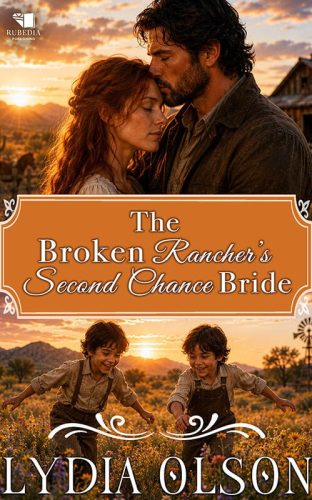
The Broken Rancher's Second Chance Bride
“If I let anyone close again and something happens…” he whispered.
“So you’ll keep everyone at arm’s length?” Her voice had gone quiet. “Your boys too? Me?”
That wasn’t what he wanted. But he was stuck. How was he supposed to find a way out?
Noah had been at the church for half an hour before they arrived. It felt wrong to be here again. Twice he almost left. But decency was his north star.
Then he saw her.
She was, in the plainest terms, one of the most striking women he had ever seen. And she was looking at him as though she were trying very hard to read something in his face.
He meant to meet her at the door, but his legs refused to move. All he could do was watch as she walked down the aisle. Toward him.
And every careful thought he had assembled over the past thirty minutes fell apart entirely.


Chapter One
Madera Canyon, Arizona
June 21, 1894
The flowers in Hazel’s bouquet were perfect.
She could hardly stop looking at them. Her father had pressed the soft ivory roses into her hands that morning with trembling pride—goodness only knew how he’d gotten them. Delicate sprigs of lavender were tucked between the stems because Thomas always said he loved the smell of it on her skin. She had picked those herself from the garden with unsteady fingers.
In the summer light streaming in through the church windows, every petal glowed.
Everything was exactly as it should be. Better than right; she was marrying her best friend.
He is going to love this, she thought, smoothing the front of her dress for the hundredth time as she began her walk down the aisle toward the altar. The fabric was the palest blush, borrowed from her cousin in Tucson and altered at the waist to nip in just so. It was very becoming, even if she did say so herself.
Her mother’s pearls were cool against her neck. Her red hair had been pinned and curled and fussed over since before sunrise. She felt beautiful in a way she never usually allowed herself to feel. It was as though her happiness was lighting her from within.
It wasn’t vanity or pride, just a fact. This was her day to be loved.
She wanted him to see her like this. She wanted to watch his face when he saw her.
Except now, as she looked up at the altar, she couldn’t see him. She looked and looked again. Perhaps, in her nervous state, she had simply missed him. She scanned the front pews, then looked again at her father and the minister. And she saw it written on their faces.
Thomas was not there.
Her heart fluttered, and she felt her face pale, but she told herself it didn’t mean anything.
There were a hundred reasons a man might be late to his own wedding. His horse could have thrown a shoe. The road from his family’s place was uneven—quite treacherous in places—and after the dry spell they’d had this summer, the ruts were deep enough to catch a wheel. Perhaps he had simply overslept. Thomas had always been a sound sleeper, something she had teased him about since they were children, since the long, lazy summers when they had grown up side by side. She had known the sound of his laugh better than her own heartbeat. And liked it better than birdsong or church bells.
He’ll come, she told herself. He always comes.
That was the thing about Thomas McBride. He had always come. He had come when she was seven years old and had fallen from the old oak at the edge of his father’s property, sitting beside her in the dirt and making her laugh through her tears until her father arrived. He had come to every harvest, every church social, every quiet evening on the porch where they had talked about nothing and everything until the stars came out. He had come to her mother’s funeral three months ago, standing by her side with his hand over hers.
He had always, always been there for her.
She adjusted her bouquet and fixed her eyes on the open doors at the back of the church.
***
The whispers started slowly.
She noticed it like a change in the weather—the air shifted, the way it did before rain.
Hazel kept her eyes on the door.
Her father appeared at her elbow, his broad hand settling warm and steady at her back. James Fitzgerald was not a man who showed his worry easily or without cause. He had weathered drought and debt and the loss of his wife with the same quiet steadiness that had always made Hazel feel safe. But she could feel the tension in him now.
“Hazel, love.” His voice was low.
“He’s coming,” she said.
“It’s been half an hour.”
“He’s coming.” She said it more firmly this time, as if saying the words with conviction would make them true. He’s coming. He wouldn’t do this. He wouldn’t leave me here. Not like this.
Her father didn’t answer. That was worse, somehow, than anything he could have said.
***
When a full hour had rolled by, Mrs. Lowe from two farms over came to stand beside her with a cup of water and a kindly expression that made Hazel’s stomach turn. It was pity. Gentle, careful, and unbearable. It was the kind of look people wore at funerals, not weddings. And Hazel recoiled from it as though she’d been struck.
“Sweetheart,” the woman began.
“Don’t.” Hazel’s voice came out sharper than she had meant it to. “Please don’t.”
“We ought to—”
“He’s just late.” Hazel heard herself say the words and hated how fragile her voice sounded, how thin. How unconvincing. “People are late. There is nothing wrong. There is absolutely nothing wrong, and if everyone would just—”
Her voice cracked. She pressed her lips together hard and lifted her chin. “If everyone would just wait.”
The bouquet trembled in her hands.
She gripped it tighter, and the smell of crushed lavender rose between her fingers.
***
It was her father who finally told her.
She didn’t know how much time had passed by then. More than an hour. Perhaps a lot more. She had lost all sense of time, standing there at that altar with her ivory roses and her mother’s pearls and the morning light shifting from gold to white as the sun climbed higher. The guests had grown very quiet. Many had left, slipping out in ones and twos with their eyes down, unable to bear witness to the waiting. Reverend Cole had retreated to his vestry. The flowers on the altar had begun to droop as the day grew later and hotter.
Her father stood in front of her.
He took her hands in his, both of them, her small, cold fingers wrapped inside his rough, warm ones. And he looked at her with those steady brown eyes that had always, in her twenty-three years, told her the truth even when the truth was hard.
“He isn’t coming, sweetheart,” he said quietly. “He isn’t coming.”
The world tilted. For months—no, years—this had been everything she had dreamed of. Even now, she could still see it in her mind’s eye—a home to tend, children to nurture. And Thomas.
“That’s not right,” she heard herself say. “It can’t be. He wouldn’t.”
“Hazel—”
“No.” She pulled her hands back. She stepped away from him and turned toward the door because if she looked at it, she could still see him coming. She could still hold the image of him walking through it, rumpled and breathless and full of apology.
“No, you’re wrong. He wouldn’t. He wouldn’t do this. You don’t know Thomas. He wouldn’t—”
There was a trembling edge to her voice now, and she gulped down air between words.
“I know, love.” Her father’s voice broke on the last word, a fracture so small that only someone who really knew him would hear it. Would know what it meant. As, deep down, Hazel did.
“He wouldn’t leave me,” she said, her voice rising again. Now, she could hear it, but she couldn’t stop it, couldn’t hold back the tide of panic any longer. “He is my best friend, do you understand? He is my best friend, and he loves me. He has always loved me. This doesn’t make any sense.”
“Hazel.” Her father moved to take her shoulders, and she turned into him the way she had as a child, her face pressed hard against his chest, the bouquet crushed between them and the scent suddenly unbearable, unbearable, because she had chosen them because Thomas loved lavender and Thomas was not here.
The sobs came then. Great, wrenching, helpless sobs that she had no strength left to hold back. They shook her whole body. She was aware of her father’s arms around her, of his hand moving in slow circles across her back, of the church around them finally, mercifully empty.
“He’s coming,” she kept saying, muffled against his shirt. “He’s coming. He’s coming.”
Her father held her and said nothing.
She knew it wasn’t true; she didn’t need to be told.
***
She did not remember the journey home.
She was aware of her father helping her into the wagon, of the familiar creak of the seat and the warmth of the afternoon sun on her bent head. She was aware of the road, and the sound of the horse’s hooves, and the way Madera Canyon looked exactly the same as it always did. The dry golden hills, the saguaros standing tall and indifferent, the sky a hard bright blue above it all. The world had not changed, not even a little bit. This is all wrong, she thought to herself. The sun shouldn’t be shining. The world shouldn’t be turning. And yet somehow it was.
She still had the bouquet in her lap. It looked rather the worse for wear now, wilting and mangled from an hour or more held in anxious hands.
At home, her father guided her gently inside. He settled her into the armchair by the window, the one that had always been her mother’s favorite, Clara’s sewing chair, with the best light. He brought water. He brought a blanket, even though the day was already warm, folding it carefully across her knees. He crouched down in front of her and looked at her with an expression she had never seen on him before, helpless and aching.
“I’ll make something to eat,” he said softly.
She nodded because it seemed like the only thing to do, though she couldn’t imagine ever being hungry again.
He went to the kitchen, and she turned her face to the window, looking out at the yard, at the gate at the end of the winding path. If she kept watching the gate, she thought, perhaps she might see him coming. In her imagination, he came running, out of breath. I’m so sorry, he said. I fell from my horse.
He would have his hat in his hands, full of explanation and remorse and love, and this—all of this—would become a story they told in years to come. Do you remember the day I was late to our wedding? he would say, and she would shake her head, pretending she had never been afraid. Had never doubted him for a moment.
The gate stayed closed. The track beyond it was empty and quiet.
The bouquet lay still in her lap.
The ivory roses, which had been so perfect that morning, had lost many of their petals, and the ones that remained were ragged.
Hazel sat very straight in her mother’s armchair and stared at the gate and told herself that Thomas McBride was coming.
She would wait.
She had always waited for him.
She did not know how to stop. Not yet.
Chapter Two
Madera Canyon, Arizona
June 21, 1896
Two years was a long time.
More than long enough to stop expecting the sound of hoofbeats on the track. Long enough, she had told herself on more than one occasion, to stop thinking about Thomas McBride altogether.
She had not quite managed that last part. And today was particularly bad; her thoughts kept snagging on the memory of him, like her dress catching on thorns.
It was the date that did it. The twenty-first of June had a way of arriving whether she was ready for it or not. This was her second wedding anniversary, or what would have been her wedding anniversary, and it stung just as badly as the first. The rest of the year, she could keep herself busy enough. Keep the memories at bay. But today they followed her everywhere, patient and relentless, the way shadows follow a person in the late afternoon sun.
She hoisted the water pail and crossed the yard toward the chicken coop, her boots scuffing the dry red dirt. The hens were restless this morning, clustering and shifting against each other. It made her uneasy. She had grown up on a ranch and had learned one lesson early—when it came to weather, animals always knew first. There was a storm brewing, she thought, even if the sky looked clear enough for now.
Two years, she thought, scattering feed with a practiced flick of her wrist. Two years today.
She had waited for a man who had no intention of coming. A man who had never thought her worth the courtesy of an explanation, though she had been half waiting for one every day since.
***
There had been rumors, of course. There always were, in a town as small as Madera Canyon. Everyone knew everyone else’s business and thought it was their right to pass judgment.
She had heard them only in fragments at first—a word here, an exchanged glance there, conversations that stopped when she walked into a room. It had taken several months before someone finally told her the truth outright, and that someone had been Martha Greer, who had never quite mastered the art of kindness or tact when it came to delicate matters.
Thomas had not left her for nothing. There had been no misunderstanding or mistake. No accident or change of fortune. No excuse, in other words.
He had left her for someone else. A woman from a wealthy family on the other side of the state, older than him by nearly a decade, with money and land and connections that his own ambitious family had been cultivating quietly for years, though that was news to Hazel. A better match. A more profitable one. Apparently, he had weighed what he had with Hazel, their friendship, the years of easy laughter, the love she had believed in so completely. He had found it wanting against an important name and a full bank account.
She had not cried when she heard that. She had thought she might, braced herself for it, but instead she had gone very still and very quiet and felt something change inside her. If she had had to explain it, she would have said it was like a door closing.
The worst of it wasn’t the betrayal. Or rather, it wasn’t only the betrayal. The worst of it was what it said about her own judgment. She had known Thomas her entire life. She had watched him grow from a freckled, gap-toothed boy into a man she believed she knew and understood inside and out. She had looked at him and thought, This is someone who would never hurt me.
She had trusted that more than she had trusted almost anything else in the world. She had gone on waiting at the altar and for months afterward, certain he would come and explain a mistake, a misunderstanding. Because she believed that he was good.
And she had been entirely wrong. Catastrophically so.
That was the thing she couldn’t forgive herself for. The thing she couldn’t let herself forget. Not for loving him, not even for losing him. For not seeing it.
***
Her father was usually right about the ranch, even now, when he was slowing down.
His health had been failing for the better part of a year, though he would not say so in as many words. James Fitzgerald had never been a man who complained. Once, when she was little, he’d fallen from a hayloft and dislocated his shoulder; one of the hands had jerked it back into place and he’d just gone on working. He was that sort of man, the sort who got on with things.
But she could see that he was moving more carefully, that he rested in the chair after dinner in a way he never used to. Often, he dozed off. She had taken on more and more of the heavy work without either of them saying anything about it. Because if they said anything about it, that would make it real, make it true.
She looked toward the house.
He was moving across the yard now with the slow, careful gait that had become familiar. He was carrying a coil of rope that he probably shouldn’t have been carrying, one hand pressed briefly to his chest before he dropped it again and straightened with visible and deliberate effort. She watched him do it.
“I can take that,” she called.
“I’ve got it.” He waved her off without looking up.
She let him have it. He needed to be useful. Taking that away would hurt him more than the rope weighed.
But she watched him, ready to step in if she was needed. She always watched him now.
***
The sky had been changing since morning.
She had noticed it first around nine o’clock. The air seemed to thicken; something charged was settling over the hills to the west. By midday, the light had lost its clean summer brightness and had taken on instead a flat, yellowish quality. It made the landscape look almost painted. The hens were still unsettled. The horses had moved to the far corner of their paddock, where they clustered together.
Storm coming, she thought again. And not a small one.
Her mind was spinning, running through a list of what needed to be done, what needed to be secured before the winds rose.
The wind picked up as if to remind her she was already running behind.
“Pa.” She raised her voice across the yard. “Storm’s coming in fast. We need to get the shed doors done.”
Something crossed his face—the familiar assessing look. “Shed doors and the paddock gate,” he called back. “I’ll take the gate.”
“I’ll do the equipment shed first, then come and help—” she replied.
But the wind swallowed the end of her sentence, and he was already moving, and the sky was pressing down low and bruised above them.
***
It came faster than either of them expected.
That was the thing about storms out here. They could move with a speed that caught you off guard, no matter how many times you’d seen their like, no matter how good you were at reading the signs. One minute the air was thick and still and pregnant with warning. The next, the wind arrived in force, bending the mesquite sideways and lifting great rolling walls of red dust off the ground. The temperature dropped ten degrees in minutes. The light went from yellow to a dark purplish-gray. And then the storm was upon you, and there was nothing left to do except take cover and wait it out.
Hazel fought her way to the equipment shed, one arm raised against the rising wall of dust, her red hair tearing loose from its braid and whipping across her face. The latch was stiff, just as she’d known it would be, and she wrestled with it in the wind, her fingers slipping, the door slamming back against her shoulder hard enough to bruise. She got it secured. She turned.
“Pa!”
She could barely see across the yard. The dust was too thick, churning and billowing in great reddish curtains, the sky above it entirely gone. She pressed forward, one hand out in front of her, calling for him, and the wind took her voice and flung it away.
Thunder went off somewhere behind the dust, and she counted without meaning to. One. Two.
She found him at the north fence.
He had made it that far and stopped, one hand gripping the top rail, the other pressed against his chest. His hat was gone. His face was gray, and his breathing was labored. As she leaned close to him, she could hear it even over the noise of the storm.
“Come on.” She got her arm around him, pulling his weight against her side. “Come on, let’s get inside, come on—”
He moved with her, leaning heavily, and she took every ounce of his weight without complaint or pause, her legs pushing against the force of the wind, her eyes half shut against the stinging dust. They had gone a few yards from the fence when she heard it.
And then there was no time—no time to duck.
She went down hard.
The ground came up to meet her, and then there was nothing. Nothing but a vast and sudden darkness that swallowed her whole.
***
When the darkness began to thin, it did so slowly, like dispersing smoke. There was pain first, a throbbing pain above her left eye that pulsed with every heartbeat. When she finally opened her eyes, the light was dazzling.
She was lying on her side in the dirt. How had she gotten there?
That’s right. There had been a storm. It had come on so fast.
The storm had passed.
The world around her was quiet as only the time after a storm can be—an exhausted stillness, the air washed clean, the light returning, golden and innocent, as if nothing at all had happened. Debris lay scattered across the yard. The tarpaulin had torn loose from the barn. A heavy metal bucket had come to rest upside down against the fence post near where she lay.
She pushed herself upright, slowly, her hand going to her eyebrow where the pain was worst. Her fingers came away dark and sticky.
“Pa,” she said quietly. “Papa, are you there?”
Her head was foggy, and as she looked about her, she could hardly make sense of the chaos around her.
And then she saw him.
He was lying near the north fence, back where she had reached him. He had not moved an inch and was lying very still, one arm outstretched, his face turned to the side away from her, and even before she crawled to him and pressed her fingers to his neck and felt the terrible, absolute stillness there, she knew.
She knew. And yet she still couldn’t bring herself to think it.
“No.” The word came out barely above a whisper. “No, no… Papa. My pa. No, please—”
She took his hand in both of hers. It was cold already. She didn’t know how long she’d been unconscious, but he must have collapsed almost as she was struck. Otherwise, he would surely have come to her aid, and she would have found him lying beside her in the dirt. Instead, he had slumped against the fence and slipped away.
But right now, Hazel knew only that he was gone, and when he needed her, she had been lying unconscious not three feet away.
She pressed his hand against her forehead and stayed there in the silent yard strewn with broken shingles and snapped branches while the golden light came back across the hills, and the guilt settled into her heart, heavy, permanent, and cold.
She had no one left.
And somewhere above her eyebrow, the wound was still bleeding, marking her face with a scar she would carry till the end of her days.
A reminder of the worst loss she had ever known.
Chapter Three
Tucson, Arizona
1896
It was only a dream. The same dream he had so often these days. He always knew it, on some level—some distant, watching part of him that stood apart from the nightmare and said, This is not real, this is not now, you have survived this already. But somehow knowing it did not help. Not even a little bit. As soon as the dream took hold, it took all of him with it; every sensible thought dissolved as he plunged into the suffocating terror of that terrible night. He was back inside that night as completely as if two years had never passed at all.
The house was dark. That was the first thing. The darkness pressed in from every side. And then the sounds. The splintering crash of the back door giving way. The low, ugly voices of men who had not come to talk or reason. He remembered reaching for Florence before he was fully awake, his hand finding her arm in the dark, and the two of them scrambling upright as the sounds moved closer, the men crashing through the downstairs rooms. They had no fear of being heard; they knew what Noah knew too. There would be no stopping them. He was one man, startled from sleep, and, by the sounds of it, they were many.
The boys. That was all he could think of. The boys are sleeping in their room.
He had tried to get to them. That was what the nightmare came back to every time—the fact that he had tried. The terrible, futile struggle. It made him try again. Made him hope. But failure was inevitable.
He had put himself between Florence and the door, had told her to run, had taken the first blow across his shoulder and kept standing because his sons were sleeping upstairs and nothing on earth was going to make him fall.
But there had been so many of them.
And Florence—
He woke up with cold sweat beading his brow and his heart thundering in his ears, a silent scream on his lips.
He lay there for a moment, his chest heaving, one fist tangled in the bedsheet, staring at the ceiling until the pale gray light of dawn confirmed what part of him already knew.
His room. His ceiling. Tucson. 1896.
He was alive.
Next chapter ...
You just read the first chapters of "The Broken Rancher's Second Chance Bride"!
Are you ready, for an emotional roller-coaster, filled with drama and excitement?
If yes, just click this button to find how the story ends!