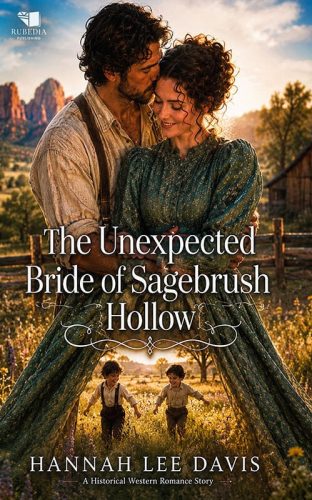
The Unexpected Bride of Sagebrush Hollow
“Nathan Calloway, you kissed me in front of the entire town.”
“And I’d do it again.” He stared at her intensely.
After a broken engagement leaves her branded a spinster, June Sinclair answers a mail-order bride advertisement, hoping to leave behind the rumors about her broken engagement and find a place where she truly belongs.
Instead, she finds a gruff horse rancher still haunted by the mysterious death of his brother and struggling to raise three grieving children on his own. Nathan Calloway never wanted another chance at love, and their marriage begins as one of necessity rather than affection.
“I must, once again, ask you to have no romantic illusions, Miss Sinclair.”
“You said no romantic illusions and I believed every word. And now you look at me like you don’t mean it.”
As June slowly earns the children’s trust and brings warmth back into the household, Nathan finds himself questioning the walls he has built around his heart. But when a ruthless moneylender returns to collect an old debt, the fragile life they’ve begun to build is suddenly threatened.
Can June and Nathan overcome the pain of their pasts, before the family they just began to create is destroyed?


Prologue
Wind had been kicking up dust all afternoon, but Nathan wouldn’t call it yet. Not when he had another forty feet to mark along the line, and those stakes and binder twine wouldn’t put themselves up.
As he walked, he turned back to Wallace—the builder out of Lander he’d hired to put up the new stable—with both arms spread.
“Look at this right here and tell me she ain’t a picture.”
Wallace squinted under his slouch hat, the brim of which hid most of his small and square frame. He kept a ruler folded in his vest pocket where another man would’ve carried a watch and, so far as Nathan had seen, he only ever used it to point at things.
Like he pointed at dirt right now.
“It’s flat.”
“Flat, he says.” Nathan hammered a stake into the ground. “I could march you to the pearly gates, and you’d tell Saint Peter his hinges want oil.”
“Likely do.”
Nathan laughed. “How’s she drain?”
“How’s what drain?”
“The ground, Wallace.”
Wallace toed the dirt. “Drains.”
“Drains how?”
“I’d say Baptist at a temperance social.”
“Huh. Ain’t that a long sentence for you?”
“Don’t go gettin’ used to it.”
He put down some more pillars, grinning as he did so, until he hit the spot where he wanted the stable doors to face.
Six months.
Six months since he’d packed his trunk off the ranch he and his brother, Jacob, had built together—now just Jacob’s—and put up to the cabin and lean-to stable on his new spread.
“Twenty stalls.” He tied the binder twine. “Eight by twelve. Hayloft above.”
Wallace took his pocketbook out. “Heap of a stable.”
“You mean to insult me or do it come natural?”
“Natural.”
“Comfort to know.” Nathan spat into the dust. “But let me teach you somethin’, my dour friend. A man builds the stable he means to fill. You build small, you think small.”
Wallace scribbled into his pocketbook.
“I am to be the fella the rest of ’em ride out to see when they’re figurin’ out how a thing’s done.” Nathan pointed forward. “Now, yonder, we’re puttin’ a breedin’ shed. Past the cottonwood there, see it?”
“I see it.”
“And the second corral—I tell you about the second corral?”
“Twice.”
“Well, I better tell you a third time, just in case—”
Wallace scribbled some more. “You keep talkin’ through my writin’, I’m liable to put the door on the back wall.”
Nathan chuckled and turned back to the twine.
Good day. Sage, hot rock, and the sun laying on his shoulders while he did his work on his new spread. Two years he’d worked for a day like this. Rode out before dawn and come home after dark to buy scrub mares cheap off the reservation traders down Wind River. Put feed and sweat into them until they got good enough for a remount officer at Fort Washakie—the Army post up on the reservation, two days’ ride north—to lay gold on the rail for one. The cavalry always wanted horses. A man who could sell them sound ones had himself a living.
Jacob had told him to take it easy, that the herd wouldn’t go anywhere, but the market would have. So, Nathan had put in the effort.
Now, he walked off the dimensions of a barn he could pay for in coin.
“Mister Calloway.”
“Hm?”
Wallace pointed his ruler west.
The sky over the Absarokas had turned the dirty green Pa had called ‘horse-killing weather,’ and a curtain of rain dragged across the foothills.
“Well, hell’s bells.”
“I’ll come out for corral measurements next week.”
The corral still needed sizing and marking before Wallace could price the lumber and the posts for it.
“Next week, he says.” Nathan clicked his tongue. “Come out Tuesday! Wednesday! Tomorrow, after the rain’s passed!”
“Next week, Mister Calloway.”
“Fine, fine.” Nathan scooped his oilcloth slicker off the stake he’d hung it on. “If the rain runs you late, tell Maggie at the boarding house to put you on my slate for tonight.”
Wallace tipped his hat and rode off before Nate fully put on his slicker.
Good man, Wallace. Slow with a pencil, and he took his time laughing at jokes, but he never padded a quote or failed to show up the day he said he’d show up. That easily put him ahead of four of five men.
Nathan watched him a moment longer and turned for the cabin with the rain coming on at his back.
The first drops hit his shoulders before he made the porch. By the time he shut the door behind him, the sky opened up proper and beat down on the cabin’s shake roof with the kind of racket that’d stop a man from hearing his own thoughts.
Nathan stood in the doorway, dripping something fierce, and then laughed.
Let it come down. It could break through the windows, down the roof, or kick down the front door all it wanted. A man who’d just walked off the dimensions of his own future didn’t begrudge the Lord a little weather!
He made his way to the strongbox—he kept it safe and secure under the loose puncheon by the stove—and hauled it to the table. Two years of scrimping and selling sat in that box, every dollar he’d set by to build the stable Wallace had just measured out. More than enough for Wallace’s earnest payment, the lumber from Lander’s mill, and a margin for “just in case.”
Then he took the paper down from the shelf, where he’d been keeping it under a tin of Arbuckle’s.
He’d written the matrimonial advertisement on a Sunday evening with the week’s work behind him and a good supper in his belly. He’d reckoned that the right humor for the job. After all, a man didn’t send out for a wife because he got lonely. He had to know what he wanted and what he’d pay, and he had to be willing to pay it.
Truth be told, he ought to have sent it to the Matrimonial News by now, but he kept putting it off.
She had to be beautiful; a successful rancher deserved no less. She had to know how to ride and read, of course, and be able to hold up her end of a parlor conversation should some fellow from back east ever come the way of Nathan’s ranch. Of course, Nathan had no need for a doormat, so she had to have grit and speak her mind.
Any woman with sense would read it and know the ad had come from a man who knew his own worth and allowed her hers as well, should she have any.
Just as he folded the paper back into thirds and slid it into the tin, somebody pounded on the front door.
“Mister Calloway! Open up, sir!”
Nathan opened the door.
The boy on the porch—one of the Petersen boys from the next ranch over, the middle one—had maybe seventeen years on him and looked wet enough to have been hauled out of a well. He rode for Sheriff Briggs on Saturdays.
“Get in here, son, ’fore you catch your death.”
“No time, sir, we have to go.” The boy wrung his hands. “It’s your brother.”
Nathan frowned. “What ’bout ’im?”
“He’s missin’, sir.” The boy gulped. “Sheriff’s puttin’ a party together—”
Nathan pushed the boy away and ran for the lean-to. Half a day in the saddle before he got to Jacob’s ranch, less if the rain let up.
What’ve you got yourself into now?
***
Someone had turned Jacob’s house over.
The tin on the mantel lay on its side on the puncheon, and whoever had ransacked the place had taken what bills it’d had inside. They had also pulled out the drawers in the bureau and left them on the floor, dragged the tick mattress of the bedspread and slit it along the seam, and tipped the flour barrel over.
Nathan stood in that kitchen and tried to make a story that fit.
He couldn’t.
Jacob didn’t have enemies. He had the kind of face that made strangers tell him their troubles and the kind of laugh that’d smooth down a rowdy saloon. Not to mention that Jacob would never have run from some drifter come to hunt for coin. Jacob would’ve stood in his doorway with the shotgun off the pegs and told the man to git.
Then Briggs dragged him off for the search.
They rode the draws above the river on the first day and found nothing. The second day, the cliffs west of Jacob’s ranch. Nothing. On the third day, a Shoshone tracker—Briggs kept him on retainer and called him William, but that couldn’t have been his actual name—knelt in the willows half a mile down from the switchback they’d turned back from on the first day and lifted Jacob’s hat out of the mud with two fingers.
Further down, they found a boot, which Briggs claimed could’ve belonged to anyone.
After making their way back up a second switchback, they discovered a churned patch of ground that William said meant a horse had reared. The look the tracker sent Briggs’ way after that and the way Briggs pressed his lips together made Nathan’s gut clench.
On the fourth day, Briggs took off his hat and held it against his chest just as he had done two years ago when Jacob’s wife had died. When he said the words that ended the search, Nathan rode off alone.
***
Nathan found the children, Rhett, Audrey, and Eli, with Mrs. Petersen—a tall woman with gray salting the brown hair beneath her bonnet—who’d fed them and put them to bed for those four days. Briggs had told him they were going to the Sisters of Charity, an orphanage out of Lander, so Nathan had come to say goodbye.
It would be the right place for them.
The sisters knew their work. They’d have beds, a schoolroom, and women who mothered children for a living. A couple of such women ought to know more about children five to eleven than Nathan would learn in a lifetime. Besides, he had no wife nor a potential one within a day’s ride. If little Audrey wanted her hair brushed, he wouldn’t know how to go about it without snagging at it.
Better to leave them with the sisters.
Nathan had a ranch to run and a brother to bury, when they found the body. The herd had to move before the first frost, too.
He just had to say goodbye.
Rhett sat on the floor by the hearth, wrapping his arms around his knees, and stared up at Nathan. Audrey leaned against the bricks next to him and hid the lower half of her face behind her sleeve. Eli slept on the rag rug with his thumb in his mouth and his other hand wound up in Audrey’s hem so tight the cloth bunched.
Nathan couldn’t look away from the boy.
He’s eleven.
Jacob’s son. He had Jacob’s mouth, his hands, and his way of looking at you all quiet, and you just knew he’d made up his mind about you. Yes, Jacob had been friendly, but some did earn his ire.
Nathan had earned Rhett’s.
If he rode off today and let the wagon take the children come Thursday, Rhett would let the sisters take him and his siblings away with no fuss. His frown told Nathan that clearly enough. The children would have food, clothes, and school. They’d grow well, and Rhett would carry that look on his face for the rest of his life, which would tell anyone that saw it that men in Rhett’s family failed to step up when it counted.
If I leave now, I’ll go to my Judgment knowing I’m the one who failed him.
***
The children had to stay with Mrs. Petersen for one more day, so Nathan could go back to his new spread and pick up some necessities.
He’d taken the strongbox, his good coat, the tin from the shelf, and the few books he owned into the wagon and shut the cabin door behind him. Not much else to take. Jacob had once called the new cabin a glorified chicken coop, and he kind of had a point about it. Nothing stopped Nathan from turning the wagon back north to Jacob’s ranch—now Nathan’s—and leaving the new spread behind.
That night, once Nathan had moved his base necessities back to Jacob’s house, it took him two hours to get Eli down.
The boy fussed, twisted, sat up, and asked for his mother in a small voice, a smaller one, and one that broke in the middle of the sentence. Nathan said the same thing back each time, and, each time, it tasted worse in his mouth. At one point, the boy asked for Buster, and Nathan had to make excuses about how they would find him tomorrow. In truth, tomorrow, Nathan would go to Lander and get the boy a doggone circus if necessary.
Audrey had given up an hour before and fallen asleep on the trundle with her boots still on.
Rhett stood in the nursery doorway and watched Nathan suffer. When Eli asked for their mother for the fourth time, Rhett crossed the room and put his hand flat on the crown of the boy’s head, and Eli quit asking and finally went still against Nathan’s shoulder, mashing his little face into Nathan’s collarbone.
Rhett, then, nodded at him and went to his own bed.
***
The fire crackled behind him as he sat at the table and read the ad he’d written.
The man who had written it—the loud, confident rancher who had walked off the dimensions of his new stable just five days ago—had become a stranger to him. This Nathan, who had taken in his niece and nephews, couldn’t do with the same kind of woman that Nathan, whose brother still lived, could have.
So, he took a fresh sheet from the drawer, pulled the inkwell over, and trimmed the nib of his pen on the strop by the lamp.
Wanted, a woman of sound constitution and sharp mind to keep house and instruct three young children in their letters. Patience and education valued above beauty. No romantic illusions. N.C., Sagebrush Hollow, Wyoming Territory.
Chapter One
The schoolhouse had emptied an hour ago, and June still hadn’t found the will to leave her desk.
She ought to have.
Slates needed wiping and the stove needed banking. Little Tom Hadley had abandoned his McGuffey’s reader on the bench again. The boy lost a book a week and would lose this one as well if June didn’t shelve it, which she would do presently. Only, the light through the western windows had turned that particular gold only October brought, the perfect color for reading, which would only be here so long.
Once she stood up to shelve little Tom’s book, she would have to admit that the afternoon was ending and that she ought to go home. But she’d walked the river road home at the same hour every weekday for four years. It’d still be there if she delayed by twenty minutes, as would Aunt Mae and supper.
For now, she could read.
She owned the copy, of course. The passages coming up next would have Elizabeth Bennet walking three miles through mud to reach her sister, and Mr. Darcy noticing that the exercise had brightened Elizabeth’s eyes, yet it would change nothing in his manner and everything beneath it. June giggled as she turned the pages.
A man might look at a woman so and not see the mud at all.
Then again, Elizabeth had walked her three miles with color in her cheeks and still had enough wit to charm a drawing room. June’s river road seldom had any mud to it, and she kept her wit folded within the pages of her books.
Which would explain why she had eighteen dollars a month to her name but no husband. Although, seeing how every married woman in Hannibal mysteriously lost her post the moment she got hitched, June’s lack of matrimony likely worked in her favor. She had company enough in Elizabeth and Mr. Darcy.
She pushed her small wire-rimmed spectacles up her nose and flipped the page again.
The door opened.
Is Tom back for his reader for once?
June looked up.
The man in the doorway stood in front of the setting sun, so, for a moment, he looked like a shadow wearing a hat. Then he walked in, and the shadow resolved into a tall man with brown hair a few inches too long and a traveler’s coat better than anything June had seen in Hannibal.
“’Scuse me, ma’am.” He took off his hat. “Heard in town the schoolhouse keeps a shelf folks can borrow from. That right?”
“Uh, yes, that’s right.” June closed her book and set it down. “Though, I confess, our selection is modest.”
The shelf had barely a dozen volumes the previous schoolmaster had left behind, and June had taken upon herself to maintain. A worn Pilgrim’s Progress, two of Cooper’s novels, a Robinson Crusoe missing its last twenty pages, a battered Ivanhoe, and a miscellany of sermons and almanacs no child would ever ask for.
“That’ll do me fine, ma’am. Ain’t got nothin’ but a long evenin’ ahead.” He crossed to the shelf and tilted his head to read the spines. “Cooper. Huh. You ever read him, Miss… ?”
“Sinclair. June Sinclair.” She rose from her desk and approached him. “I have, some time ago.”
“What’d you reckon?”
June blinked.
No one had asked her opinion on a book in… well, who knew? Years, possibly. Well, Aunt Mae had, but she only did that because she knew what June would say and wanted the pleasure of getting a rise out of her.
She blushed.
What did she think of Cooper? A great many things, obviously, all of which her mind had held perfectly organized not five minutes ago, but which now clucked around her head like startled hens.
Say something, June, anything.
“I… found him stirring in the descriptions.” June looked away from the man. “Uh, and somewhat wearying in the speeches. Though, I was perhaps too young when I read him to be fair in my judgement.”
He laughed.
Oh, was that a bad thing to say?
Gentlemen rarely cared to hear a woman contradict a famous author—stupid, June, stupid—especially ones they had been about to comment on themselves. However, he did smile at her, not past her or politely through her, so maybe she hadn’t ruined the whole conversation.
“Wearyin’ in the speeches. Hell—beg your pardon, ma’am—that’s about the truest word anyone ever said on Cooper.” He shook his head. “Mind my askin’ what you got there on your desk?”
She glanced back at her book.
A man like this, a traveler, would likely think her silly, a country schoolmistress with her nose in a love story, and find it disgraceful that she sighed over a fictional Englishman. Not that she expected him to mock her. He’d likely smile politely and tuck the moment away to tell over a drink.
Then again, he had laughed at Cooper. Perhaps, she could trust him with Austen.
“Pride and Prejudice.”
“Hm.” He nodded. “A favorite of yours?”
“The favorite.”
“Well, in that case, I reckon I’m keepin’ company above my station.” He tucked the Cooper under his arm. “Mind if I take this one on good faith? I’ll have it back in a week.”
She glanced at the shelf.
The books primarily waited for the children to take an interest in them, and June generally loaned them only to those grown folk that Mr. Pritchard, who had endowed the collection, knew. Even then, she always kept details—name, book, date out, date returned—in a small ledger. In four years, she’d never let anyone walk off with a volume on nothing but his word.
She ought to fetch the ledger, but she knew she wouldn’t. There was a first time for everything, and he would be the one she broke the ledger rule for.
I ought to at least ask where he’s staying.
June blushed and smiled. “Of course.”
He tucked the Cooper under his arm, went to the door, and paused with his hand on the frame. The October light came through the window and laid itself along his jaw and the unshaven shadow at his throat. That coat of his outlined perfectly the easy set of his shoulders.
“Miss Sinclair.” He put on his hat. “A man could pass through a hundred towns ’fore he found a lady kind enough to talk Cooper with him. Much obliged.”
He closed the door behind him.
June took her book and pressed it against her chest. Keeping company above his station. What a thing for a man to say. Even more, what a thing for a man to say to her. No, it didn’t matter. He’d be gone from Hannibal soon enough—she should’ve asked when—and she’d be back to her reading and her river road.
At least I’ll see him again when he brings the Cooper back.
She stood there a moment longer than she ought have before she scolded herself and set about closing the school.
Slates first. Then stove. Tom’s reader went on the shelf where the Cooper had been. It wouldn’t do to leave a gap in the row now, especially one at eye level like that, and—
June shook her head.
Look at me, smiling at a shelf like a girl of sixteen.
Where had she set the recitation cards? On the desk, where her book had been, of course, no other place for them to be. Aunt Mae would notice the minute June came through the door—she had a way of noticing everything, the old cat—and June had no idea what she’d say when Aunt Mae, inevitably, asked.
A lecture would certainly be on its way, and June would deserve it after lending out one of Mr. Pritchard’s books without the ledger. She’d sit through it knowing all the while she would do exactly the same thing again tomorrow if she had the chance.
She’d finished her chores around the school and taken her bonnet and stood at the open window fastening it when the voices came.
Two men, perhaps three, on the path outside the schoolhouse. Nothing odd about that. The road ran past the schoolhouse, and folks often walked it at this hour. In fact, most locals liked to meet here before heading off together.
Then he laughed—she really ought have asked his name—and June froze.
She really oughtn’t eavesdrop. His privacy belonged to him, and doubly so considering he’d likely only stayed near the schoolhouse because a local he knew had told him to wait for them there. However… she hadn’t closed the window yet, and they would have no idea she’d stopped to listen.
“—gospel truth, I swear it. Plain as a fence post and twice as straight.”
“Whit, tell me you didn’t.”
“Sure did. Made her recommend me a book.” He laughed again. “Had to see how long she’d talk to a man ’fore she figured out he was funnin’ her.”
The other voice chuckled. “How long?”
“Hell, she still hadn’t figured it out when I left. Poor thing went the color of a beet when I asked what she was readin’. Pride and Prejudice, she says, like she was confessin’ to murder.”
The other man cackled. “You’re a bastard, Whit.”
“I’m a bored bastard is what I am. Spinster like that—schoolmarm, spectacles, the whole sorry kit—she’ll think on me a week. Cheapest entertainment I can find ’fore I leave.”
“What’re you gon’ do with the book?”
“Pitch it in the river, most like. What do I need a book for?”
Then another voice joined them and took them away.
June stood in the middle of that schoolroom with her bonnet strings half-tied and her hand on her throat. She would not cry. Crying would only confirm her a fool thrice over, as she had heard all this before, in other rooms, though people tended to be more subtle when they spoke with her face to face.
That’s what you get for eavesdropping.
She finished tying her bonnet and locked the school.
***
“You’re home late.”
June hung her bonnet on the peg. “I stayed to read for a bit.”
Aunt Mae sat by the kitchen window, mending a skirt, and looked at June over her spectacles. Fifteen years as a widow had thinned her, but all the walking she did—with June’s full support, of course—had kept her spry. She kept her hair, more silver than brown now, pinned in the same neat coil she refused to change no matter how much June asked.
June looked down. “What?”
“Sit down. I’ll pour.”
Ever since Uncle Thomas had died, Aunt Mae had stopped pretending to like her tea weak, so June could right about leave her spoon standing in it.
“Now… ” Aunt Mae settled across from her. “Who was he and what did he do?”
“Aunt Mae, I don’t—”
“June Eleanor Sinclair.”
June gulped and told her. Aunt Mae usually took things on the chin when it came to talking and debates, but using your full name meant the time for arguments had ended.
So, June told her everything.
When June finished, Aunt Mae set down her cup. “I got half a mind to track that fella’ down and box his ears good.”
“Aunt Mae.”
“I truly do.” She reached across the table and put her hand over June’s. “But I won’t. You know why?”
June shrugged.
“’Cause he ain’t the trouble. You are.”
“What?”
“You been wastin’ your evenings on women who pity you and men that ain’t fit to look at you. Hell, child, you need to clear out of Hannibal altogether. This town’s made up its mind about you, and that ain’t fixin’ to change.”
“I know.”
“Good.” Aunt Mae rose, went to the sideboard, and returned with Matrimonial News under her arm. “Patty left this for you a few days back. I had a notion we’d be readin’ it together ’fore long.”
June skimmed the pages.
A widower in Kansas wanted a stout woman to help him keep hogs. Stout did a great deal of work in that sentence, and June would not be reading the rest of his advertisement. A man in Dakota Territory needed a wife fond of children and slow to talk back. Slow to talk back. This man had really written this and sent it to the paper. A bachelor in Denver looked like a good pick for a moment, but he wanted a woman with no spectacles.
Aunt Mae snorted at that. June set her teacup down with a thump.
What in the world do spectacles matter?
Then she found Mr. N. Calloway.
A horse rancher in the Wyoming Territory, near Lander, wanted a wife of intellect and education to teach three young children in his charge. True, the advertisement said no romantic illusions, but nothing could be perfect. At this point, June would just share Mr. Darcy with Elizabeth and be content with her lot.
“This one.”
Aunt Mae raised an eyebrow. “Wyoming’s a fair piece from here.”
“I know.”
“You sure about it?”
“I am.”
“Well… ” Aunt Mae set the paper down. “Reckon we’d best get to writin’.”
***
Dear Mr. Calloway,
I write in response to your notice in Matrimonial News. My name is June Sinclair. I am six-and-twenty, in good health, and have served as schoolmistress in Hannibal these past four years. I know the McGuffey Readers and the methods of recitation and have taught children ages of five to fourteen.
I am capable and willing to undertake the instruction of your three children.
One matter I must mention plainly, if you are to accept me. My aunt, Mrs. Mae Sinclair, is my only living family. I cannot come to your ranch without her. She is fifty years of age and in sound of health. Though she can no longer work a full day, she can be of use in your household.
If this is not an obstacle, I await your reply.
Sincerely,
June Sinclair.
Next chapter ...
You just read the first chapters of "The Unexpected Bride of Sagebrush Hollow"!
Are you ready, for an emotional roller-coaster, filled with drama and excitement?
If yes, just click this button to find how the story ends!