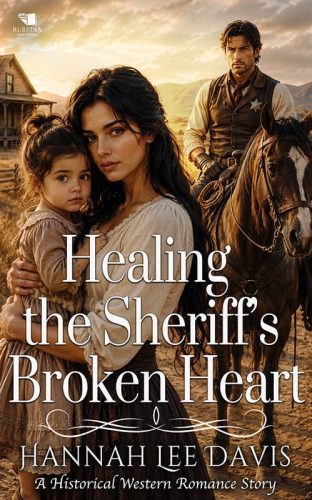
Healing the Sheriff's Broken Heart
“This marriage was supposed to protect the ranch.”
“Now it’s about protecting you, Lucy.”
Lucy Carter has spent years holding her family together after her father’s death. But when her greedy cousin lays claim to her ranch, Lucy realizes she’s running out of options.
Her only hope may be Michael Reed, a widowed sheriff who walked away from the badge after tragedy shattered his life. Quiet, guarded, and carrying more guilt than any man should, Michael wants nothing to do with trouble anymore.
Until Lucy asks for his help.
“You need someone willing to stand beside you,” Michael says quietly. “And I won’t let them take what’s yours.”
Their marriage begins as a practical arrangement—protection for her ranch, a second chance for his reputation. Yet as danger closes in and long-hidden secrets rise to the surface, Lucy begins seeing the kindness beneath Michael’s hardened exterior.
Because sometimes the safest place to belong…
is beside the person willing to fight for you.


Prologue
Fawn Valley, Montana Territory
October 1882
The stew pot was nearly empty by the time Michael Harper set his spoon down.
“Looks like you scraped the bottom clean,” his wife said from across the small pine table.
“I’ll take that as a compliment,” he replied.
Mary smiled, looking tired but pleased with herself. She had tied her hair back with a strip of blue ribbon, though loose strands had escaped and curled along her cheeks from the heat of the stove. A cradle stood near the wall beside her chair. Inside it, their daughter, Charlotte, slept with one fist tucked beneath her chin.
Michael leaned back and stretched his legs under the table. Their cabin wasn’t large—just one main room with a stove, a narrow bed tucked behind a curtain, and shelves Mary’s brother had helped him nail into the wall—but they’d never longed for anything grand, not for more space or better comforts. Mary had always said that a family was what made a house a home, and she was right.
Michael glanced toward the cradle again.
“Hard to believe she turned one today,” he said quietly. “She’s getting so big already.”
Mary followed his gaze and sighed. “Too fast. Soon she will be hanging onto your bootstraps beggin’ you to teach her to ride and shoot.”
The baby stirred as if in answer, making a soft sound in her sleep.
Michael chuckled. “I was expecting you to say she’d be hanging onto your apron strings, learning how to cook and sew.”
“Oh, I have no delusions about that,” Mary said. “Our little girl is just like her father, and I know her father doesn’t have any traditionalist notions on how a woman should be raised.”
“That’s right,” Michael agreed. “Always believed a woman should be treated equal to a man.”
“And that’s one of the many reasons I love you, Michael Harper.”
Michael smiled at her, then looked at his sleeping daughter in the crib again. “The older she gets, the more she looks like you…even that stubborn little chin.”
Mary laughed softly, and as always, the sound warmed the room more than the fire ever could.
The smell of venison stew still hung in the air along with scents of fresh bread and wood smoke. Outside, the wind brushed against the cabin walls. Early autumn had settled over the valley, and the nights were starting to carry a chill.
Michael gathered the bowls and spoons.
“You sit,” he said. “You’ve done enough for one day.”
Mary raised an eyebrow. “And you haven’t?”
“Sit,” he insisted.
Mary opened her mouth to reply, but an owl hooted loudly outside the window, startling Charlotte awake. When she began to cry, the sound echoed off the walls.
“She’s got a pair of lungs on her,” Michael said, smiling. ‘I’ll give her that.”
“Well, that she gets from you.” Mary pushed back from the table and carefully lifted their daughter from the cradle. “That and her appetite.”
Michael chuckled as he carried the dishes to the basin by the stove. He poured water from the kettle Mary had kept warming and added a splash of lye soap. The simple work suited him. After a day of riding patrol and settling disputes, quiet chores at home felt like a reward.
Behind him, his wife moved slowly across the room with the baby in her arms.
“Is she back asleep?” he asked.
“Almost,” Mary said softly.
Michael glanced over his shoulder. Charlotte’s dark eyes blinked up at the lamplight. She made a small sound and stretched her fingers, as if testing the world. As he wiped a plate dry, Mary hummed softly.
“Will you move the crib beside the bed?” she asked.
Michael nodded and moved across the kitchen to the crib. He lifted it and carried it, placing it beside Mary’s side of the bed.
“Thank you.”
Michael listened to his wife’s soft footsteps fade behind the curtain as she carried Charlotte to the bed. The baby gave a small protest, he noticed with another smile, but she settled again soon enough.
He finished the dishes quickly, stacked them to dry, and wiped his hands on a towel. Then, he moved to the shelf near the door and picked up his revolver.
The metal was cool in his hand.
Mary’s voice drifted from the other side of the curtain. “Hush now, Charlotte,” she murmured. “That’s it.”
Michael pulled a chair closer to the lamp and sat down. He opened the cylinder and checked each chamber out of habit, then set the cartridges on the table beside him and reached for the small rag he kept in a drawer.
The fire popped in the stove.
Behind him, Charlotte made one more small sound as he ran the cloth along the barrel. He worked slowly, wiping away the fine grit that gathered after a long day of riding. His old mentor, the sheriff who had first trained him, used to say a man who neglected his weapon was asking for trouble.
Take care of your gun, and it’ll take care of you.
He checked the cylinder again before loading the cartridges back in place. Then, with the weapon cleaned, he lowered the lamp wick a little and stirred the fire with the poker. The flames brightened, throwing a warm glow across the floorboards.
Across the room, the curtain shifted as Mary stepped out.
“She’s asleep,” she said.
“Come sit down,” he said, nodding toward the settee by the fire.
Mary settled beside him on the worn settee he had bought secondhand from a storekeeper in town. The cushion sagged in the middle, but it was comfortable enough if they leaned close together.
Which they always did.
Michael slipped an arm around her shoulders, feeling her rest against him with a quiet sigh.
“Long day?” he asked.
“Not bad,” she said. “My mother stopped by this morning. She brought another jar of preserves.”
“She’s determined to keep us fed.”
“She also says you work too much.”
Michael snorted. “She’s been saying that since I was fifteen.”
Mary tilted her head to look at him. “You do work a lot.”
“That’s the job.”
Being the sheriff meant early mornings and late nights. Most days were simple enough—keeping the peace, settling small conflicts, making sure drunken cowhands didn’t break too much furniture in the saloon.
But there were other days, too. Days when men thought a badge was something to challenge, when trouble rode in from outside town. He had learned early that keeping order wasn’t about strength alone. It was about patience, knowing when to speak and when to stand firm.
Still, sitting here with Mary beside him and his daughter sleeping ten feet away, a thought he had been thinking ever since Charlotte’s birth came to the forefront of his mind.
“Hmm,” he mused.
“What is it?” Mary asked.
“Just something I’ve been thinking about…”
He paused, wondering if now was the right time to bring this up.
“Michael?” His wife half-smiled. “What is it?”
He turned to her. “I’m thinking of hanging up my belt.”
“You mean not being the sheriff anymore?”
“That’s right. Ever since Charlotte was born, the job just doesn’t have the same appeal.”
“What’s changed?”
“Well, I want to be around more,” he said. “I hardly see you or Charlotte. She’s asleep when I leave in the mornings and asleep when I get back at night. I mean, she turned one today, and I missed most of it.”
“But you love your job.”
“I know.” He sighed. “But I also want to make this family my priority now.”
“What would you do?”
“I might fancy gettin’ into a bit of ranch work. Maybe a horse or two… some cattle.”
“You want to be a cowboy?”
“Yes, ma’am.”
The fire crackled.
“So?” he asked. “What do you think?”
His wife pressed her lips together. “I don’t want you to give up what you love for us.”
“I am not giving up anything I don’t want to give up. I love this family, and I want to be here with you.”
Mary shifted to face him, reached up, and cupped his face. “You know that I will support you, no matter what.”
“I know.”
She leaned in and kissed him softly on the lips, then she rested her forehead against his for a moment.
“I love you, Michael.”
“And I love you.”
They sat in comfortable silence as the fire burned, and the smell of warm pine filled the room. Michael listened for any sound from the cot, but the baby stayed quiet.
His gaze moved around the cabin. The table he had built with his own hands, Mary’s sewing basket near the lamp. A pair of little socks hanging near the stove to dry. It wasn’t much, but it was theirs.
In truth, he couldn’t pretend that he didn’t love his job; he did. But he wanted to build something lasting, a real home for his wife and his daughter, who would grow up knowing she was loved. Reflexively, he tightened his arm around Mary’s shoulders.
“You’re thinking again,” she said.
“Just counting my blessings.”
Mary rested her head against him.
“Well,” she said after a moment, “you’d better not count too loud. You might wake her.”
Michael smiled. “I wouldn’t dare—”
Just then, a sharp knock broke the quiet, and she stiffened beside him.
“It’s late,” she murmured. “Were you expecting someone?”
Michael shook his head. No one came calling at this hour of the night unless something was wrong.
The knock came again, quicker this time.
Rising from the settee, Michael crossed the room. His hand went to the revolver resting on the small shelf near the door. He checked the cylinder by habit before opening the door a few inches.
A boy stood on the step, shifting from one foot to the other.
Michael recognized him—Eddie Collins, the blacksmith’s youngest. The boy couldn’t have been more than twelve. His coat hung loose on his thin shoulders, and he looked half-asleep.
“Evening, Sheriff. Harper,” the boy said.
“It’s near midnight,” Michael replied. “What’s the matter?”
The boy held out a folded scrap of paper. “I have a message to deliver.”
Michael took the note and stepped closer to the lantern hanging beside the door.
The handwriting was hurried but recognizable.
Sheriff Harper— Someone’s been at the store. Windows smashed and the door forced. I fear they may still be nearby. Please come at once.
— Samuel Wilkes
Michael frowned. Wilkes was a cautious man. He wouldn’t send for help unless he believed he needed it.
“Go on home,” he said to Eddie. “And stay there.”
The boy didn’t need to be told twice. He hurried off the porch and disappeared into the dark as Michael shut the door and turned back toward Mary, already standing close by.
“Trouble?” she asked.
“Wilkes says someone broke into the store. He asked me to come at once.”
Mary glanced toward the cot where the baby slept. “Now?”
“That’s what he wrote.”
Michael crossed the room and picked up his hat from the peg by the door. His wife watched him quietly, her lips pressed together in a thin line.
“I’ll take a look and be back soon,” he said.
She nodded.
Michael stepped closer and placed his hands on her shoulders. Needing to touch her. To reassure himself, as much as he wanted to reassure her.
“You shouldn’t have to deal with this much longer,” he said. “I will talk with the mayor tomorrow, and once the town council hires a new sheriff, my work will ease up. I’ll only be riding out when they truly need me.”
Mary gave a small smile. “I’ll believe that when I see it.”
He just shook his head. “Lock the door behind me. And keep the rifle near.”
Her mouth tightened a little. “I always do.”
“I know.” He hesitated for a moment, glancing toward the cot again. Then, he leaned down and kissed her forehead. “I won’t be long.”
He stepped outside into the cool night air. Mary closed the door behind him, and a moment later, he heard the bolt slide into place.
Michael saddled his chestnut stallion, Captain, quickly in the small shed beside the cabin. The animal snorted softly as he tightened the cinch.
“Easy,” he murmured, patting the horse’s neck, then mounted. A minute later, he was riding toward town. The road was quiet under the moonlight. A thin layer of frost had already begun forming along the grass beside the trail. The air smelled faintly of pine.
Michael pulled his coat tighter around himself. He was tired in a way that settled deep in his bones. The baby had been waking often through the night these past weeks, and Mary needed her rest. That meant he usually walked the floor with Charlotte while she slept.
Still, he didn’t mind. Holding his daughter in the quiet hours made the long days worthwhile.
What he did mind was being called out over broken windows. If someone had smashed Wilkes’s storefront in a drunken fit, it could have waited until morning.
The ride into the town of Fawn Valley took nearly twenty minutes. By the time he reached the main street, most of the buildings were dark.
The general store, also darkened, sat at the corner near the livery.
Michael slowed his horse and looked over the building. The lantern hanging outside the store door swayed in the breeze. Its weak light showed the front windows clearly.
They were intact.
Frowning, he dismounted and tied his horse to the hitching rail.
“Wilkes?” he called out. There was no answer.
Michael stepped onto the wooden porch and pushed the door open slowly, hearing the bell above it give a soft jingle. Inside, the store smelled of flour, leather, and lamp oil. Shelves lined the walls, stacked with canned goods, bolts of cloth, tools, and sacks of grain.
Nothing looked disturbed.
“Wilkes?” Michael called again.
Only silence answered him.
He walked farther inside, scanning the room carefully, his hand resting on the grip of his revolver. But there was no broken glass or forced door. No sign of a struggle. He moved behind the counter and checked the back room, where Wilkes usually kept his ledger and extra stock. And, again, found nothing out of the ordinary.
Michael stepped back into the main room slowly, and a tight feeling settled in his chest.
Wilkes had insisted he come right away. Yet the store was quiet and untouched. Walking outside, he glanced up and down the street, but the town slept peacefully under the moonlight.
He took one last look at the building before he turned away. He untied his horse, swung into the saddle, and turned Captain toward home. With every mile, the uneasiness in his chest grew stronger.
He urged the horse faster.
By the time his cabin came into view in the distance, Michael was already leaning forward in the saddle, his jaw tight.
And then he saw it. Something moving in the darkness ahead.
At first he thought it was shadows shifting along the road. Then the shapes separated into horses.
Several riders were coming from the direction of his house, and his heart fell.
“Hey!” he shouted, digging his heels into his horse’s sides.
The animal surged forward.
The riders noticed him at once. One of them glanced back and cursed, then spurred his horse harder. The rest followed. Michael’s eyes swept over them as the distance closed. Three… no, four men.
One rider held something bulky across the saddle.
Thieves?
His first thought was that they must have broken into the shed or the tack room while he was gone.
“Stop!” he shouted, but the men rode harder instead. So Michael pushed his horse faster, the pounding of hooves echoing across the frozen ground.
Then he saw something that made his stomach drop.
Another rider rode ahead of the others, with another person sitting in front of him in the saddle. It was a woman, and as the wind lifted a loose strand of dark hair, Michael’s breath caught in his throat.
It was Mary.
For a moment his mind refused to accept what his eyes were seeing.
Then the rider shifted, and Mary struggled in his grip.
“Mary!” he shouted, angry now.
The riders urged their horses faster.
Michael pulled his revolver and fired a shot into the air, its crack splitting the night, and the horses ahead reared and scattered.
“Let her go!” he screamed.
One of the men swore.
The rider holding Mary shoved her away suddenly, and Michael saw her body pitch sideways.
She hit the ground hard, even as his horse was still several lengths away.
“Mary!”
Then another rider tossed the bundle he had been carrying.
It landed in the dirt not far from where Mary had fallen.
The bundle moved, and a thin cry pierced the night.
Charlotte!
Michael hauled hard on the reins and swung down from the saddle before his horse had fully stopped. He ran to the bundle and dropped to his knees.
The blanket was damp as he pulled it back with shaking hands.
Charlotte’s face was red with crying, and relief hit him so hard it nearly knocked the breath out of him.
“You’re all right,” he said hoarsely, gathering her carefully into his arms. “You’re all right, sweetheart.”
She wailed louder, her small hands waving.
Michael pressed her against his chest.
Behind him, the sound of galloping hooves faded into the distance.
He barely noticed.
All that mattered in that moment was the small, living weight in his arms.
Charlotte’s cries were strong and steady. She was cold and frightened, but she was alive.
Michael closed his eyes briefly.
“Thank heavens,” he whispered.
He wrapped the blanket tighter around her and stood, turning toward where Mary lay, a short distance away in the road.
She had fallen on her side, one arm stretched awkwardly in front of her.
Michael walked toward her slowly, Charlotte held close against his chest.
“Mary,” he called softly.
She didn’t move.
He quickened his pace.
“Mary.”
The wind stirred her nightdress as he dropped to one knee beside her.
The lantern from the cabin porch was too far away to give much light, but the moon showed enough. Her eyes were open, but there was no life in them.
Michael shifted Charlotte carefully into one arm and reached out with the other.
His hand trembled as he touched Mary’s shoulder.
“Mary,” he said again.
There was no answer.
He leaned closer, searching for the rise and fall of breath, but there was none. A cold weight settled deep in his chest.
Michael already knew. Still, he pressed two fingers to her neck, hoping to feel something.
Anything.
But there was nothing.
Charlotte cried against his chest, her small body trembling, as Michael sat back slowly in the dirt beside his wife.
The riders were gone, and the road stretched empty under the moonlight.
Michael looked down at Mary’s still face, and his throat tightened as he pulled Charlotte closer against him, holding her protectively with both arms now. Lowering his head, he felt tears begin to spill, rolling down his cheeks and into his lap.
The baby’s cries filled the silence.
And Michael and his daughter cried together, for the wife and mother they had lost and for the future that had died with her.
Chapter One
Brooks Ranch, Helena, Montana Territory
April 1886
Lucy Brooks dipped the pen into the ink bottle and carefully wrote the last number in the ledger. “Twenty-seven sold in March.”
She paused to check the column again, running the tip of the pen down the page, as Ruth Green, her best friend, leaned forward across the table to look at the column of figures. They sat at the wide kitchen table in the main ranch house, where sunlight streamed through the window, warming the worn wood surface on which account books, receipts, and a small stack of letters were spread out between them.
“That’s three more than last year, isn’t it?” Ruth asked, blue eyes widening.
Lucy turned back a page in the ledger and nodded. “It is.”
Ruth sat back with a satisfied grin. “Then you can stop worrying.”
Lucy closed the book partway but kept a finger tucked between the pages.
“I never said I was worrying.”
Ruth raised an eyebrow. “You reorganized the entire tack room last week because you said it ‘looked inefficient.’”
“It did look inefficient.”
“And you counted the feed sacks twice yesterday.”
Lucy set the pen down and gave her friend a patient look. “That was because Horace swore the last delivery was short.”
“And was it?”
“No.”
Ruth laughed.
Lucy glanced out toward the barn for a moment.
Spring had come early. The pastures were already showing patches of green, and several mares were close to foaling. Her father had always said a good spring could carry a ranch through the whole year.
Lucy hoped he was right.
Ruth tapped the ledger again. “You should be pleased. Your father would be.”
Lucy rested her hand on the book, and for a moment, she didn’t answer.
Even after nearly a year, the memory still came to her sometimes without warning. The knock on the door, the ranch hand standing on the porch with his hat in his hands, the news that the carriage had overturned on the mountain road.
Her parents had been traveling back from Helena after meeting with a buyer.
Neither of them survived the crash.
Lucy swallowed and straightened the stack of receipts beside the ledger.
“Well,” she said quietly, “the ranch is doing well. That’s what matters.”
Ruth studied her for a moment but didn’t speak right away. Instead, she reached for one of the papers.
“And these are the payments from the horse auction?”
Lucy nodded. “Most of them.”
Ruth skimmed the list. “You did better than anyone expected.”
Lucy allowed herself a small smile.
The auction had worried her more than anything else since taking over the ranch. Her father had always handled the big sales himself. Men from all over the territory had come to the Brooks ranch to buy horses from him.
Lucy hadn’t been certain they would show the same confidence in her, but they had come, and they had bought.
“Horace helped,” Lucy said. “He’s been breeding these lines longer than I’ve been alive.”
“That man would walk into a fire for you,” Ruth said.
Lucy believed that was probably true.
Horace Baxter had worked for her father for nearly thirty years. Since the accident, he had made it clear that he considered the ranch just as much Lucy’s responsibility as it had been her father’s. Sometimes, he reminded her of that several times a day.
“You should have seen him at the auction,” she murmured. “Standing there with his arms crossed like he was daring anyone to question the horses.”
Ruth laughed. “I would have paid good money to see that.”
Lucy closed the ledger and pushed it aside. “I’m glad the numbers look strong,” she went on. “But we still have a lot to do before summer.”
“Of course you do.” Ruth made a face. “It’s a ranch.”
Lucy stood and walked to the window. She could see two hands repairing a section of fence near the barn, and a group of horses grazing in the pasture beyond the corrals, their coats shining in the afternoon sun.
Slowly, she rested her hands on the windowsill.
When her father first began teaching her the business, she had been barely fourteen. At the time, she’d thought he simply enjoyed having company while he worked. Only later did she realize he had been preparing her. He’d never believed she should be left helpless simply because she was a woman.
“You need to understand every part of this place,” he had told her more than once. “Because someday it may be yours.” She just hadn’t expected someday to come so soon…
Ruth joined her at the window. “You’ve done exactly what you promised them.”
Lucy glanced at her. “What do you mean?”
“After the funeral,” Ruth said. “You told me you wouldn’t let the ranch fall apart.”
Lucy remembered. She had stood right here in this room, staring out at the same fields, wondering how one person was supposed to manage something her father had spent a lifetime building.
“I said I would try,” she amended.
Ruth nudged her lightly with her elbow. “Well, you’re succeeding.”
Lucy looked out over the land again—at the barns, the corrals, the wide stretch of pasture beyond them. Her father had built all of it from nothing more than a few horses and stubborn determination. The weight of responsibility was familiar by now.
“I intend to keep it that way.”
“I never doubted it.” Smiling, her friend closed the ledger with a soft thump and pushed it across the table. “Is it lunchtime? Numbers make me hungry.”
Lucy smiled back. “You’re always hungry.”
“That’s because I use my brain more than you do.”
Lucy raised an eyebrow. “You spent the last half hour scribbling horses in the margin of the account book.”
“They were excellent scribbles.”
Lucy shook her head “I think there’s still bread in the pantry. And Mrs. Carter left a jar of apple preserves this morning.”
Ruth brightened immediately. “Now, that sounds like proper work.”
Lucy crossed the kitchen toward the pantry door, but before she reached it, the sound of hoofbeats carried through the open window. Both women paused before Ruth stepped away.
“Expecting someone?” she asked.
Lucy frowned. “No.”
As the hoofbeats slowed, she moved to the window and looked out.
A rider was coming through the gate at the front of the house. He sat tall in the saddle and rode with the easy confidence of someone accustomed to being on horseback. His dark hair caught the sunlight as he removed his hat—and she felt an uneasy jolt of recognition.
The resemblance was unmistakable.
The same dark hair her father had carried. The same strong jaw that appeared in several old family portraits. She hadn’t seen him since she was a girl, but she knew immediately who he was.
“Lucy?” Ruth said quietly. “Who is it?”
Next chapter ...
You just read the first chapters of "Healing the Sheriff's Broken Heart"!
Are you ready, for an emotional roller-coaster, filled with drama and excitement?
If yes, just click this button to find how the story ends!
When is the release date. I’m always afraid I’ll miss it
Great news, Myrna—it’s tomorrow!✨ If you want to be the first to know about my future releases, you can join my mailing list here: https://rubedia.com/author-pages/hannah-lee-davis/novella/ (free novella included!) and follow me on Facebook here: https://www.facebook.com/AuthorHannahLeeDavis/ ❤️
I like the story line so far and I’m looking forward to reading the book.
I hope the full story gives you even more to hold onto, sweet June💖
Caught and kept my attention
Thank you so much, sugar❤️