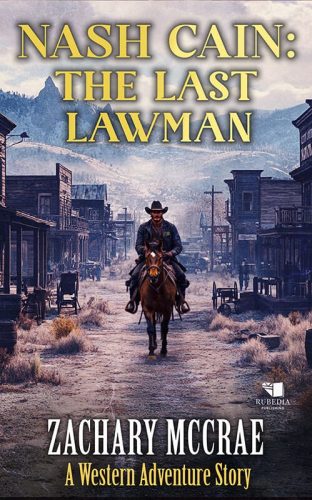
Nash Cain: The Last Lawman
They made a mistake giving him the badge. Now Nash Cain is making them pay…
Nash Cain didn’t come to Barton Creek, Texas, to stay.
A seasoned ex-marshal and former soldier, he takes a wounded man back to his home—but finds a town ruled by powerful cattle barons and hired guns. No one talks. No one resists.
Until Nash takes the badge.
With only a handful of allies, Nash starts to push back. But every move he makes brings him closer to a violent reckoning with the men in power.
A body in the street.
A warning shot in the dark.
Now, walking away isn’t an option.
Because in a town owned by violence…
justice has to be taken at gunpoint.


Chapter One
Texas, 1870
The land ran out in long, tired folds, the grass worn thin in places where the wind had worried it down to dirt. That old wind carried dust scrub, as it always did. The air tasted outright sour.
Nash Cain let his horse, Brandy, pick the path, and before long, they came across a track: two shallow grooves carved into the dirt. A wagon had come through here, and from the looks of it, not long ago. The ruts were shallow but clear, one side a little deeper than the other where the load had leaned.
Curious despite himself, he adjusted course, steering Brandy to stay along the trail. The saddle creaked under him, leather gone soft in places, stiff in others.
Same as most things, he thought grimly.
Nash rode with one hand loose on the reins, the other resting against his thigh. His revolver sat low on his hip, leather around it worn smooth. He hadn’t drawn it in weeks. Longer, maybe; he didn’t keep track anymore.
That had been the point: not to draw it, not to think about it.
By noon, every color had burned down to the same tired shade. Nash shifted in the saddle and rolled his shoulders with a wince, vainly trying to dislodge a crick that never quite left.
The war had given him that, and the years after had ensured it would remain.
Ahead, the ground dipped into a shallow draw marked by a line of cottonwoods, their leaves dull and unmoving, trunks pale against the darker brush. There might be water there, or maybe there once had been.
Brandy flicked his ears.
“Easy,” Nash said.
He rubbed his jaw with the back of his hand. His beard had come in uneven, rough, and thick along the chin, bristly scruff covering his cheeks. He’d shave when he reached a place with a barber. Nash wasn’t sure where; he supposed wherever the road died, he’d make a stop.
For years, he’d always had somewhere to be, something to ride toward or away from. A town that needed setting right. A man who needed finding. A badge that kept him from turning aside—even when he’d wanted to.
He’d left all that behind; now, he was dust in the wind.
Suddenly, a shot cracked across the open ground, not close enough to startle Brandy into panic, but near enough that he lifted his head and went still.
Nash did the same. He wasn’t stupid, and he didn’t take chances.
Could be a hunter…
The shot had come from the line of trees ahead, maybe a little beyond. Hard to tell in country like this. The land distorted distance and noise.
He waited, guiding Brandy to a stop by a large cottonwood, and kept his eyes on the trees.
A minute passed. Then another.
Brandy blew out a breath.
“Shush, boy.”
He could turn away—take a line south, cut wide around whatever lay out there, and be gone before the sun reached its height, avoiding any chance of trouble. No one would know. No one would ask.
“Don’t be a fool, Cain,” he muttered to himself. “Just keep riding.”
But when he closed his eyes, he saw faces: the lifeless faces of dead boys.
Corpses, laid out on dull brown dirt beside bent rifles, marred by gunpowder burns.
All of those soldiers had left mothers behind, and plenty must’ve had sons and daughters too. He wondered where all those bones had gone. Probably still right there, unburied.
With a start, Nash realized his hands were shaking.
Looks like I ain’t done with the world of man after all.
He exhaled once, long and slow, and turned Brandy toward the line of trees.
The ground sloped down into the draw, the grass thinning as the soil gave way to patches of packed earth. Hoofprints appeared after a while, fresh enough that their edges hadn’t crumbled yet.
Nash’s eyes moved over the ground, reading the spacing of the tracks.
No sign of a struggle…
He slowed Brandy as he approached. The stench reached him before he even saw the flies; sharp and metallic, it overcame everything else, even in the open, with the wind moving.
Blood.
Brandy shifted uneasily as Nash urged him to take a step, then another, bringing them just to the edge of the trees.
A wagon listed crookedly to one side in the shade, one wheel sunk deep into the soft ground near an old streambed. The canvas was torn along one side, hanging loose, its edge dark where something had soaked into it.
A stiff-legged mule lay motionless in the traces, neck bent at an unnatural angle. A few yards off, a man lay on his back, one arm thrown out as if in a failed attempt to catch himself.
Nash swung down from the saddle, his boots hitting the dirt with a soft thud, and looped the reins loosely over a low branch. Brandy stayed where he was, though his ears remained pinned toward the wagon.
Steeling himself, Nash walked to the man on the ground and crouched, resting two fingers against the man’s neck.
Nothing.
He left his hand there a second longer anyway, just in case, then sighed and sat back on his heels.
By Nash’s reckoning, the man had likely been in his midthirties, but it was hard to tell with the dust and the blood darkening his shirt. A round hole torn in the fabric showed where the bullet had gone in. The wound gaped high on his chest, closer to the collarbone than the heart. The exit had done more damage, tearing through cloth and flesh alike.
The shot had been close. Too clean for distance, but definitely not an expert shot; it’d found its mark, but Nash doubted it’d landed where the shooter had intended. That said luck, not skill.
Nash turned his head, listening, letting his eyes move across the trees, the brush, the open land beyond.
“Hello?” he called.
For a moment, there was no answer. Then, from the wagon, a quick intake of breath.
Nash moved without thinking, crossing the distance in a few long steps. He reached the torn side of the canvas and paused to listen.
Another gasp.
He reached out and pulled the canvas back to reveal a man laying half-turned against a stack of crates, one arm pressed tightly to his side. Blood had soaked through his shirt, darker and heavier than the dead man’s, the fabric clinging where it was wet.
His eyes opened, squinting in the sudden light, then widened when they found Nash.
He swallowed. “You alone?”
Nash glanced over his shoulder, taking in the stillness of the trees, the empty stretch of land beyond.
“Looks that way.”
The man gave a small nod, as if that settled something, and murmured, “Thought so.”
Nash stepped up into the wagon, careful not to shift it further. The wood creaked under him, but held. He knelt to take a closer look.
This man’s wound sat low on the right side, just above the hip, but it wasn’t a clean pass. The blood had spread wide, soaking into the cloth, pooling where the man’s body pressed against the boards.
Nash tilted his head toward the body outside. “You shoot that other guy?”
The wounded man coughed, a wet sound that caught in his chest. His hand tightened against the wound as if determined to hold himself together by force alone, but he was losing a lot of blood.
Reaching out, Nash winced as his fingers slipped over the sodden fabric. He watched the man, measuring the breath, the color in his face, the way his eyes struggled to stay steady.
“What’s your name?” he asked. “Can you give me that?”
“D-Dan… Danie—” He broke off, spluttering, spraying tiny flecks of red into the air.
“Daniel?” Nash guessed.
The man nodded weakly, his eyes shining with relief and, perhaps, cautious gratitude.
“All right, Daniel, I want to get you to the sawbones. But first, can you tell me what happened here?”
Daniel swallowed, then winced at the movement. “Two of ’em,” he croaked, his voice dry as dust. “Come out from the trees. Didn’t say nothin’—just came on.”
Nash glanced back at the dead man. “You know ’em?”
Daniel shook his head quickly. “No. Never seen ’em before.”
Nash held his gaze, sensing reluctance beneath the man’s words; he supposed that was fair, though—Daniel didn’t know him from Adam, after all—so he decided not to push.
For now.
“Go on.”
Daniel’s breath hitched. “First one raised on me, so I fired.” He let out a weak, humorless sound. “Didn’t think I’d hit him, though. Truth be told, I ain’t much of a shot, but… He dropped.”
“Lucky for you,” Nash said wryly.
“Lucky…?” Daniel’s chin dipped. “Yeah. I guess”
“You said there was two of ’em—what about the other man?”
“Ran off.” Daniel’s eyes darted toward the canvas flap, as if expecting the man back any second. “Soon as his partner went down, he turned tail and lit out.”
“You get a look at him?”
Daniel hesitated. “Not a good one,” he said. “He wore his hat low. With the sun in my eyes, I couldn’t swear to nothin’.”
Nash studied him. “You said you didn’t know him, though… right?”
“Didn’t recognize him,” Daniel amended hastily.
“You didn’t recognize him, but you didn’t see him either?” Nash asked, raising a brow.
“I suppose—” Daniel licked his lips. “I mean, he didn’t seem familiar. That’s all.”
Nash chewed his tongue. Oddly, despite the fact that Daniel’s story didn’t line up, the man didn’t strike Nash as a liar.
Just then, Daniel sucked in a breath as his hand slipped from his side. Fresh blood welled through his shirt, and he fumbled, trying to stem the flow.
Nash’s attention flared. “Let me see.”
“It’s nothing,” Daniel said.
“That so? You tellin’ me you ain’t bleeding through your hand?”
Daniel gave a weak smile that faded almost immediately. “Clipped me. Reckon it went clean through.”
Nash peeled the man’s hand back enough to look. Ugly as the wound was, it wasn’t wide. However, despite what Daniel had claimed, the bullet was still in there somewhere, deep. Even so, blood loss would claim Daniel’s life before the bullet had a chance, and Nash had seen worse men make it.
“You’ll keep,” Nash said, then added, “if you don’t talk yourself dry first.”
Daniel let out a breath that might have been a laugh. “There’s a doctor in my town—Barton Creek. It’s not far. I can get proper looked at there.”
Nash nodded. “You’ll get there,” he said, “but not if you keep jawing.”
Daniel’s mouth snapped shut.
“Good.” Nash stood and turned, then glanced back over his shoulder. “You riding alone?”
Daniel jerked his chin weakly. “That’s Breaker—he’s mine.”
Nash’s eyes followed the movement to see a gelding standing a short distance away, reins trailing.
“Not for long, he ain’t.”
He jumped down from the wagon and crossed to the horse. Breaker rolled his eyes at the smell of blood and stamped nervously, but allowed Nash to catch the reins and bring him in.
Daniel watched, brow creasing. “What are you doing?”
“Unless you want to ride with a corpse,” Nash said, “I’ll be hoisting him up there.”
Daniel blinked. “Why?”
Nash narrowed his eyes. “Because decent folk don’t leave corpses lying in the dirt.”
Daniel’s eyes darted from the dead man to his gelding, then back to Nash. “All right.”
Nash led Breaker alongside Brandy, looping the gelding’s reins and tying them off short. After checking the knots, he grabbed his canteen, a small brown bottle, and a rolled wad of mostly clean linen, then returned to the wagon.
Daniel’s head had sunk back against the crate, his skin having lost color in just the few minutes since Nash had left. Sweat beaded his forehead. His lips were cracked, and white gathered at the corners of his mouth.
Nash raised the canteen. “Small drink.”
Daniel nodded, and Nash held the canteen to his lips and tilted it gently upward. Daniel coughed at first, then managed a few mouthfuls, growing more eager with each swallow.
Nash pulled the canteen back before he could make himself sick. “That’s all for now.”
Daniel shut his eyes, breathing through his nose.
Nash set the canteen aside and unrolled the linen, then picked up the bottle. The sharp smell of strong whiskey filled the wagon as he pulled out the stopper with a pop. He was no doctor, but he’d seen his fair share of blood, and no sane man traveled any distance without the means to clean and bind a wound—at least temporarily.
He inhaled slowly. “Hold still, Daniel.”
The man’s eyes snapped open. “What—”
He broke off with a pained gasp as Nash cut away his shirt and upended the bottle over the wound, dousing it in whiskey. Before he could gather himself enough to struggle, Nash proceeded to wrap his shoulder, cinching the linen tight and passing it around the man’s torso a few times for good measure.
Nash worked quietly, his hands steady. The awkward placement of the wound made things difficult, but the makeshift bandage would hold for now.
He tied the linen off and nodded to himself. “We find that doctor, you’ll be all right.”
Taking a deep breath, Nash took stock of the situation. If Barton Creek wasn’t far, as Daniel had claimed, it should slow the bleeding for long enough to reach the town. They had two horses, sound but not fresh, one corpse, and one wounded man who’d likely fall if he tried to sit straight on his own. He found a few blankets in the wagon, along with the torn canvas tarpaulin; the crate might’ve been useful if Nash had time to break it down, but the way Daniel was losing blood, it wasn’t worth the risk.
After cutting two lengths of rope, Nash dragged a blanket free and folded it double, then rolled another into a thick pad. Then, he laid both across the saddle and cinched them down hard. It would sit awkward, but with any luck, it’d keep Daniel from slipping.
Finally, Nash returned to the dead man, taking a moment to study the body.
Broad through the chest, heavy in the shoulders, he’d obviously been a working man. Nothing soft about him. His face was ordinary enough in death: lips parted, eyes fixed on nothing. Based on the rough looks of him, Nash figured Daniel was telling the truth—if not all of it.
Nash took off his hat and stood a moment in the heat.
Some lawmen made a show of elaborate speeches concerning the dead, as if God were hard of hearing. Nash had never seen the use in that, so he didn’t make a habit of praying long over strange men; the Lord knew the shape of a life better than any man standing over it.
Nash put his hat back on, then dragged the body over to the horses and lashed it to Breaker’s back, shrouding it with a scrap of canvas from the wagon. It wasn’t much, but it was something.
Better than leaving a man staring up into the sun.
The mule, he left where it lay. No helping the poor beast now.
When he climbed back into the wagon, Daniel was waiting. Nash lifted him gingerly—Daniel was lighter than he looked, at least—and stepped down from the wagon. Nash felt the heat of him through the bloodsoaked shirt, the weakness in him.
Reaching Brandy’s side, Nash settled Daniel as carefully as he could against the padded saddle.
Daniel sucked a hissing breath through his teeth, then groaned low in his throat.
“Stay with me,” Nash said.
“Trying,” Daniel spluttered. “We’re headed northwest.”
Nash mounted behind him, one arm firm around his middle, keeping pressure on the wound as best he could. He took the reins in his other hand, turned Brandy out of the trees, Breaker in tow. They started toward Barton Creek.
Daniel kept quieter than Nash expected for the first half-hour. He breathed shallowly, his head tipping back now and then against Nash’s shoulder, but he stayed conscious. Eventually, he asked for water again, and Nash gave him a mouthful.
Daniel drank, coughed, drank again. “You a lawman? You carry yourself that way.”
Nash kept his eyes on the land ahead. “Was.”
Nash felt Daniel take a breath, as if to question him further, but thankfully, he seemed to think better of it.
Nash had grown tired long ago. Tired of drunks and grieving women. Tired of ‘innocent’ men with blood still wet on their hands. Tired of riding home with another killing set on his back, rightful or not. Tired of being the kind of man folks sent for only after things had already gone bad.
He’d buried good men. He’d shot bad ones. In the end, the ground held them both the same.
Eventually, the horizon changed, barely more than a hint of color, but noticeable to his trained eye: a line of thick trees, and a faint suggestion of smoke beyond them, rising into the stagnant air in thin, straight lines. Town smoke, most likely—too many for a temporary camp.
Barton Creek.
Abruptly, Daniel spoke. “What’s your name?”
“Nash.”
“You go out of your way like this for everybody, Nash?”
“No.”
“Then I must be favored, eh?”
Nash grunted. “You’re looking pretty unlucky to me.”
Oddly, that seemed to please Daniel for some reason. Chuckling, he shifted his weight and relaxed, dozing in place.
As they rode on, the trees ahead grew larger, the smoke clearer. Barton Creek wasn’t far now—beyond the next rise or the one after it, squatting in the heat like any other town, waiting for trouble to ride in.
Nash generally passed wide of places like that, keeping to the fringes where he could trap, trade, and sleep under his own blanket, without a soul to answer to but God.
Yet here he was again, carrying a wounded stranger toward a doctor, a dead man behind him, and the taste of gunsmoke lingering in his thoughts.
Daniel stirred, rousing into consciousness. “I know these trees—this is home, ain’t it?”
Nash’s eyes stayed fixed on the distant line of trees.
“Yours, maybe.”
They rode on, the light slanting lower, the long miles of day gathering behind them.
Chapter Two
By the time Barton Creek took full shape out of the trees, the light had gone the color of old brass. Nash had been watching the place for the better part of an hour as it rose out of the land in pieces. First the smoke, then the tops of cottonwoods along the creek, then the scattered roofs and false fronts of buildings, washed flat in the lowering sun.
It wasn’t much of a town at first glance: a main street, a church steeple set back some, a livery, a hotel with a porch running along its front, and farther off, the squat shapes of corrals and sheds where the cattle trade had left its mark on everything around it.
Daniel stirred against him.
“That it?” Nash asked, the words little more than breath.
“That’s it.”
Daniel gave a small nod, though Nash couldn’t tell whether he’d truly seen the town or only assumed.
Daniel’s gelding was laboring now, as was Brandy; dark sweat had dried and risen again along his neck and shoulders.
Nash leaned forward and patted Brandy’s neck gently. “Almost there, boy.”
The road broadened as they came down toward a creek crossing. Wagon ruts deepened. The ground was packed harder where more feet had passed over it. A broken barrel hoop lay half-buried in the dirt. Someone had thrown fish guts down by the reeds, and the smell carried sour off the bank. A mongrel dog nosed through and darted away when it saw them coming.
The town itself sat in that hour between work and supper—enough light left for business, enough weariness in the day that folks had begun turning inward. A woman in a faded blue dress was taking washing from a line behind one of the houses near the creek. Two boys stood outside the mercantile, barefoot.
Nash felt their eyes before he reached the first building.
“Barton Creek…” Nash’s eyes slid back to the wounded fellow. “What do you handle there?”
Daniel wetted his lips and seemed to gather himself before speaking.
“Post and such,” he said. “Information. Mostly papers. Notices. Letters. Some from Austin, some farther on. I publish whatever folks will pay to read.”
“A newsman, then.”
Daniel gave the faintest twitch of a smile. “That’s the grand name for it.”
His head tipped back against Nash’s shoulder for a moment. Nash felt the man’s weight grow heavier, then tremble as he fought to stay upright.
“How’s a newsman end up all alone out there?”
Daniel drew a shallow breath. “It’s a small town, you see, so I gotta deliver myself. Hear more than folks think.” He shifted a little, careful of his wound. “Barton Creek’s had an uneasy season. Men getting pushed off claims, stock turning up where it shouldn’t… Council don’t do much. Law, neither.”
Nash stayed silent, looking over Daniel’s shoulder, where blood had started to seep through the makeshift bandage. The bullet hadn’t come out the back. He was out of shock but still hurting.
Not good, but not a death sentence either, with a doctor close.
“So, you shot him first, huh?” Nash jerked his chin back at the corpse.
“Drew after, though.” Daniel’s fingers shook as he wiped sweat from his face. “Like I said, I’m no slick shooter, so maybe he was drunk. Not sure. Lucky me.” He grimaced, pain biting the words down.
They stopped at the edge of town, where the main track widened. The street had grown busy—women carrying baskets, a wagon trundling past, children trailing behind it. No one looked their way for long. The air tasted of sage and the coming heat.
Nash looked at the dust on his boots, then glanced back at the distant hills.
He watched the streets unfold, his eyes picking out movement where there was none. He thought about the dead man strapped to the gelding behind them. There’d be questions.
Brandy ambled through town, Breaker in tow. Men stood on plank sidewalks, eyes shifting toward the stranger bringing in the wounded man. Nash ignored the stares.
Eventually, they reined up before a white-painted square house with a brass plate reading CARSON, M.D. above the door.
He swung down, then hurried to catch Daniel before he fell. Blood had soaked through the makeshift bandage, and the man’s eyes rolled with pain.
The door opened before Nash could knock. A tall, lean man in shirtsleeves stood there, medical bag in hand. Behind him, a woman appeared, her hair pale gold in the late light, skin burnished from the Texas heat. She looked Nash over quickly; then, her gaze landed on Daniel and sharpened.
“Bring him in here,” the doctor said without preamble.
Nash nodded wordlessly. He lifted Daniel, feeling his bones and weight, the shaky exhalation as the wounded man struggled to get his feet beneath him. Daniel’s head lolled, but he’d perked up at the sound of the doctor’s voice.
“Daniel Whitlock, what trouble have you landed in this time?” the doctor said, soft but steady, as Nash carried Daniel inside.
The room smelled of liniment, clean rags, and whiskey. Nash set Daniel on a cot in the corner, pressing down on his shoulder when he tried to rise.
The nurse crossed to Nash’s side with a basin. Nash watched her hands as she rolled up her sleeves with practiced, impatient fingers.
Then, she pinned Nash with a keen gaze. “What happened?”
“Set on by two men. Killed one, but other ran.” He lowered his voice. “Bullet’s still in him.”
She nodded, already tearing away the bloodsoaked linen over the wound. “You do this?” Her tone was direct, unflinching.
“Yes.”
She grunted approvingly. “You know to bind a wound. That’s better than most.”
The doctor leaned down, examining the wound. He nodded at Nash. “Thank you, sir. I’m Ethan Carson. This is my sister, Kate.”
The nurse’s head turned, and her eyes met Nash’s.
“Nash Cain.”
She nodded curtly, but didn’t respond. He’d expected the usual fear or suspicion, but saw only slight impatience in her honey brown eyes before she bent to press a damp rag to Daniel’s forehead.
Nash said nothing as he watched, noting how she worked: quickly, confidently, with no wasted motion. She was pretty—sun-browned forearms, hair pulled back, brown eyes sharp as a tack. Her attention was fully absorbed in her work, intensely focused as she passed the doctor surgical scissors, boiling water, and a needle.
“We’ll see to him now. I’ll need you to wait outside,” Ethan said, already washing his hands. “I’ll send word as soon as I finish.”
“Of course, Doctor—”
“Please, call me Ethan.”
Nash nodded, stepped out onto the porch, closing the door behind him, and leaned against the white-painted rail.
He took out his pocket watch and flipped it open, then took his time cleaning his hands with a kerchief and canteen. The ache in his thigh from an old bullet wound flared as he settled onto the top step.
A voice broke the spell. “You brought him in?”
The nurse—Kate—stood in the doorway, hair coming loose around her ears.
“Don’t look like he’s in too much trouble… right?”
She nodded. “He’s got a bullet to show for it, but he’s alive.” She leaned against the doorframe, arms crossed, eyes shadowed by oncoming clouds. “You new in town?”
“Just passing through,” Nash answered.
“That right?” She looked him up and down, her eyes eventually landing on the old marshal’s badge looped through the saddlebag slung over his shoulder. “You look like you’ve seen trouble before.”
“Seen my share.”
Kate studied him, measuring his curt reply. “Plenty of folks’ve seen trouble. Don’t mean they know how to handle it.”
Nash watched her gaze move down to his hands—scars, blunt knuckles, careful movement—but she didn’t flinch. He liked that.
She straightened and motioned him inside. “Ethan wants to talk to you. Come on.”
Inside, Daniel lay half-asleep, chest and shoulder bound more securely now; His skin was still pallid, but he breathed easier.
Ethan stood at a basin, washing blood from his arms. “Thank you again,” he said, retrieving a towel and drying his hands. “Not many would stop to help a stranger on the trail out here.”
Nash shrugged. “Wouldn’t feel right riding on.”
Ethan nodded. “You say there was another attacker—one who ran? Did you get a look at him?”
Nash raised an eyebrow. “Wasn’t there when it happened.”
Kate scowled. “Pike’s boys prowl from dawn to dark these days. Be careful out there.”
Nash raised an eyebrow, curiosity piqued, but refrained from asking just who, exactly, this “Pike” was.
Stay out of it, Cain. You ain’t the law no more.
Ethan cleared his throat. “Don’t venture too far. I’d like a word soon. I take it you’re staying here, in town?”
Feeling his boots jitter, Nash thumbed with the idea of declining. Still, a night’s rest wouldn’t kill him.
One night. I can afford one night…
Smiling thinly, he opened the door and stepped into the dusty wind, vowing not to let this town and its woes get stuck under his skin.
Nash Cain was a man with no home, and he aimed to keep it that way—no matter what.
Next chapter ...
You just read the first chapters of "Nash Cain: The Last Lawman"!
Are you ready, for an emotional roller-coaster, filled with drama and excitement?
If yes, just click this button to find how the story ends!
Looking forward to the rest of the story!
Thanks for sticking with Nash Cain, Garry!
This sounds like a great book to read. Can’t wait for the next chapters.
Donna, hope it was worth the wait!
Very good start. 2 of yours are in my top 10.
John, the ex-Texan
Top 10?! Appreciate this, partner!🤠
I like what I’ve read so far and look forward to reading the finished book.
Hope the full ride held up, Tallulah!
Sounds like it is going to be a great story.
Hope it proved you right, Anna!