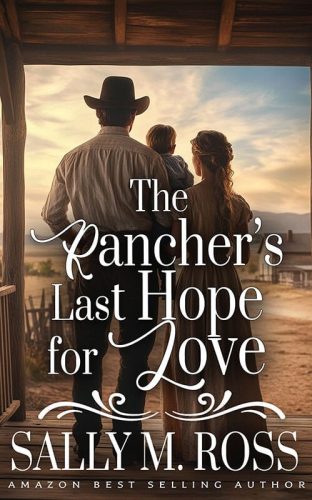
The Rancher's Last Hope for Love
“Are you afraid of the music, Gus?”
“I’m afraid of what happens when it stops, and I still can’t let you go.”
Hope Whitcomb learned the hard way that a man’s word is as fleeting as a Pennsylvania summer. Humiliated and deeply wounded by a fiancé who left her to marry another woman, Hope answers a governess ad and flees to the Missouri frontier, determined never to trust a man again. But as she steps onto a failing ranch, she finds herself drawn to a man who treats his heart like a fortress.
Gus Calder is a man of stone, burdened by grief. He only asked for a governess for his son, not a woman who makes the quiet house feel like a home. He’s spent years building walls to keep the world out, but Hope is the thing he never saw coming.
When a lawless gang threatens to burn everything to the ground, everything shatters. In a land that demands everything, will they find the courage to stop running and fight for each other?


Prologue
Osage River Country, Central Missouri
April 1877
The ranch wasn’t ruined. Not yet. But it was close enough that he could feel it, like the edge of a drop beneath his boot.
The numbers refused to behave.
They sat there on the page like stubborn livestock, scattered and unruly, refusing to be herded into anything that made sense. Gus Calder leaned over the kitchen table, forearms braced against the scarred pine, eyes burning as he ran through the figures again.
Feed. Wages. Repairs.
Fence posts split by winter ice. Veterinary costs from the sickness that had swept through part of the herd in March. Replacement tack. Freight charges from town. Each expense had seemed manageable on its own. Together, they pressed down like a weight on his chest.
He drew a line beneath the column with the stub of his pencil and added the total again. The scratch of graphite was the only sound in the kitchen besides the faint tick of the clock above the stove and the low pop of a dying ember in the hearth.
It didn’t change.
The spring had been wrong from the start. Too wet when it should have been dry. Too cold when the calves came. Pasture torn up and slow to recover. Buyers were cautious, offering less than last year and acting as though Gus should be grateful for it.
He pushed back in his chair and scrubbed both hands over his face. The lamplight wavered, shadows stretching long across the room, turning familiar objects into distorted shapes. Grace had always said the kitchen felt different at night. Too quiet, too honest.
You think too loud when it’s dark, she’d teased him once, coming up behind his chair and resting her chin on his shoulder. That’s when worries get ideas.
The memory hit hard. Gus dropped his hands to the table and stared at the worn wood, jaw tightening until his teeth ached. He hadn’t meant to think of her. He never did. It just happened. She slipped in when he was tired or distracted, like a blade finding a gap in armor.
Seven months.
It still felt impossible that she’d been here last autumn, moving through this very kitchen with a basket on her hip. She hummed while she worked, laughing when Sammy toddled after her with sticky hands. Illness had taken her quickly. Too quickly for a man who believed that hard work and vigilance could stave off trouble.
He exhaled slowly and forced his attention back to the ledger.
Hunter would be back soon.
His cousin had ridden into town earlier that afternoon to collect payment from a rancher on the north road. A man who had been late twice already but owed them enough to cover the worst of the spring expenses. Hunter had clapped him on the shoulder before leaving, his grin easy, confident.
Quit worrying. I’ll be back before dark, and we’ll square this away.
Once that money was in hand, Gus could breathe easier. Maybe mend the south fence before the cattle tested it again. Maybe set a little aside for emergencies. Maybe stop staring at numbers like they were a verdict.
A sound drifted down from upstairs.
Soft at first. Then a little sharper.
“Ma…”
Gus went utterly still.
The word was small and broken, dragged up from sleep, followed by a hitching breath.
“Mama…”
His chest tightened, his breath catching before he could stop it. He turned his head toward the stairs, listening as another whimper followed, then a sob.
Sammy had been restless all week. The nightmares came most often in the early morning hours, but sometimes, like tonight, they reached for the boy sooner, pulling him out of sleep with questions Gus couldn’t answer and needs he couldn’t fix.
He set the pencil down with care and stood, the chair scraping softly across the floor. His legs felt stiff as he crossed the kitchen, the ache in his joints reminding him he’d been sitting too long. He reached the first stair just as the front door opened.
Cool evening air swept inside, carrying the scent of damp earth and budding leaves. Boots sounded softly against the floor.
Maya.
She closed the door behind her and turned, shawl pulled tight around her shoulders. Her eyes went straight to him, concern already there. Worry lived in her gaze now, constant and unrelenting, carving shadows beneath her eyes that hadn’t been there before.
“He’s crying,” Gus said quietly.
She nodded once. “I heard him outside.”
He hesitated, fingers curling briefly around the banister. “I was going to—”
“I’ll take him,” she said gently, already moving toward the stairs. “You stay.”
Gus opened his mouth to argue, then stopped. Pride rose, quick and instinctive, followed just as quickly by the heavier truth pressing down on him. Maya had been the one to soothe Sammy most nights since Grace’s death. She had patience that Gus sometimes lacked, especially when grief lingered so close to the surface.
“Thank you,” he said instead.
She touched his arm in passing and climbed the stairs, her steps quiet. Gus remained where he was, one hand braced against the banister, listening as her voice drifted down. She murmured to Sammy, soft and low, then began to hum.
The tune had no words, just a gentle rise and fall that seemed to smooth the air itself. Sammy’s cries dulled to sniffles, then faded altogether.
Gus closed his eyes.
When Maya returned, she paused in the doorway of the kitchen, watching him. The lamplight caught the worry etched into her face. She looked thinner than she had a year ago. Fragile in a way that unsettled him.
“He’s asleep,” she said. “For now.”
“Good.” Gus cleared his throat and gestured toward the table. “Hunter should be back soon. Once he brings the payment, I can—”
“Gus.”
He stopped at the sound of his name.
Maya stepped farther into the room, gaze flicking from the ledger to his face. “You can’t keep doing this alone.”
“I am doing it,” he replied, sharper than he meant to. He forced his tone down. “I have to.”
She shook her head slowly. “Grace is gone. And Hunter and I… we won’t always be here,” she continued. “We want children. A family of our own.”
His jaw clenched. He nodded once. He had known their plans. Of course, he had. Hunter and Maya had married young, full of plans, laughter easy between them. It wasn’t fair to expect them to put their lives on hold because tragedy had gutted his.
“I know,” he said. “I’m not asking you to.”
Maya searched his face, then looked away, wiping at her eyes. “You need help. Someone steady. For Sammy. For the house.” She hesitated. “For you.”
Before he could answer, a sound split the evening air outside.
“Gus!”
Gus’s heart slammed into his ribs hard enough to steal his breath. For a split second, his mind refused to catch up, suspended between the kitchen’s lamplight and the raw edge in that voice.
He was moving before thought caught up. Lunging for the door, he yanked it open, and the night rushed in cold and damp. Hooves thundered into the yard, sparks flying as iron struck stone. The horse stumbled.
“Hunter!”
Gus ran.
The horse skidded to a stop, sides heaving, eyes wild. Hunter had pitched forward in the saddle, his body folding unnaturally. Then he fell, hitting the ground with a sickening, hollow thud that Gus felt in his bones.
“Hunter—!”
Gus dropped to his knees beside him, hands frantic, grabbing shoulders, rolling him over. The world narrowed violently.
Blood.
Too much of it.
Hunter’s shirt was soaked through, dark and slick beneath Gus’s fingers. The smell of iron filled the air, sharp and unmistakable. Panic roared in his ears.
“What happened?” Gus demanded. “Hunter, stay with me.”
Hunter’s face was gray beneath the grime, breath coming in ragged pulls. His eyes found Gus’s, glassy but still aware.
“Robbed,” he rasped. “On the road back. Three… maybe four.” A wet cough tore through him. “Took the money.”
“No,” Gus said fiercely. “Never mind the money. You’re going to be fine.” He scrambled to his feet, trying to haul Hunter up. “We’ll get you to the doctor. Maya!” he shouted. “Get the wagon—”
Hunter’s hand clamped weakly around his sleeve.
“Too late,” he whispered.
Gus froze. “No,” he said again, the word breaking. “Don’t say that.”
Hunter’s grip slackened, but his eyes never left Gus’s face.
“Listen to me.” His breath hitched. “You take care of her. And the boy. Promise me.”
The world narrowed to the sound of Hunter’s breathing, to the warmth soaking into Gus’s sleeves.
“I promise,” Gus said hoarsely. “Just hold on.”
Hunter’s mouth curved faintly. “Knew you would.”
His chest shuddered once.
Then it didn’t rise again.
Gus stared down at him, waiting. Willing air back into his lungs. Willing warmth back into his body.
The night answered with silence.
Behind him, Maya cried out. A raw, tearing sound that split what was left of the world. Gus bowed over his cousin, forehead pressed to Hunter’s shoulder, blood staining his clothes, the earth cold beneath his knees.
The ranch. The debts. The boy upstairs who would wake crying for a mother who would never come.
All of it crashed down at once.
Gus Calder had sworn to protect what was his.
Now, kneeling in the dirt beside the body of the man who had built this life with him, he understood a terrible truth that would shape every choice he made from this night forward: Loving anyone meant risking everything.
Chapter One
Pine Hollow, Pennsylvania
May 1877
Hope Whitcomb’s fingers were sticky, no matter how many times she wiped them on her apron.
She stood at her mother’s narrow kitchen table, bent over a small crock of jam as if she could will it to behave. The fruit had boiled down to a thick consistency, clinging to the spoon in glossy ribbons that caught the morning light and made her mouth water. Strawberry, this time. Berries Hope’s little brothers had picked from the edge of the creek while teasing one another and stepping carefully around the nettles.
Hope pressed the spoon to the inside of the crock, smoothing the surface, then covered it with a circle of wax paper, the way her mother had taught her years ago. She tied the cloth over the top with twine, fingers quick and practiced. Hope tried not to think too hard about what it meant to bring a gift like this.
Jam was intimate. Domestic. It belonged to hearths and families. It belonged in a home.
It belonged with a man who meant what he said.
Hope’s cheeks warmed at the memory of William’s last letter. Inked lines that had made her heart beat too fast when she read them under her quilt by lamplight.
Soon, Hope.
Soon I’ll speak to you about everything we’ve been planning.
Soon.
That word had been a lantern in the dark these last weeks, swinging gently in front of her as she moved through her days. Soon, she would have something solid beneath her feet. Soon, the ache of uncertainty would be replaced by a sense of belonging.
She tucked the jam into a basket lined with a clean cloth, beside a parcel of cookies wrapped in brown paper. She’d baked them before dawn, when the house was quiet, when her mother hadn’t yet woken, and the only sound had been the creak of the stove settling and the distant cough of a neighbor’s rooster.
Cinnamon and molasses. William had said once that they reminded him of his childhood.
Hope smiled as she set the basket’s handle upright.
“Those look fit for a church social,” her mother said from behind her.
Hope was startled and turned, heart thumping. Her mother stood in the doorway with her hands folded loosely at her waist. Her hair was pinned back, face already set into the careful composure she wore when the day demanded too much of her.
Her mother’s eyes flicked to the basket.
“I’m not going to the church social,” Hope said quickly, then regretted the sharpness. She softened it. “It’s just… the bazaar. Emily said there’ll be ribbons and new notions, and Mrs. Landry’s bringing her embroidery. I thought—”
“You thought to bring those to William,” her mother finished.
Hope’s throat tightened. “Yes.”
Silence stretched between them, filled with the faint whistle of the kettle on the stove. Hope held her mother’s gaze, then looked away first, busying her hands with the basket again as though checking the cookies would make the moment pass faster.
Her mother didn’t outright disapprove of William. That wasn’t her way. Her mother rarely raised her voice. She didn’t need to.
She simply asked questions that Hope didn’t know how to answer.
Where was his family? Why had Hope never met them? Why did he always come to Pine Hollow but never invite her to his town?
“He’s a good man,” Hope said, more to herself than to her mother. “He’s kind.”
“He’s charming,” her mother corrected softly, but there was something weary in her tone. “Those are not always the same thing.”
Hope’s fingers tightened around the basket handle. “He’s busy. His work keeps him there.”
“Busy men still have families,” her mother said. “Busy men still make room for what matters.”
The words landed too close to Hope’s heart, lodging there like a thorn. She forced a breath through her nose and lifted her chin.
“Today will be different,” she said. “We’re going to the bazaar. He’ll be there. I’ll see him. And—” Her pulse jumped. “And maybe he’ll finally… say what he’s been meaning to say.”
Her mother’s face softened, just a fraction. She crossed the room and brushed her thumb over Hope’s knuckles. A rare touch, warm and brief.
“I want good things for you,” she murmured. “I want you safe.”
Hope nodded quickly, as if agreement would keep her from having to defend her heart further. “I will be.”
A wagon wheel creaked outside. Hooves stamped. A voice called Hope’s name with cheerful impatience.
“Hope! Are you ready? Emily’s liable to climb right out of her skin if we don’t go soon!”
Hope’s mother stepped back, the moment folding away like a letter tucked into an envelope. Hope grabbed her bonnet and tied it under her chin, then lifted the basket.
“Don’t be home late,” her mother said.
Hope managed a smile. “I won’t.”
But as she hurried out, she felt her mother’s gaze on her back, weighted with things unsaid.
Emily Carter was perched on the edge of the wagon seat like she couldn’t bear to sit properly.
She wore her best dress, blue calico with tiny white flowers, and her bonnet was new, the ribbons still stiff. Her cheeks were pink with excitement, her eyes bright, and when she saw Hope, she clasped her hands together as if she might pray out loud for the day to hurry up.
“Finally!” Emily said, reaching down to take Hope’s basket with both hands. “I thought you’d decided to torment me.”
Hope laughed despite herself, climbing up onto the bench. “I was finishing the jam.”
Emily peered into the basket with reverence. “Oh, it smells heavenly.”
“Don’t eat it,” Hope warned, nudging her with her elbow.
“I wouldn’t,” Emily said, far too innocently. “Not unless you blinked.”
Emily’s brother, Thomas, clicked his tongue at the horses, adjusting the reins. He was older than Emily by several years and had the patient, long-suffering expression of a man who’d been dragged into too many of his sister’s schemes.
“You two done fussing?” Thomas asked without looking back. “It’s a long ride.”
Emily leaned forward, lowering her voice to a conspiratorial whisper even though Thomas could certainly hear her.
“Today’s the day,” she breathed.
Hope smiled, warmth spreading in her chest. “Oliver?”
Emily nodded so vigorously her bonnet ribbons trembled. “He said he needed to speak with Father. And he asked me what color I liked best for a ribbon. Who asks a woman about ribbon unless he means to buy her something important?”
Hope’s grin widened. “Maybe he means to buy you a ribbon.”
Emily gasped, scandalized. “Hope Whitcomb.”
Hope laughed and bumped Emily’s shoulder. “I’m teasing.”
“I know you are,” Emily said, though her smile faltered for an instant, betraying the nerves beneath. Then she brightened again and leaned closer. “And your William will be there too.”
Hope’s heart gave a small, traitorous leap.
Thomas snorted.
“Your William,” he repeated under his breath, though Hope pretended not to hear.
Emily’s excitement spilled over into the space between them, warm and infectious. She talked the whole way. About the bazaar stalls, the ladies who would be there, the possibility of a fiddler, and about the rumors that someone might bring lemon drops from the city. Hope listened and laughed at the right places, letting Emily’s chatter fill her ears so she didn’t have to listen to her own thoughts.
The road to Maple Glen wound through green hills and budding trees. Spring had finally decided to show mercy, laying new leaves over bare branches, coaxing wildflowers to the edges of the path. The air smelled of damp soil and fresh grass and the distant, unmistakable sweetness of lilacs. Hope breathed it in, her hands folded in her lap, fingers occasionally brushing the basket handle as if she needed to reassure herself it was still there.
The basket was her courage.
Because the truth was, even as she smiled, Hope’s stomach kept tightening into small knots.
She had never been to Maple Glen.
Not once.
William always came to Pine Hollow. He met her on quiet walks, on Sunday afternoons when Emily could be persuaded to join them at a respectable distance, or sometimes on the road when Hope was carrying books for her mother’s tutoring work. He was always pleasant, always kind, and always full of warm promises.
But never once had he mentioned marriage and what would come next for them.
Hope convinced herself it was because he was busy. Because men were proud. Because introductions mattered and plans took time.
Because he was waiting until he could do it properly.
Soon.
Emily’s mother’s voice echoed in Hope’s mind, uninvited. Busy men still make room for what matters.
Hope pressed her lips together and fixed her gaze on the road ahead.
Today would be different.
Maple Glen appeared like a painting on the horizon. White church steeple rising above the rooftops, smoke curling from chimneys, wagons lined along the main road like beetles. Colorful bunting had been strung across storefronts, and music drifted faintly through the air, the distant thrum of a fiddle warming up.
Emily squealed softly, clasping her hands. “Oh, look!”
Thomas guided the wagon into town, careful among the crowd. The streets were busy with women in bonnets and men in clean shirts, children darting between adults like sparrows. Stalls had been set up along the churchyard and down the lane. Tables covered with quilts, jars of pickles, pies beneath cloth domes, hand sewn dolls lined up in neat rows.
Hope stepped down from the wagon and felt her heart lift despite herself. The bazaar was brighter than Pine Hollow’s small gatherings. More noise, more people, more possibilities. The scent of fried dough and coffee drifted through the air.
Emily linked her arm through Hope’s at once, squeezing.
“We’ll go past the church first,” she whispered. “Oliver said he’d be there early.”
Hope nodded, holding the basket carefully.
They moved with the crowd toward the churchyard. Hope’s eyes flicked automatically over the faces around them, searching.
There.
Near the church steps, she spotted William’s familiar dark hair and straight posture.
Relief washed through her so powerfully that it made her knees feel weak.
Emily made a delighted sound and half lifted her skirt to hurry, then stopped.
Hope stopped too.
Something was wrong.
A cluster of people stood near the church doors, gathered close, murmuring. Women dabbed at their eyes with handkerchiefs. Men spoke in low, solemn tones. Someone laughed briefly. Not joyfully, but nervously, the way people did when they didn’t know what else to do.
Hope’s gaze fixed on the church doors.
They opened.
A woman stepped out.
She smiled at William.
Hope’s breath caught, relief surging… and then dying.
Because William smiled back.
The woman walked beside him, arm in arm. She wore a pale dress. Cream-colored, fine fabric; lace at the sleeves. Her veil was pinned back, and her cheeks were flushed. William’s hand rested over hers, possessively, as if it belonged there.
Hope’s vision narrowed.
For a moment, her world was only the sight of his hand on another woman’s arm.
Her basket slipped in her grasp, tilting enough that she felt the jam jar shift inside.
Her heart began to pound so hard it filled her ears.
“Hope,” Emily whispered, her voice suddenly sharp with alarm.
Hope barely heard her, but it didn’t matter. Her feet moved on their own, carrying her forward, through the crowd, toward the church steps.
Toward William.
Her mind reached for explanations the way a drowning person reaches for air.
Maybe it was a sister. A cousin. Someone he was escorting. Maybe there was a funeral. Maybe…
But the woman’s veil.
The way people stared.
The way William’s expression held a careful, contained pride.
Hope’s throat tightened until it hurt.
“William!” she called, the name cracking as it left her.
Heads turned.
William’s eyes lifted.
And when his gaze landed on Hope, something flickered across his face. Shock, yes, but also something else.
Not joy.
Not relief.
Not the bright warmth he always wore for her.
Fear.
Hope’s stomach dropped.
He stopped walking. The woman beside him glanced up at him, smiling, then followed his gaze.
Her smile faltered.
Hope surged forward, unable to stop herself now. She raised the basket slightly, as if proof of her effort could force this moment back into shape.
“I brought—” her voice broke. She swallowed hard. “I brought you something. I thought you’d like—”
Emily caught her arm from behind like a lifeline, yanking gently but firmly.
“Hope,” Emily said urgently, close to her ear. “Stop.”
Hope shook her head, eyes locked on William.
“What is this?” she demanded, and the question came out too loud, too raw.
William’s jaw worked. He opened his mouth, then shut it again. His eyes darted to the crowd, then to the woman beside him, then back to Hope.
As if he were weighing the best way to handle the situation.
As if she were a mess to be managed.
The woman beside him straightened, dignity snapping into place like a corset tightened too fast. Her chin lifted. She looked at Hope as though she had stepped in mud and tracked it into the church.
William finally spoke, voice low and strained. “Hope… you shouldn’t be here.”
The words hit her like a slap.
Hope swayed, the world tilting.
“I shouldn’t be—” She laughed once, brittle. “You’re the one who shouldn’t be here. You said—”
“I know what I said,” he snapped softly, and his eyes flashed with something that looked like anger.
Emily’s grip tightened. “Hope, please.”
Hope barely felt it.
She stared at William’s hand still resting over the woman’s arm. The woman’s fingers curled under his, claiming him. The crowd pressed in, silent now, hungry.
Hope’s lungs refused to draw a full breath.
“Who is she?” Hope whispered.
William’s mouth tightened. His gaze slid away. “My wife.”
The word slammed into Hope’s chest.
Her mind went blank.
Wife.
It took her a full moment to grasp the meaning; it made no sense. How could it? Not when he had written to her. Not when he had kissed her hand and called her dear. Not when he had spoken of a future like it was a promise already sealed.
The woman flinched slightly at the word, then lifted her chin higher, as if daring anyone to question it.
Hope’s fingers went numb around the basket handle.
Emily stepped forward, voice trembling with outrage. “Your wife? William, what are you saying?”
William’s gaze flicked to Emily, then back to Hope. His face tightened as if he’d bitten down too hard. “It… It’s complicated.”
Hope stared at him.
Complicated.
That was all he had.
Thomas had edged closer now, face darkening as he took in the scene. But he didn’t step in… not yet. Maple Glen wasn’t their town. He knew these weren’t their people. They were visitors, outsiders, suddenly standing in the center of something ugly.
Hope couldn’t move.
Her whole body felt frozen, as if the spring air had turned to ice inside her blood.
Emily tugged her again.
“Come on,” she whispered fiercely. “We’ll go. We’ll—”
“No,” Hope rasped.
She wrenched her arm free, stepping closer until she stood at the bottom of the church steps.
William looked down at her, a muscle ticking in his jaw.
“Tell me,” Hope said, voice shaking now. “Tell me you didn’t—”
His eyes flickered again, that same flash of fear. “Hope, don’t.”
Don’t. Like she was the one who had done wrong.
The woman beside him spoke for the first time, voice cool and measured. “William, who is she?”
Hope’s vision blurred.
William hesitated. Only a second, but it was enough.
Then he said, “No one.”
Hope’s heart stopped.
The basket slipped from her fingers.
It fell, hitting the packed earth with a dull thud. The jar inside clinked. Hope didn’t hear if it broke. She heard only the rush of blood in her ears, loud as a river in flood.
No one.
That was what she was.
Emily made a sound of protest, but Hope couldn’t bear it. Couldn’t bear the faces watching, the pity already forming, the whispers she could almost hear before they even began.
Her throat tightened painfully. She couldn’t breathe properly.
She turned.
And ran.
She didn’t know where she was going.
Her feet carried her through the crowd, past stalls and baskets and tables laid with food, past women calling after her in startled voices, past a child who stared wide-eyed. Someone reached out as if to stop her, and she jerked away, nearly stumbling.
The world narrowed to one single need: Get away.
Next chapter ...
You just read the first chapters of "The Rancher's Last Hope for Love"!
Are you ready, for an emotional roller-coaster, filled with drama and excitement?
If yes, just click this button to find how the story ends!
Wow!! what a start!! cant wait!!
I hope the ending was worth the wait, Celia!✨
I hope your upcoming book comes out soon! From the beginning, I can’t wait to see how it ends!!
Your excitement makes me smile, Patsy!🌟 Thanks for reading!💖
Based on this preview of the book, the whole story is going to be a do not miss. Looking forward to finishing the whole story.
I hope you enjoyed the full story just as much, Donna!🥰