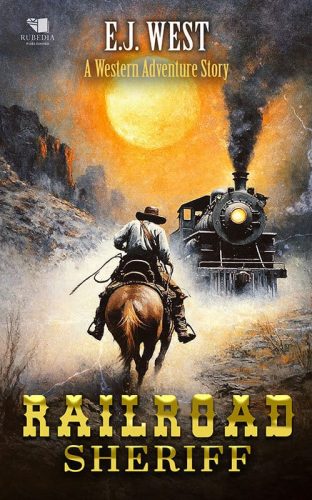
Railroad Sheriff
The railroad runs on blood, and Gus Reed is done watching it spill…
After the Civil War shattered his world, former sheriff Gus Reed drifts across the frontier with nothing left to lose. But when the Texas & Pacific Railway hires him to investigate a series of “accidents” that have killed dozens of workers, Gus is pulled into a deadly game of greed and revenge.
Ruth Quinn is determined to find justice for her husband’s death. Her search for answers brings her face-to-face with Gus—a man who’s sworn off heroics but can’t walk away from the truth.
Gus and Ruth are caught between a railroad war and the outlaws who thrive on chaos. To survive, they’ll have to trust each other—and face the kind of truth that burns hotter than revenge.


Prologue
Fort Davis, Texas, 1865
Gunshot.
Gus Reed’s lean body froze. He wasn’t scared of the possibility of getting shot anymore; he was just ready. The war took things from a man, after all. For Gus, it had taken three years of his life and a whole lot of friends. But it had also managed to take away that easy, momentary panic when faced with the prospect of death.
He crouched, his body completely motionless over the collection of brushwood and twigs lying before him, about to become his morning fire.
But not now. If his ears did not deceive him, and he had just heard a gunshot, Gus knew he didn’t want to draw attention to his camp. He had no idea who the shooter could be, or whether it had anything to do with him.
Were there bandits in these hills? Outlaws?
Or maybe even worse–ex-soldiers like him. Texas and the southern states were full of them now that the war was over. And many of them were angry.
Gus listened intently to the sound of the surrounding trees. Birch branches swayed and scratched above his head. The leaves sighed, whispering threat, threat, threat.
Gus Reed was all of twenty-seven, and hunkered in a birch wood copse about a day out from Leon Spring, Presidio, Texas. Very slowly, his hand moved to the Colt revolver lying in its holster on the ground. Even though the war was officially over, he still never spent more than a few minutes without its troublesome company.
There’s danger on these trails. There had been a lot of deserters in the last few months, as it became increasingly clear that their side was losing. Everyone could see the writing on the wall after General Lee surrendered.
But the danger was worth it, wasn’t it? Gus breathed. The war was over, and his old unit had been disbanded, and that meant he was on the road home.
His family ranch, where his pa and fiancée waited for him, wasn’t far from here. It could only be another morning’s ride. Gus’s heart skipped a beat. He had gotten this far without incident. He offered a quick prayer that his last morning before seeing his family again would be a peaceful one.
His hand popped the buckle of his gun belt, and in a moment, he felt the reassuring weight of the six-iron in his hand once again. The grip was bound with smooth red leather that fit his palm just as it had matched that of his father, Sheriff Pat Reed, before him. The inscribed bucking stallion and the lone star picked out in the leather were all but faded water marks now—but Gus knew they were there.
Here we go again.
Gus moved. He crept to the edge of the small clearing. He offered a calming shush to Admiral, his dappled gray Saddle-bred. The horse huffed softly and gently stamped one impatient hoof. The horse would be fine, Gus knew. Admiral had stood firm while cannons boomed in the distance and rifle fire zipped through the sky. It was rare to find a horse like this.
He picked his way through the trees, carefully choosing each step to avoid crackling leaves or slipping on mud. He drew in a slow breath, smelling the air for signs of cordite and gun smoke. There was none.
Only a few hours from home! Gus thought. Maybe the shooter was just a hunter. Maybe there was no danger at all…
Gus’s mouth hardened into a line. He couldn’t take that risk, though, could he? He had come so far, and through so much to get back here… Maybe the shooter was already downwind, or else the sound had echoed down the Texan valley he was in. Sound got strange in these small, winding valleys between the hills.
Gus knew this land like the back of his hand. It was only a short ride from Fort Davis, his hometown, and where his Pa and Sara waited for him.
Four years. He still couldn’t quite believe he was really going home. A tremor of something—was that nervousness?—ran through him. Had he changed? What would Sara, his fiancée, think of the man he had become? Sara Roberts was as sweet as they came. She had cried the day he had told her he needed to put the sheriff’s badge down and fight.
‘But what about Fort Davies? Your people?’ He still remembered the heartbreak in her voice and the way her large blue eyes had looked at him.
My people. That was right. He had become the sheriff after his father had put down the badge, and his responsibility had been the town that had sprung up around the military encampment.
‘What about my people when the Union army comes riding in?’ Gus had pointed out. He wondered if he felt the same now, knowing what it had cost.
Gus stepped out of the edge of the copse to see the signs of a camp. A circle of blackened firewood and charcoal lay on the bare earth, and the ground was puckered and churned with hoof prints. There were even several places where the short, stubby grass of the southern Texas plains had been flattened.
Three, four men? Gus guessed. But the fire was out, and looked as though it had been out for the night.
So who were these people? And where had the gunshot come from?
Gus lifted his head to scan the valley before him. The ground shifted from the green of the creek grass to the steady yellow-orange of prairie grass. The valley was small, dotted with a few larger trees on the valley floor… and there, rising over the bluff on the far side, was a thin ribbon of black smoke.
The smoke was in the direction Gus had intended to take today.
It was rising right over where the Reed family ranch should be.
***
“Sara!” Gus hollered, pushing Admiral faster and faster still. He didn’t remember crossing the valley. He didn’t remember the steep climb up the bluff on the far side.
All he could think of was Sara and Pa.
The black clouds were thickening ahead of him, changing from a column to a drift. This was no singular fire. This was an inferno.
Obscenely, his mind marked the places he remembered as he sped past them. The oldest American Chestnut from here to town, which he had once fallen out of, and Little Creek, where he used to play as a boy. But Gus ignored everything. He tore his way through the trees on the other side, far too fast. That was sensible. He could almost hear his father’s stern voice telling him to slow down… but he didn’t.
He descended the far side of the bluff only to burst onto the open plain and see the utter destruction of his home ranch.
Fire had completely taken the main barn and stables. They were nothing but billowing black now, but it was the main house that made him shout.
His house was on fire. Flames were spewing from the top windows, and he couldn’t even see his front porch for the billowing, burning heat haze.
“Sara! Pa!” he roared, galloping into the open yard.
Every second counts. Every moment might be the difference between life and—
That was when he saw them. Two bodies out the front of his house, his father’s stilled form lying over Sara’s stilled legs as if in his last act he had tried to protect her. Gus didn’t want to, but his soldier’s eye and his sheriff’s mind read the awful legacy of the scene like a book.
His father’s rifle was a short drop away from his outstretched hand. His father, with his limp and his arthritis, would have already arrived too late. The men who had done this would have been surrounding Sara, and Pa had thrown himself into the thick of it, heedless of his aching limbs that didn’t work too well anymore.
No. This wasn’t happening. This couldn’t be happening. Gus had only stopped last night, so he wouldn’t arrive at the ranch in the middle of the night, scaring the people he loved. Gus had wanted a morning to clean up, to wash as much of the war from his body and mind as he could.
He wanted to return home a new man, for a new start.
Everything was supposed to be different…
A torrent of anger poured through him. It made his limbs shake. His thoughts turned black.
The gunshot he had heard earlier. That must have been this attack, mustn’t it? He had heard the outlaws who did this only this very morning!
Gus trembled with rage. He felt angry and sick. All he knew was that the ones who did this might still be nearby.
“Where are you? Come out and fight me!” Gus yelled. He kicked Admiral into a gallop, heading past the burning house. He hadn’t seen any riders on the way here, and the campfire he had found was already cold. Had he been only a few hours behind his fiancée and father’s killers without even knowing it?
He burst out of the yard, charging onto the open grazing plains as he scanned the horizon. Great, black-winged birds rose from the land a little to the west.
There! There was a small dust trail to the south. He was sure he could see figures underneath it. Riders.
How many? Three, maybe four?
Gus broke into a gallop, leaning as low as he could as he held his father’s revolver steady. They were still so far away, and from the looks of it, they were riding hard. He fired once, twice, and—wonder of wonders—he thought he even saw one of them flinch on his saddle.
“Fight me, you cowards!” he yelled, not caring if they couldn’t hear him. He willed the very winds to carry his challenge to them. He willed the earth to open up and swallow them. For the skies to strike them down…
But none of these things happened. He pushed Admiral as fast as the gray had ever gone before, but the riders ahead of him were even faster. They had put on a burst of speed, and their horses were fresher than Admiral was.
“Come back!” Gus yelled after them, but they were little more than specks, and then nothing but a haze. Still, Gus rode. He continued riding until Admiral started to snort, his hooves skittering as he began to tire.
No, no, no…
But Gus could no more deny reality than he could deny the death of his loved ones. Admiral was panting, gasping for air, slowing more until his gallop became a canter, which became a trot, and then a tired, limping walk.
The day was already drawing long, and the sun was descending towards the western horizon by the time that Gus returned to his ranch house, which had mostly burnt itself out by now. The last licks of flames ate up what remained of the charred walls, and the ruins still smoked.
Was this real? Gus felt like he was in a living nightmare. What if this were some awful dream? A mixture of what he had seen during the war, thrown into his waking mind…
But the sight of the bodies reminded him that, no, this was no dream.
How could God let this happen?
“Gus? Gus—is that really you?” A voice shouted from the entrance to the yard.
Gus spun around, a snarl on his lips, and his gun held high… to see Joe Thornberry swinging himself off his steed. Joe’s hair had turned completely white now. He lived on the nearest ranch to theirs and had already sent two sons off to the war. Joe’s eyes widened suddenly.
“Whoa there, Gus. It’s me, remember? You remember me?”
Huh? Gus saw the look of fear on his neighbor’s face. Why is he looking at me like that?
Gus realized he still had his revolver up and leveled against Joe Thornberry, his family friend. He lowered it quickly, feeling ashamed. Joe had looked at him like he was a madman—like he was dangerous.
And maybe I am, Gus thought.
Thornberry and Pa went back years, with Thornberry even acting as one of Pa’s deputies, before he had decided to concentrate on his ranching business.
“I just saw the fire and came over right away. Sweet Lord, this is awful, just awful,” Joe was saying, taking off his hat as he saw what had become of the Reed ranch. Gus turned away. He couldn’t hear the man’s platitudes at the moment. He didn’t want to hear anything from anyone right now.
“I can get the boys from the fort. All the troops have had to go in and surrender, but some of the others have already come back. Josef. You remember Josef, Ma Reuben’s son? He’s solid, he’ll come. And with the others, we can clear the ranch, clean it up.”
“Don’t.” Gus almost spat the word. What was Joe standing there for? What was the old man trying to tell him—that his place could be cleaned up after this? That he could start again?
He had just lost Sara. His Sara. And his father lay in the dirt just on the other side of the house with her. His stern, brave father, whom Gus had looked up to all his life. He had only gone to war because he knew his father was here with Sara, and the town of Fort Davies still had a lot of respect for the fearsome, older Sheriff Reed.
Joe let out a deep breath. Gus heard the crunch of the man’s boots as he stepped up behind him.
Don’t come near me. Not right now!
“Son, I’m so sorry this has happened. It’s happening all over, especially in these last few months. There are bands of outlaws on the trails, going from town to town. The Myers place was attacked just this autumn gone, and the Brinks too…”
Dimly, there was some part of Gus that knew that this was terrible news for the town. It was terrible news for the people who suffered at the hands of these outlaws. But Gus couldn’t think of that right now. He didn’t want to think about anything. He wanted to find those who had done this. He wanted to bury the only people he loved.
“I don’t want your help, Joe!” Gus burst out, cutting the older man off in mid-sentence. Joe looked stunned, blinking rapidly as he reached for Gus’s shoulder. It was probably meant as reassurance, but Gus pushed the hand away.
No.
“Gus, don’t be like that…” Joe once again started to say, when Gus turned on him.
“Be like what, Joe? Like a man who has just lost his fiancée and his father? Who has just got back from three years of killing for the generals who just gave up anyway?” Gus roared at him. He gestured at the wreckage behind them, at the smoking ruins of his life.
“You want me to be happy I’m back? Thankful I’m alive? Is that it, Joe?” Gus demanded.
The older man staggered back a few paces, as if Gus’s words were actual bullets, fired from a gun. Gus could see he was on the verge of opening his mouth again.
“Just leave, Joe,” Gus said quickly and turned on his heel. The main barn was a ruin, but he had his soldiers’ small travel shovel still stowed in Admiral’s packs. It was barely as long as his forearm and used to dig out fox-scrapes in an open field.
It would have to do.
He heard Joe sigh and the retreating sound of the man’s footsteps before the jangle of harness as he mounted up.
“I can see that you need your peace right now, and I respect that. But I’m going to come by tomorrow anyway, Gus,” Joe called back.
Gus ignored him and heard the man ride away into the gathering evening.
Big Joe Thornberry could return tomorrow, all he liked. He could bring whatever was left of Fort Davies if he wanted to.
Gus was done. Every time he lifted his eyes, his heart broke some more. Gus knew exactly what he had to do. He was going to bury his people, and then he was going to leave this place for good and never come back.
There was nothing here for him anymore.
Chapter One
Marshall, Texas, 1878
The air was split by the sudden blare of a train whistle. Smoke belched upwards into the sky, accompanied by raised shouts.
Criminy. Gus spat into the dirt and gave a soothing murmur to Admiral. The horse snorted uneasily.
Marshall was too full of noise. Every manner of whoop and holler, train bell, and delivery cart jangled and tore at Gus’s senses. She was a busy city, alright, and was even worse than the last time he’d made his way through here.
“But she’s good for work,” he said. Not that Admiral was listening. The horse swished his tail scornfully.
“I don’t really want to be here either, old man,” Gus muttered, and clicked her forwards regardless.
Everyone said that Marshall City was a success story for the reconstruction. The last of the occupying Union soldiers had left last year, and the new Marshall-Texarkana rail line had just been established. What had once been mostly wooden porch-style houses on the main streets had been replaced by clean, pale stone buildings in the new style. Smoke was a constant haze over the city from the many factories and powder mills that had turned from churning out Confederate arms to newer steel works.
The streets were busy with people. Carts and wagons had chocked each other up in their rush into town, and Gus now rode past them, seeing the pale, ever-hopeful faces of settlers inside, alongside the delivery wagons that kept Texas’s first metropolis fed and working.
“Florida Oranges! Sunshine in a glass!” Other carts were more enterprising, setting up roadside stalls of produce, most of it brought in by the new railroad.
But the sun shines on good and bad alike, doesn’t it? Gus recalled a phrase his father often used to say.
There were people in the streets who wore tailcoats and stove hats, but there were also the small gatherings of men in neck kerchiefs, dusty leathers, and hard eyes. Marshall’s opportunity wasn’t just a blessing for those who lived by the law, Gus reckoned.
Admiral huffed a little, and Gus patted his neck once more.
“We need supplies—and a bit of coin won’t go amiss either,” Gus said. He patted his already light coin purse, attached to his belt. A string of very successful trail jobs over the summer had been followed by some rather disastrous scouting trips, which had sapped his finances.
You play the hand you’re dealt, Gus sighed. That had been the way of his life for almost a decade and a half. He picked up jobs as a trail master or scout, tracker or bounty-hunter, and mostly kept his head down. It was easier that way.
“Let’s see if Westman’s is still open,” Gus said, remembering his old watering hole the last time he was here. That had been during the war, picking up supplies and restocking before being sent out east. He directed Admiral off the main drag and down one of the side streets that were just as busy—this time with saloons and boarding houses. A couple of women whistled down to him as he rode, but earned no more than a hat tip from him. Maybe the working women of Marshall liked tall men, Gus thought to himself.
I’m not going to be here long, he promised himself. Enough to pick up some new work, maybe. And if not? He could always head west. There were rail jobs or plantation jobs, and always people who needed guiding over the Sierras.
Next chapter ...
You just read the first chapters of "Railroad Sheriff"!
Are you ready, for an emotional roller-coaster, filled with drama and excitement?
If yes, just click this button to find how the story ends!
A very common start, yet a different direction. A ex-texan like me, can picture this….
Always glad to have a real Texan’s seal of approval. I’m happy I could take you back to those familiar horizons, partner! 🌵