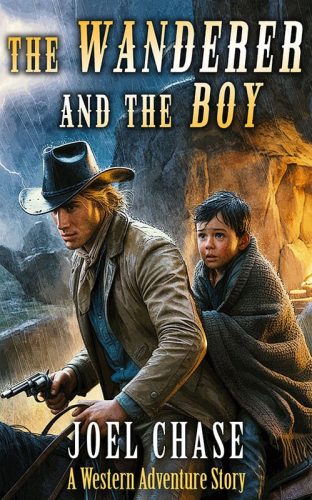
The Wanderer and the Boy
Philip felt the weight of the Colt at his belt, the road beneath his boots, and the boy pressed against his side.
Philip Corey thought often of where his best friend lay buried.
They had talked together of heading West, where there was room for every man and gold in every stream. Perhaps leaving the orphanage and taking the California Trail was God’s hand at work.
What he had not expected was little Thomas, a mute orphan of nine, following him. How was he to keep a boy so small alive on the road when he barely knew how to keep himself alive?


Prologue
Natchez, Mississippi—April 25, 1867
Philip Corey looked out of the window into a mist of rain and wondered where his best friend was buried. Tommy had left for the war, heading east into the rising sun, and hadn’t come back. Was he under the bloody soil on some battlefield? Georgia? Virginia?
His hands moved over a wooden horse, newly carved. He carefully wiped it, blowing the last shavings of wood. Next to him on a workbench were his tools. Before him, sitting in a semi-circle and watching him finish the toy with eyes wide with wonder were the other children of the orphanage.
“Will it run, Philip?” asked Rosie, six years old and already bossing the others like she was General Robert E. Lee himself.
“If you push it hard enough, it just might.” Philip smiled, testing a wheel. It rolled true, not wobbling once. “There. Now, who’s ready to give him a name?”
“Thunder!” shouted Frankie, his grin missing two teeth.
“Thunder it is,” Philip said, handing over the toy. Frankie clutched it as though it were gold, darting away before anyone could change their mind. The other children chased after him, their laughter echoing down the halls as they ran. They skirted the tin buckets left out to catch leaks from the roof. Drops of water punctuated the receding sound of their play.
Watching them, Philip felt the tightness in his chest ease. Their joy had a way of washing out the noise of the leaky roof and empty cupboards. He had little to give, only his hands and what they could make, but that seemed to be enough for them. He grabbed an unfinished block and started carving, hoping to lose himself in the steady strokes of his knife.
A tug at his sleeve pulled him from his momentary trance. A young boy sat cross-legged on the floor, watching Philip carve. While all the other children ran off to play, one had remained. Little Thomas, they called him. He was nine, thin as a reed, with eyes too big for his face. He was a kind boy, but the other children tended to avoid him on account of the fact he couldn’t speak. Some of the older, meaner children even teased him for it, saying his parents must not have wanted a defective child.
Philip didn’t care about that. Thomas was Thomas, and that’s all that mattered to him.
“Hold on, Tom. This one’ll be for you.”
Thomas smiled up at him, excitedly.
A creak of floorboards broke the stillness. Nurse May, her skirts swishing like dry leaves, appeared in the doorway. She had a round face with dark, caring eyes and black hair, tied up tight.
“Philip,” she said, her tone brisk but kind, “Mr. McGregor wants a word in his office.”
Philip wiped his hands on his trousers and rose. “What for?”
She shrugged. “Didn’t say. But you best go now. He’s in one of his moods.”
Thomas turned to Philip, concern clear in his eyes.
“I’ll be okay, Tom. You go on with Nurse May. I’ll finish this up later.” He ruffled Thomas’s hair, stood up, and made his way down the narrow hallway to Jack McGregor’s office.
The sound of rain pattered overhead, a slow, steady beat. The walls were bare except for a faded map of Mississippi and a wooden cross. Jack sat behind a desk piled with papers, his spectacles low on his nose. He was a large man, shoulders stooped from years of hard work and harder choices. Once, Philip had thought of him as a father. Lately, Jack had acted exactly how Philip remembered a father acting. Even down to the drink, Jack took more and more.
Philip stood in front of Jack’s desk. Though his trousers were patched and frayed and his shirt more repaired than original, he stood as straight as he could, his calloused hands clasped behind his back.
“You wanted to see me, sir?”
Jack looked up, eyes tired but sharp. “Close the door, Philip.”
Philip did. The room felt smaller for it. Jack took off his spectacles and rubbed his eyes.
“You’ve been with us near all your life, haven’t you?” he rumbled.
“Yes, sir. Since I can remember.”
“Well,” Jack said, setting the glasses aside, “that’s just it. You ain’t a child anymore. You’re nineteen now and a man grown.”
Philip said nothing. He could feel where this was heading, but he let the man speak. Jack leaned forward, fingers laced atop the desk.
“You know as well as I do this place is struggling. We’re short on beds, short on food, short on everything but rain and holes in the roof. The county’s cut our funding again, and the preacher says he can’t do more.” He hesitated. “We got new boys coming next week. I need your bunk.”
Philip stared at him, feeling like he’d been punched in the gut.
“You’re sending me away.”
Jack’s eyes flickered, then settled into that dull, practical calm Philip had come to hate.
“It ain’t that simple. You’ve done your share here. More than most. But this is a house for children, son. And you’re ain’t one no more.”
Philip crossed his arms. “Where am I supposed to go?”
The show of defiance made Jack’s cheek twitch, and his big hand clenched around a pen. He rubbed his other hand through his whiskers, muttering. His temper had got shorter and shorter these last few years.
“There’s work up north if you want it, logging and rail. Then there’s the shipyards and factories out east. You got hands that can build. Folks’ll pay for that. I can give you a letter of character.” He opened a drawer and pulled out a folded piece of paper, sliding it across the desk. “That’s all I can do.”
Philip didn’t touch it. “So that’s it? After nineteen years?”
Jack’s mouth tightened. “Don’t make this harder than it is. No one said this was a home for life.”
Philip took a slow breath, forcing down the anger that rose in his throat. He thought of Tommy, a hand to his shoulder like a falling boulder.
Build up a wall, Phil, and hide yourself behind it. Don’t do no good to let anyone see they got to you. High and strong.
“High and strong,” Philip whispered in answer to that memory.
“What’s that? Speak up,” Jack said irritably.
“You care about any of us anymore, Jack?” Philip said, his anger breaching that wall before he could stop it.
“Watch your mouth, boy. That’s Mr. McGregor to you. Don’t pretend you know what it’s like to walk a mile in my shoes. Caring don’t put food in a child’s belly. And I got fifty of ‘em to feed. You’ll understand one day.”
“I understand now.” Philip took the paper and folded it without looking.
The wall was up, and he was safe behind it. He left before Jack could answer. Back in the workshop, the children had gone, and the room was quiet but for the steady drip of water from the ceiling. The toy horse sat on the floor where Frankie had dropped it, its little wheels glistening with a fine sheen of damp. Philip crouched, picked it up, and set it on the windowsill.
Outside, the river caught the afternoon light like dull steel. A steamboat whistle sounded faintly from somewhere downstream, a rare sound these days, and something stirred in him. Maybe this was what Tommy had felt, that pull toward the horizon. That ache for a life that meant something more than patching roofs and carving toys that would be forgotten before the week was out.
He sat down again, turning the knife in his hand, and thought about what lay beyond the edge of Natchez. Jack hadn’t mentioned one particular direction.
West.
That’s what Tommy always talked about. Going out west. Where there’s room for every man and gold in every stream.
Maybe that was God’s plan for him, to find out what waited over the next rise. The door creaked, and Nurse May peered in.
“You all right, Phil?”
He nodded. “Guess I’ll have to be.”
She stepped closer, her face soft with sympathy. “You were always too big for this place. The world’ll suit you better.”
“I don’t know about that,” he said. “The world’s big. I ain’t.”
“Don’t fool yourself. You’ve got the makings of something.” She reached into her apron and pulled out a small cloth packet, holding it out to him. A sharp and bitter smell hit Philip’s nose. “Medicine for the road. You’ll get a sore head if you don’t sleep proper. Boil these up when you feel the thump start. Works on boys and mules.”
Philip pressed the small cloth packet into his palm like it was a treasure.
She laid a hand on his shoulder. “You mind God, and He’ll mind you.”
Then she left, and the quiet came back, heavier than before. Philip started gathering his tools, but anger swept through him like a bush fire. He kicked them away from him, his whittling knife skittering across the uneven boards like a snake. It was all well and good to tell him his bunk was needed, but what was he supposed to do? Thomas peered out the window, as if the answers he sought lay beyond the confines of the room.
From the window, he could see the town below, half-swallowed in the gray morning. Natchez wasn’t the grand place it used to be, not since the riverboats stopped coming regularly. The steeple of the Baptist church stood proud above the sagging rooftops, but most everything else looked tired. Mud streets, peeling paint, folks working harder for less every year. It was a small, country town, the kind that kept a man hemmed in. Philip had long since learned that Natchez looked smaller the longer you stayed. Beyond the town was the Mississippi itself—broad, brown, and endless—and beyond that, a world he’d only heard about in other folks’ stories, a world Tommy had gone to find and never returned from.
Philip thought of Tommy’s golden hair, the color of ripe corn, so similar yet so different to Philip’s own sun-bleached hair. He remembered the way Tommy grinned back over his shoulder as he followed the recruiting sergeant in gray, off down Main Street and into the east.
See ya, spud! he’d called, using his nickname for Philip, who’d always been the shorter of the two.
See ya, Tommy, Philip had whispered back, knowing even then that God was splitting their road.
“All well for you to head off to the wild blue yonder, Tommy. But you was always the brave one. God knows,” Philip told the air, thudding his back to the wall and sliding down it.
Is this what I get for a God-fearin’ boy my whole life? Is this what Tommy got?
He didn’t know who he was angrier with, Jack McGregor for bringing him up and then casting him aside, or God Almighty for his damned plan, whatever that might be.
When his anger finally abated, he picked up his whittling knife, hammer, and chisel, then wrapped them in cloth and slipped them into a satchel that Jack had given him for his birthday one year along with the tools. “Guess I’m gonna see what’s past you after all,” he murmured.
He slipped the knife into his pocket. A knife had a lot of uses beyond whittling. The letter went into his threadbare coat. He felt the weight of both, one sharp, one heavy, both his to carry now.
Need to make a plan. No sense walkin’ out there without one. I’ll be fox fodder within a week. Got tonight at least.
Tomorrow, he’d visit the secret hiding place where he and Tommy kept their stash of contraband. He could hole up there until he had enough food to hit the road. He didn’t know where he’d get food from. Work for it, he supposed. Then he’d meet the river and whatever lay beyond it head-on. Like Tommy. Like a man.
And if the world tried to break him… Well, he’d learned how to build things that lasted.
Chapter One
Natchez, Mississippi—April 26
The cry of a wailing child, voice high with upset, followed Philip from the orphanage. It sounded like little Kitty Nelson. His step faltered, and he almost turned back, aiming to see what was wrong and how he could make her smile. Philip stopped himself. There would always be a reason not to leave, and he didn’t have the luxury of any of them.
He’d already said goodbye to all of them, and it had almost broken him. Philip had told himself a man doesn’t get broken up over goodbye. He faces the world with steel in his jaw and a glint in his eye. But his goodbye hadn’t been like that. The children had crowded him as though to stop him from leaving with their bodies. Nurse May had cried, and Philip had tried damn hard not to as well.
He walked out to his old hideout with the slow certainty of a man who knew where his feet would take him even if his head argued otherwise. The path left the last clapboard shacks of Natchez, skirted a patch of scrub oak and persimmon, and climbed a little rise where the red clay showed through. The Mississippi glinted between the trees, broad and brown as a plow horse’s back, and the wind carried the river’s wet smell. He followed a deer track into cane and sumac, then stooped under a fallen limb and came into a small hollow where a lightning-struck sycamore leaned against a twin like a pair of tired men.
This was the place. He’d found it when he was nine, on a day he’d taken a whipping for fighting a bully who’d cornered Andy Burns with a stick. He’d run until his lungs burned, then crawled into this bowl of ground and cried where nobody could hear him. After that, he kept his childhood treasures here: a clasp knife before he’d earned a real one, an old marble, a twist of string, a flattened penny he’d hammered on a rail, later a small tin box to keep it all dry.
Then there was the Colt. And Tommy’s journal.
The battered, stained book with its painstakingly formed letters was an open wound. Philip had been unable to bring himself to open it, let alone read it. Maybe it would be a friend to him on the lonely road.
He knelt and brushed leaves aside. The tin lay where he’d left it, under a slab of bark and a stone. He pried it up and took the lid off. Inside was the dull gray gleam of the pistol he’d found one day at the river’s edge. He’d never told anyone about it but had cleaned it religiously, practiced aiming it while hoarding the three rounds he’d found in the chamber. The idea that three had been fired, that the gun might have been used in a shoot-out, had been thrilling. Next to the Colt, wrapped in cloth, was the photograph.
It was a small card, edges scuffed, the image dim with the years. A traveling photographer had come through on a bright day when the roof didn’t leak, and Jack had laughed at a joke somebody told. The orphans were lined in two rows under the pecan tree, best shirts on and hair combed flat. Philip saw himself there, skinny and solemn looking, too embarrassed by his crooked teeth to smile. Standing a step behind him was a tall boy who looked like the world belonged to him. Tommy. And behind them was Jack, younger by a mile, his mouth easy, a hand on Tommy’s shoulder as if he meant to steady the whole lot of them and could.
Philip sat back on his heels, the photo in his hand.
“You changed,” he said to the Jack in the picture.
The man at his desk these days didn’t look like the one under that pecan. A man could turn from warm to cold and not even know the exact day it happened. Maybe it was what the county men did, or the nightly sums, or years of rain on a roof that never quite held. Or maybe a heart just wore out from always choosing between hungry mouths.
He looked at Tommy’s face and the place beside it where the light had faded to a white blur. It was all he had to remember Tommy by. He had no letters, no grave he could visit. The war swallowed boys and gave back only stories and a list in a newspaper.
“Everything changes,” he said.
The card blurred. He blinked hard and held it closer. “The Lord gave me a home and now He’s taking it away. All right. What then? Find another? Where? Where, you son of a—”
He stopped himself on the edge of blasphemy and damnation, tears making the world blur, anger at the tears making him clutch the Colt hard. He pressed the photo to his knee until it warmed, then put it back in the cloth, as carefully as if he were returning a bone to the ground. The brave face he’d worn around the little ones slipped off him like a wet shirt. Out here, there were no children to make a show for and no Nurse May to say God saw him. He let himself sag with it.
He lay back on the leaves and stared up at the slant of sycamore limbs. He folded his arms under his head and watched clouds drift through the gaps until his eyes stung, and then, without meaning to, he slept.
***
In his dream, the path ran straight as a string through tall grass and the horizon shone like brass. Tommy walked ahead in an old army coat, his step easy, head tilted as if he listened for something only he could hear. Philip tried to catch up. Every time he lengthened his stride, Tommy did the same. Philip called. The wind took his words and laid them down in the grass. Tommy didn’t turn, but he lifted one hand and beckoned, and that hurt worse than if he’d waved him off. Philip ran, lungs burning, the grass slapping his knees, but he could not close the last ten yards.
***
He woke with his own breath loud in his ears and a shadow crossing the hollow.
“Hey there,” a man said. A hoof scuffed on clay. “You alive or only thinking about it?”
Philip blinked. A wagon stood at the edge of the sumac, a single horse hitched between the shafts, and a man on the seat. The wagon held a sack of corn, a coil of rope, a hoe, and a wooden butter churn. Behind the man, the hollow of day was bluer than it had been when Philip lay down. He must have slept a while.
“Afternoon,” Philip said, pushing up on his elbows.
The man took him in. “You lost?”
“No, sir.”
“You drunk?”
“No, sir.”
“Hungry?”
Next chapter ...
You just read the first chapters of "The Wanderer and the Boy"!
Are you ready, for an emotional roller-coaster, filled with drama and excitement?
If yes, just click this button to find how the story ends!
Looking forward to the next chapter.