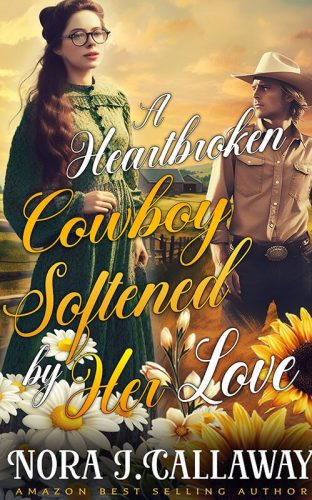
A Heartbroken Cowboy Softened by Her Love
Can she forge her own path and help him find peace, or will destiny’s hand keep their love story unwritten?
Lena flees an arranged marriage to her menacing fiancé, setting her sights on the untamed West. Answering a mail-order bride ad, she seeks a life of respect with Tom, a rancher she’s fallen for through heartfelt letters. But will those written words come to life when they finally meet?
Tom, a guarded rancher still aching from a past betrayal, juggles ranch duties and the care of a child that’s not his own. When Lena arrives, he hopes for a marriage of convenience to ease his burdens. Yet as he meets her, could he dare hope for love, risking another broken heart?
The couple’s fledgling romance is put to the test as Lena’s ominous past tracks her down. Will their love story remain an unwritten chapter, or will they find the courage to make it real under the prairie moon?


Chapter One
St. Louis, Missouri, 1871
The tinkling notes of a pianoforte, genteel and polished, stirred the still air. Lena looked up from her copy of Silas Marner and let her eyes rest briefly as she stared at the flocked silk wallpaper. Her gaze wandered over the patterns of roses worked into the fabric, and then across to the fine chintz-covered chairs and the mantel with its porcelain statuette.
The drawing-room was oppressively hot, the sun pouring through the west-facing windows. She felt sweat trickle down her back, her neck hot where the low bun in which she’d arranged her hair touched it. She glanced over at her family who sat around the pianoforte to see how they fared, but nobody else seemed to have noticed the heat.
“Lena…come and sit here and put that book away,” her father called to her from where he and Mother sat on the long divan.
“Papa…” Lena countered, reaching up and tucking a strand of cocoa-brown hair behind one ear. “I’m in the most exciting bit. I can’t put it down.”
Her cat, Thistle, who had been sleeping on the chair beside her, jumped up in surprise when she raised her voice, leaping soundlessly to the floor. Thistle was Lena’s ally in the house, and also her dearest friend. Lena had found her when she was just a kitten and had raised her by herself, weathering Mother’s censure and disapproval. Now, at two years old, Thistle was a fixture and even Mother couldn’t get rid of her. If Papa minded, he tolerated the creature well enough. Lena adored her.
“Lena, your sister is playing the piano. You could at least come and listen to her.” Lena’s stepmother, stern and cool, interrupted her protestations. “And get that dreadful cat out of here; she’ll tear the furniture.”
Lena sighed.
She stood, stifling her inner protest that she could hear perfectly well from just a yard or two further away at the table. She didn’t want to start an argument. Her spectacles slid down her nose, and she pushed them up, annoyed, and walked over. Her parents were all too ready to support Pricilla in everything, and any protest Lena made would have been shouted down.
“Priscilla, dear, you can start from the fifteenth bar again,” Mother called to Priscilla, who sat at the piano. Priscilla, blonde curls bouncing as she turned, dimpled at her mother.
“Of course, Mama. But that’s the hardest bit.” She frowned, her bright smile turning into a pout.
“You need to practice it more, then, dear,” Mother said firmly. Priscilla sighed and turned to the piano, her lower lip protruding in the way it did when she concentrated excessively, or when she was annoyed. Lena felt her heart warm, in spite of the tense atmosphere around her.
Priscilla is a dear.
She felt her brow crease in a frown as Priscilla tackled the difficult part of the sonata, feeling sympathy twist inside her. Mother always pushed Priscilla to excel in crafts like embroidery and piano playing, while she was content to let Lena pursue her own interests, provided that she, as the elder sister, helped with the running of the house. With a staff of many servants, the Beecham girls didn’t need to do any housework, but a staff still required overseeing and the accounts needed to be done. Lena felt her frown deepen as she recalled she needed to go over them with the housekeeper. The sound of a cadence, loud and triumphant, brought her attention back to the moment.
“Well done, Priscilla. A bit messy near the end, but more practice and it will do,” their mother declared formally, a few desultory claps sounding in the quiet space of the drawing-room as the family applauded her effort.
“Thank you, Mama,” Priscilla said, coming to sit down on the long chair beside her mother. “Whew. It’s hot. Can you ring for tea, Lena? Better still, we could have some lemonade.” She fanned herself with her hand.
“Of course,” Lena agreed, standing up at once. She went to the bell rope and rang, waiting for a second or two to see if she could hear Miss Epsom coming to check on them.
“Now, with a few more goes at that piece, it’ll be ready for Mrs. Lexington’s party next week.” Mother sounded brisk.
“Mama…” Priscilla protested. “In a week! I can barely find the time to practice, and it’s still awful. How can I get it done by a week?”
“You have plenty of time,” Mother declared. “I will set you the task of playing it through at least twice a day.”
Priscilla rolled her eyes and grinned at Lena, looking up as Miss Epsom came in, the tea trolley wheeled in front of her. Everything was as Mother had requested it. Her parents had sailed from England, and Mother kept the standards of the house as high as if they still lived in London.
“Good! Another raisin loaf!” Priscilla announced. She grinned eagerly at Miss Epsom, who grinned back and cut her a slice. All the staff liked Priscilla well enough; she was a good girl, if a little petulant, and Lena was pleased they liked her. Mother, who was not Lena’s birth mother, was not as well-liked about the household.
“Priscilla, dear, you’ll not be able to eat dinner if you eat all that raisin loaf,” Mother chided gently. She ignored Lena, who was reaching for a cup of tea beside her.
“I will!” Priscilla declared. “I rode all morning! I could eat three raisin loaves.”
“I bet,” Papa chuckled. Mother raised a brow.
“Priscilla, it isn’t seemly. Riding is not a proper pastime for a young girl.” Her nose crinkled. “What would Mr. Staveley think of that?”
“Mama…” Priscilla pulled a face as if she’d bitten into a sour peach. “Can we not mention that?”
“Priscilla, dear—” Papa protested. Priscilla whirled around.
“Papa! Not you, too? Can I not have one meal in peace without suitors being discussed? As if it isn’t bad enough, it being so hot! Why aren’t you bothering Lena about it? She’s older than me!” She sighed and leaned back in the chair, pouting. Papa cleared his throat.
“It’s not a trivial thing, sweetling,” he said gently. “It is important that you girls choose well. The bank won’t run itself, and I can’t pass the fortune on to you two.”
“Papa, I know!” Priscilla protested. “But I don’t want to talk about it. It’s miserable! I don’t want to think of you…of your…” She stood up and walked out of the room.
Lena glanced at her father. Papa looked down for a moment, and Lena tried to guess what he was thinking, but it was hard. When he looked up, his eyes were calm.
“Lena, dear… It’s hard, I know. But Priscilla needs to understand the importance of her choice. Staveley is a good man. A fine head for numbers, a fine family. He’s a good prospect. Can you not try to talk some sense into her?”
Lena frowned. “Papa, I don’t know.” She felt one temple throb, the beginnings of a bad headache. Whenever arguments broke out in the house—as they did often, since Mother and Priscilla always seemed to be arguing, either among themselves or with Lena—her head gave her pain. “You know what Priscilla is like.”
“What are you suggesting?” Mother countered, her cheeks red, voice high with indignation. “Priscilla is a fine girl! And if you were to make an effort to focus on your accomplishments instead of your silly reading, maybe you’d be the one marrying Staveley. But I can’t expect you to be able to hold his attention. You with your spectacles and your bookishness and your lack of looks.”
Lena felt her body flood with shame, like hot water pouring through the vessels in her skin. She looked down at her hands, fighting the urge to run out of the room, to cry. It was cruel. Priscilla was beautiful, it was true. But did her mother have to emphasize it, have to make her feel so plain, so ill-favored, every day?
“Alexa, dear,” Papa said gently, trying to calm Mother, but she was clearly not ready to let the supposed insult go. She was hard on Priscilla herself, but if anyone else—especially Lena or Papa—thought to say a negative word, she was unremitting.
“No! Don’t try to play as if you don’t think the way I do. It was your idea, after all, to wed her to Darrow. You know as I do that your horse-faced older child isn’t going to find a husband on her own.”
“Enough!” Papa yelled. Lena put her hands over her face, tears flooding her eyes. Her head throbbed, and her body cringed with shame. Every comment her stepmother made was like a blow hitting Lena’s very soul.
“Well, I’m going to go and find Priscilla,” Mother declared. She stood, and her soft footfall, followed by the click of the door, fell into a quiet room.
Lena drew in a breath, trying not to cry. Her dark eyes were shut, her long, thin hands buried in the dark fall of her hair where she gripped her aching temples. The pain she’d kept hidden for weeks threatened to reveal itself, and she didn’t want to sob all day—her eyes would swell, and then Mother would have more to say about it.
“Lena?” Papa’s voice was gentle. “Lena…”
Lena tensed. She swallowed hard. Her father was a man, she knew, who tried to be fair. He might not show her, or Priscilla for that matter, much affection, but she was aware he loved both of them. His heart was still ravaged by grief following Lena’s mama’s death, and it was that which kept him silent and unemotional. She knew that. But his disinterest in his daughters had led to some unpleasant results, and Lena couldn’t help resenting that.
“Papa, how could you?” she whispered. “You didn’t really say that, did you?”
“What?” Her father’s voice was louder, and she looked up to find he’d moved closer, coming to sit across from her in the big leather-covered armchair. He reached for her hand, and she squeezed his, holding tightly onto it as if for assurance.
“That I’m too ugly?”
“No.” Her father snorted. “No, sweetling. I don’t think you’re ugly. I think you’re ruining your eyes with your reading and that spectacles don’t flatter you. But ugly? No.”
Lena felt her heart twist. He was being kind, she knew. She reached up and tucked her dark hair behind one ear, wincing inside. Was she that monstrous? Even Papa wasn’t exactly complimenting. He often said that she squinted and that her glasses ruined her face. Mother might be crueler, but his words were damaging because she knew he was trying to be as nice as possible.
“Now, come on, sweetling. Come and have some tea. We can go and check on Priscilla later. Your mother is just…difficult this afternoon. It’s the heat.” He reached into his pocket, wiping his brow with a flannel, drying it where the sweat had gathered. His dark hair, black and dusted with gray, was high on his brow. He was a handsome man, with a long, angular face and dark eyes. She always thought she looked like him.
Maybe I’m so hideous that I want to believe that.
Was it really that bad? Mother was so scathing, and none of the staff had ever called her lovely, though Priscilla had been admired all her life. Like Mother, Priscilla had blue eyes, a neat, pretty mouth and a sweet chin and long blonde curls. She was petite, and she had curves where Lena had a slender figure. The pale, patterned and embellished fabrics of the low-cut but elegant gowns that were made for Priscilla would have ill-suited Lena, who favored plain colors and simple designs. She always wore high necklines, even for evening-dresses, and even in summer she favored longer sleeves—Mother had said she had skinny arms, which were not attractive or fashionable.
“I’m not cross with Mother,” Lena murmured. “Papa…I just… You didn’t really plan to wed me off?”
Her father winced. A look of pain came into his eyes, and Lena felt suddenly unable to breathe, knowing that what her stepmother had said was true.
“I want you to be safe, daughter.” He grimaced. “Darrow is a good man. He’s upstanding and god-fearing, and he’s managed to put away a fine fortune all these years. I want you to be able to live well.”
“Papa!” Lena stared. “You want to wed me to…to…” She paused. The feeling of nausea that had been growing since Mother started insulting suddenly twisted her stomach, and she pressed her hand to her lips, feeling as though she was going to be ill. Mr. Darrow was many years her senior, but she would have looked past that except for his cruel, cold nature. He was a guest at the house occasionally, and even without having imagined her father might make an arrangement between her and him, she had come to dislike him for how unfriendly he was to the servants and how ill-tempered he seemed with everybody.
“You should want that, too,” Papa murmured. “He’s coming for a visit soon to tea, so you can talk then,” he added, and she knew he was trying to sidestep everything.
“Papa…”
“Lena, please. I don’t want to argue.” Her father spoke firmly.
Shock made her stare at him, unable to understand what he said or what was happening for a moment. How could he expect her to accept this? Even if he’d told her kindly, when they sat in his office sometimes after checking the accounts, she would have been horrified. Papa looked back at her, then looked down, clearly ashamed. He cleared his throat.
“I need to go check some accounts,” he said softly. He stood and walked to the door.
It was only when she heard Miss Epsom coming past in the hallway that Lena recalled that she was still sitting rooted to the spot in the drawing room. She looked down to where her fingers were clutching the book with white knuckles.
She stood, straight backed, and walked to the door, grasping for resolve amongst her tangled emotions. She could not face Mr. Darrow and his leering looks and his cold, cruel manner. She could not let her father give her to that creature. There had to be a way around this. There had to.
Chapter Two
St Louis, Missouri, 1871
Lena lay in bed, bright sunlight sheeting onto her face. She opened her eyes, her head still sore. She’d retired to bed the previous night with a bad headache, and even this morning it felt unpleasant. She slipped out of bed and drew back the curtains, her long nightshift whispering about her ankles.
The tea is today.
She felt her body tense with a mix of terror and disgust, the nausea that had clutched at her stomach since yesterday threatening again. Mr. Darrow had been invited.
I can’t do it.
The thought of Darrow, of his leering face and his callous manner, made her feel sick without even seeing him. She took her navy-blue dress out of the wardrobe. It had a high collar and long sleeves, and, despite the heat, it was her choice. It felt as though she wore armor, and she would need to. Mr. Darrow had always paid her unpleasant attention—how could Papa even think of brokering a marriage between the two of them?
She slipped off her nightshift and drew on a petticoat and then shrugged into the dress. Her long hair was loose, and she pinned it up severely, thoughts returning to Papa’s words.
I suppose I really am that ugly.
The looking glass showed her a long oval face, framed with dark brown hair, and two large dark eyes, staring through the round lenses of her glasses. The dress fastened at the base of a long neck and at the bottom of the mirror she could see her slight shoulders. She tilted her head, studying her face. Her skin was pale, her chin a slight knob, her lashes black. Her mouth was perhaps a little full-lipped, her eyes slightly unfocused as, even with the glasses, she couldn’t see that well and had a very slight squint. She thought of Priscilla’s face, imagining it as she studied her own, comparing it to hers. Priscilla had wide blue eyes, unobscured by glasses, with pale lashes that matched her blonde curls. Her mouth was like a porcelain doll’s, as was her skin. She looked like a doll—painted, pretty, exactly like she should.
I really am so much uglier than her, just like everyone says.
Swallowing her sadness, Lena went out into the hallway. Breakfast was swift, eaten with her family in the parlor. Thistle tried to follow her in, but Lena made sure she went upstairs. Thistle’s presence was always contentious, and Lena didn’t want to argue. Her head already hurt.
“You spoke to Mrs. Lowden about the tea?” Her father asked as she took a seat at the table, referring to her job of organizing everything with the housekeeper.
“Yes, Papa,” Lena commented, her stomach revolting at the sight of food. She glanced over at him, wishing she could go with him to his study after breakfast and forget about the tea instead of supervising the staff as they prepared it. She still felt closer to him than anyone else in the household, despite his apparent betrayal. If only she could talk to him without Mother being in the room, perhaps he would listen to her. But would he? He had grown more and more distant every year since Mama passed away. She looked down at the table, throat too tight for words.
She glanced over at her stepmother and Priscilla, who sat at the other side of the table. Priscilla reached for the newspaper that lay beside Papa’s plate.
“Priscilla, dear, leave the newspaper,” Mother’s voice interrupted her thoughts. “You’ll strain your eyes.”
“Yes, Mama.” Priscilla sounded dutiful, but Lena could see a tightness to her mouth that suggested she wasn’t going to listen. As Lena had guessed, Priscilla paused and then, when Mother started talking to Papa, she opened the paper again.
“Mama…what’s this?” she asked, pointing to an advertisement.
“Oh, Priscilla, leave that,” Mother protested. She reached over and glanced at the article Priscilla had been reading. Lena watched as Mother raised a brow, then shook her head. “It’s a heinous crime, that’s what it is.”
“Oh!” Priscilla sounded interested. Lena wanted to chuckle—if Mother thought that was going to distract her from the article, she had made a poor guess. Priscilla hadn’t been that interested before, but she looked fascinated now. Mama looked sour.
“Tell her,” she said, turning to Lena’s father. “Tell her that this nonsense of men out West writing to ask girls back East to wed them is a heinous crime.”
Lena glanced at Papa, who looked baffled for a moment, but nonetheless must have agreed with Mother, as he cleared his throat. “Yes. Girls, these men should not be allowed to write such letters. One can’t broker such a thing through the newspapers. I agree it’s most unseemly.” He looked away; his address clearly done for the moment.
“But…” Mother looked as though she expected him to be more condemning, but Papa had reached for the paper again and a second or two later, he dabbed his lips with his napkin and excused himself. Lena looked after him, wishing he would pause, would say something, would possibly even say there would be no tea today, that he’d made another decision. But he turned around and walked to the door.
Once Papa had left the room, it was even more uncomfortable for Lena, who never liked to face Mother without him being in the room. She ate her breakfast hastily and excused herself, going upstairs. Her mind was a whirl of confusion. How could Papa condemn a newspaper advertisement asking a woman to choose of her own free will to wed someone, when he himself was forcing her into an arrangement with someone she despised? It made no sense. Propriety and manners were foolish, if they could condemn the one but allow the other.
She had to get out of here. Living in this world of contradictions, of cruelty, of putting a calm face on over all the pain inside was no longer something she could do.
The morning wore on. Lena went to the kitchen to oversee the preparations, but every cake fork she checked for rust, every patterned tablecloth, each tiny detail reminded her that soon Mr. Darrow would be here. She recalled those cold eyes and how, sometimes, they warmed when they looked at her, but not in a way that reassured her—far from it. She shuddered.
I can’t face him.
She swallowed hard, the nausea that had clutched at her guts all morning threatening to make her void her breakfast. As the time drew closer, she felt more and more ill. Something about Papa’s manner in the last few days had suggested to her he’d already decided. It was only a matter of time until she was wed, and she had to do something about it.
She couldn’t settle all day and went out walking, and by four in the afternoon the drawing room was set for the afternoon tea.
Please, God, let this go off in the way I need.
Next chapter ...
You just read the first chapters of "A Heartbroken Cowboy Softened by Her Love"!
Are you ready, for an emotional roller-coaster, filled with drama and excitement?
If yes, just click this button to find how the story ends!
Absolutely perfect cound not put it down
Thank you so much!!!❤️❤️